WTI Crude--
Brent Crude--
Natural Gas--
ND Rig Count--
WTI Crude--
Brent Crude--
Natural Gas--
ND Rig Count--
Global Markets

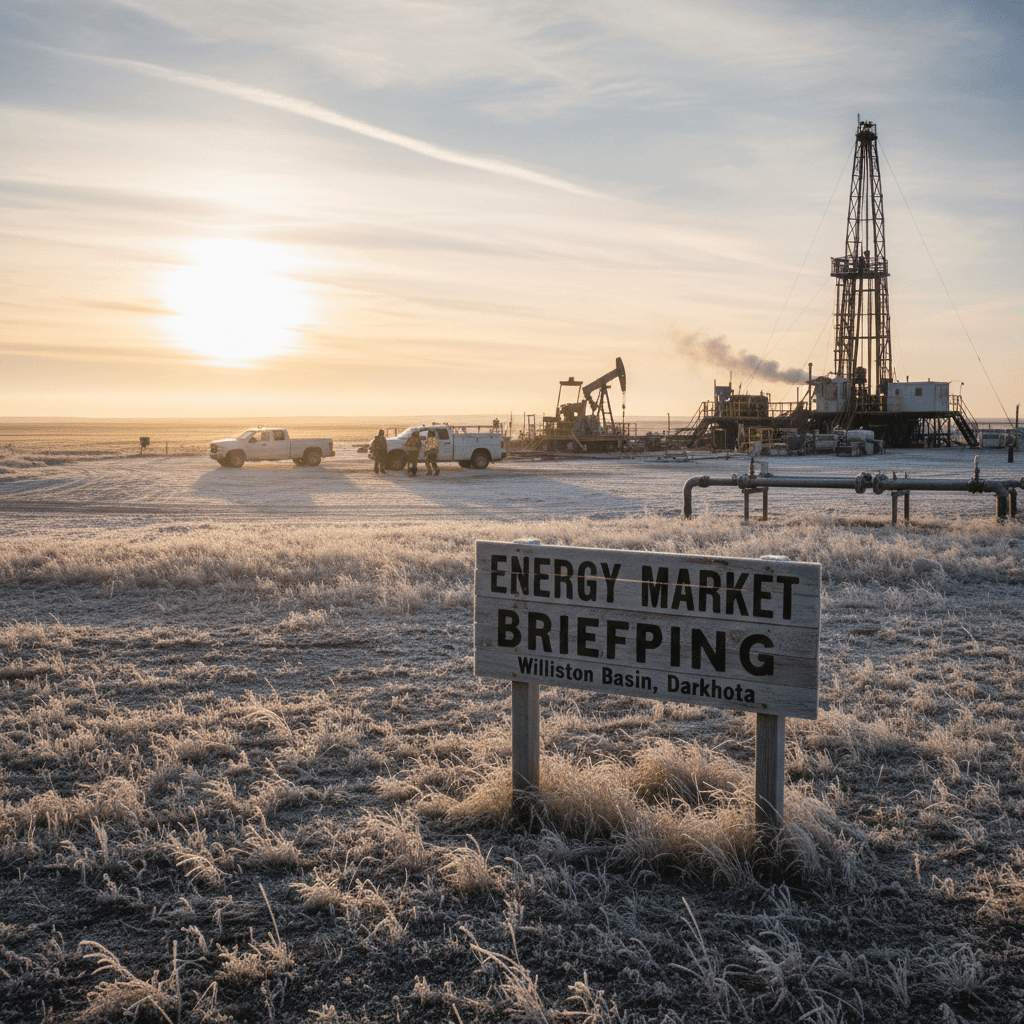
Geopolitical, Market Shifts Pose Contrasting Outlook for Bakken

Russian instability and rising U.S. output forecasts create a complex price environment for North Dakota producers.

Bakken Wire Staffยท๐ŸŒ…Afternoon Wireยท

Rumors of a renewed Russian military mobilization are triggering policy shifts in Central Asia that could add to global oil market volatility, according to a report from OilPrice.com. The source indicates Kazakhstan and Kyrgyzstan are implementing new tracking systems and visitor fees, measures seen by local observers as a response to a fresh influx of Russians seeking to avoid potential conscription. For Bakken operators, such geopolitical instability historically supports oil prices by introducing supply risk premiums, though the direct impact remains uncertain.

Concurrently, the U.S. Energy Information Administration (EIA) has raised its long-term forecast for domestic oil production, according to a separate OilPrice.com report. The EIA now expects U.S. crude output to reach 14.3 million barrels per day in 2027, up from its July forecast of 14.0 million bpd. For 2026, the forecast holds steady at a record 13.8 million bpd. This rising domestic supply ceiling could act as a moderating force on prices, capping the upside for Bakken barrels.

The EIA data shows the production growth is primarily driven by the Permian Basin and the Gulf of Mexico, not the Bakken. U.S. production averaged 13.7 million bpd in the first half of 2026, a 2% increase year-over-year, with the Permian expected to average 6.8 million bpd this year. The report notes WTI averaged $84 per barrel through August 2026, up significantly from $65 the prior year. This price environment remains profitable for many basins; Permian breakeven prices were reported at $69 in the Midland and $63 in the Delaware as of March.

A third report highlights a structural shift in global energy investment, with China solidifying its dominance in clean technology. OilPrice.com reports Chinese companies now hold 75% of the world's clean energy patents, up from 5% in 2000, and outspent the rest of the world combined on clean energy investment between 2019 and 2025. This long-term trend underscores the evolving demand landscape that Bakken producers must navigate, even as U.S. tariffs have failed to stem the flow of Chinese solar and battery imports.

For North Dakota, the immediate outlook is shaped by the tension between supportive geopolitics and rising U.S. output. The potential for disruption from Russian mobilization rumors contrasts with the EIA's projections of steadily growing American supply. Bakken operators will continue to compete for capital and market share within a national portfolio increasingly focused on the Permian and offshore projects, while long-term planning must account for the accelerating global transition toward electrification and clean tech led by China.

Source

OilPrice.com (Russian Mobilization Rumors Ripple Across Central Asia, EIA Raises 2027 U.S. Oil Output Forecast, How China Became the World's First Electrostate)
geopoliticseiaoil production forecastrussiachinaclean energywti price

Share this article

Related Articles

The Afternoon Take - Energy Market Briefing
Global Markets

Energy Market Briefing

Energy Market Briefing For Bakken Wire | Thursday, September 10, 2026 1. Headlines Oil prices surged sharply today. According to Rigzone, Brent crude soared more than 6% to $107.63 per barrel, with WTI closing at a four-month high of $103.90. The primary catalyst cited by sources is escalating geopolitical risk in the Middle East, specifically heightened tensions around the Strait of Hormuz, a critical oil transit chokepoint. Rigzone reports that Iran and the U.S. are bracing for a protracted war, directly rattling markets with supply disruption fears. In other major news, the U.S. Energy Information Administration (EIA) released updated forecasts. The agency raised its 2027 U.S. crude oil production outlook to 14.3 million barrels per day (bpd), up from its previous estimate of 14.2 million bpd. For 2026, the forecast remains at a record 13.8 million bpd. Concurrently, the EIA projected U.S. natural gas production will hit a record 111.7...

๐ŸŒ…Afternoon WireยทSep 10
The Midday Take - Energy Market Briefing
Global Markets

Energy Market Briefing

Bakken Wire Energy Briefing Thursday, September 10, 2026 1. Headlines Oil prices are surging sharply today. As of midday, WTI crude is trading at $101.59 per barrel, up $5.54 (5.77%), while Brent crude is at $106.90, up $5.69 (5.62%), according to price data. The rally follows the weekly U.S. inventory report from the Energy Information Administration (EIA), which showed a draw of 400,000 barrels in commercial crude stocks for the week ending September 4, bringing inventories in line with the five-year average. This aligned with the prior American Petroleum Institute (API) estimate of a 300,000-barrel draw. Geopolitical tensions remain the dominant market narrative. Multiple sources from Rigzone report that Iran and the U.S. are "bracing for a long war" and "digging in for a protracted war," with Iran stating it is "ready for escalation." These headlines follow reports of escalating attacks and the closure of the Strait of Hormuz to...

๐Ÿ”†Midday WireยทSep 10
Global Energy Shifts Amplify Methane, Coal Dynamics for Bakken - Bakken Wire
Global Markets

Global Energy Shifts Amplify Methane, Coal Dynamics for Bakken

Two major International Energy Agency (IEA) reports published Thursday underscore global energy dynamics with direct implications for North Dakota's Bakken formation, highlighting persistent methane emission challenges and shifting fossil fuel demand driven by geopolitical conflict. According to an IEA annual tracker cited by OilPrice.com, global energy-related methane emissions are about 80% higher than levels reported by countries to the UN. The United States, a signatory to the Global Methane Pledge aimed at a 30% reduction by 2030, is listed among the world's biggest methane polluters, alongside Russia, Iran, Venezuela, and Turkmenistan. Fossil fuel operations contribute about one-third of human-caused methane emissions, which heat the planet up to 80 times more than carbon dioxide over two decades. For Bakken operators, this global scrutiny reinforces the focus on emission reduction efforts. The IEA noted that abandoned wells and mines accounted for roughly 8 million tonnes of global methane emissions in 2024, "demonstrating...

๐Ÿ”†Midday WireยทSep 10