WTI Crude--
Brent Crude--
Natural Gas--
ND Rig Count--
WTI Crude--
Brent Crude--
Natural Gas--
ND Rig Count--
Global Energy Shifts Amplify Methane, Coal Dynamics for Bakken - Bakken Wire
Global Markets

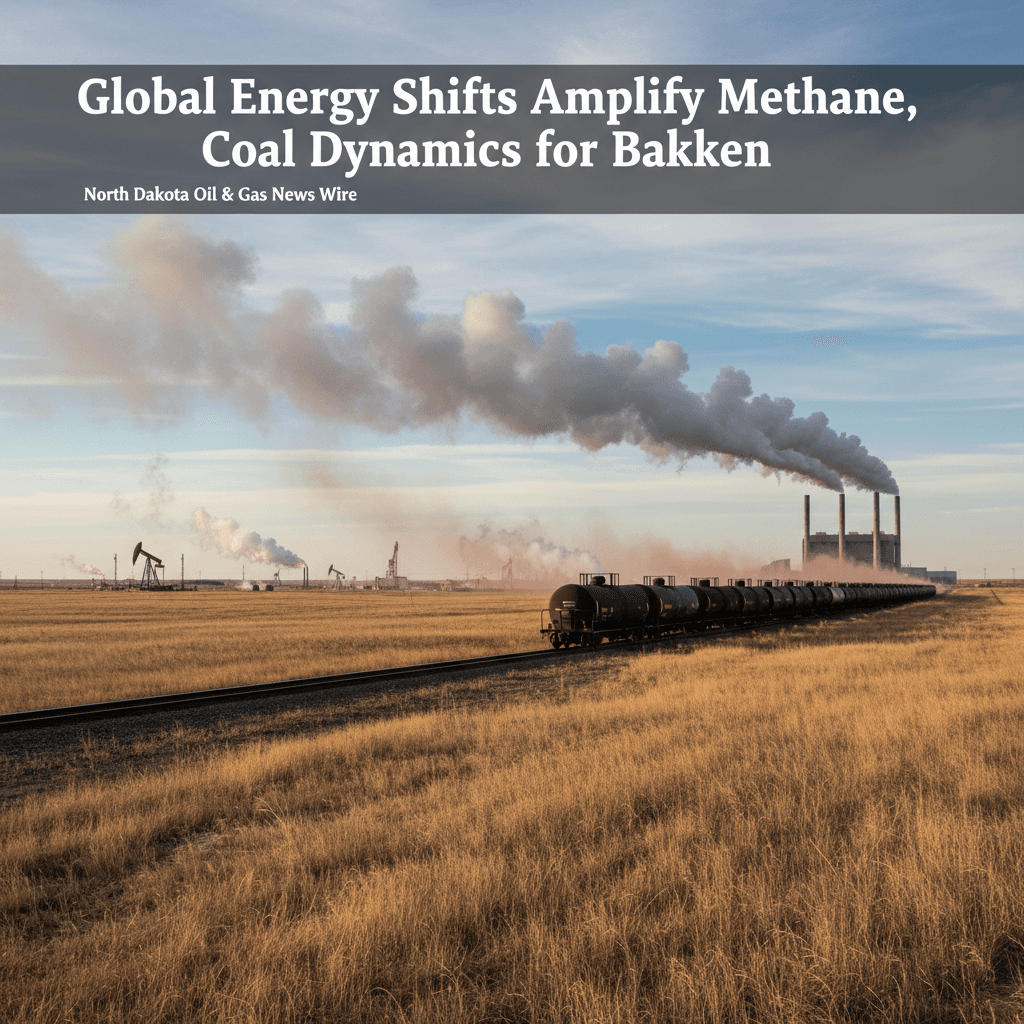
Global Energy Shifts Amplify Methane, Coal Dynamics for Bakken

IEA reports highlight global methane divide and record coal demand, factors influencing regulatory and market pressures on North Dakota producers.

Bakken Wire Staff·🔆Midday Wire·

Two major International Energy Agency (IEA) reports published Thursday underscore global energy dynamics with direct implications for North Dakota's Bakken formation, highlighting persistent methane emission challenges and shifting fossil fuel demand driven by geopolitical conflict.

According to an IEA annual tracker cited by OilPrice.com, global energy-related methane emissions are about 80% higher than levels reported by countries to the UN. The United States, a signatory to the Global Methane Pledge aimed at a 30% reduction by 2030, is listed among the world's biggest methane polluters, alongside Russia, Iran, Venezuela, and Turkmenistan. Fossil fuel operations contribute about one-third of human-caused methane emissions, which heat the planet up to 80 times more than carbon dioxide over two decades.

For Bakken operators, this global scrutiny reinforces the focus on emission reduction efforts. The IEA noted that abandoned wells and mines accounted for roughly 8 million tonnes of global methane emissions in 2024, "demonstrating the severity of leaving them unplugged." This data point underscores the regulatory and environmental importance of well-plugging programs in North Dakota.

Separately, the IEA's Coal Mid-Year Update 2026 projects global coal demand will rise by 1.2% in 2026 to a record 8.94 billion tons, a reversal from pre-war forecasts of a slight drop. OilPrice.com reported this surge is a direct result of the Iran war, which has choked LNG supply through the Strait of Hormuz for over six months, pushing LNG prices higher and prompting utilities in China, India, Japan, South Korea, and Europe to shift to coal.

While not directly affecting Bakken crude exports, this major energy supply dislocation creates a complex global fuel mix. The shift to coal, a more emissions-intensive fuel, could indirectly affect long-term demand narratives for all hydrocarbons, including oil. The IEA stated that if the Strait of Hormuz remains closed to LNG shipments well into next year, "global coal demand could further rise to new record highs."

The concurrent reports depict a global market where security-driven demand for fossil fuels remains robust, even as international pressure to mitigate emissions, particularly methane, intensifies. For Bakken producers, the environment demands operational efficiency to manage emissions in line with global pledges, while market fundamentals are being reshaped by distant geopolitical events affecting competing energy sources.

Source

According to reports from OilPrice.com citing International Energy Agency data published on September 10, 2026.
ieamethane emissionsglobal coal demandlnggeopoliticsregulation

Share this article

Related Articles

The Midday Take - Energy Market Briefing
Global Markets

Energy Market Briefing

Bakken Wire Energy Briefing Thursday, September 10, 2026 1. Headlines Oil prices are surging sharply today. As of midday, WTI crude is trading at $101.59 per barrel, up $5.54 (5.77%), while Brent crude is at $106.90, up $5.69 (5.62%), according to price data. The rally follows the weekly U.S. inventory report from the Energy Information Administration (EIA), which showed a draw of 400,000 barrels in commercial crude stocks for the week ending September 4, bringing inventories in line with the five-year average. This aligned with the prior American Petroleum Institute (API) estimate of a 300,000-barrel draw. Geopolitical tensions remain the dominant market narrative. Multiple sources from Rigzone report that Iran and the U.S. are "bracing for a long war" and "digging in for a protracted war," with Iran stating it is "ready for escalation." These headlines follow reports of escalating attacks and the closure of the Strait of Hormuz to...

🔆Midday Wire·Sep 10
The Morning Take - Energy Market Briefing
Global Markets

Energy Market Briefing

Bakken Wire Energy Market Briefing Thursday, September 10, 2026 1. Headlines Oil prices are trading higher this morning, continuing a rally that saw Brent crude close above $101 per barrel on Wednesday, its highest level in four months, according to Rigzone. As of this briefing, WTI is at $97.52 and Brent at $102.46. The stated drivers are escalating Middle East tensions, falling inventories, and renewed Chinese buying, which are tightening physical markets. The geopolitical risk premium is being compounded by severe logistical disruptions. OilPrice.com reports that tanker rates have hit record highs, with the daily rate for a Very Large Crude Carrier (VLCC) from the Middle East to China reaching almost $800,000. Shipbroker Fearnleys notes the tanker market is "so tight" due to shippers taking much longer, inefficient routes to avoid the high-risk Strait of Hormuz, where a U.S.-Iran tanker war is escalating. Elsewhere, the energy transition narrative shows conflicting...

☀️Morning Wire·Sep 10
Global Markets

Global Clean Investment Drops 17% as Tanker Rates Soar to Records

Global investment in clean energy technologies fell 17% in the first half of 2026, driven primarily by a major policy shift in China, according to a report from the Rhodium Group cited by OilPrice.com. The decline underscores a recalibration in energy transition funding as governments prioritize energy security amid tight and expensive hydrocarbon supplies. China, the world's largest cleantech investor, saw its investment in alternative energy and electric transport plunge 49%, a drop of $133 billion, after moving to market-based pricing for renewables and phasing out EV purchase-tax exemptions. This slashed China's share of global clean tech investment from 52% at the end of 2025 to 39% by June 2026. Meanwhile, investment increased in India and the European Union. Simultaneously, the cost of moving oil across the globe has skyrocketed due to escalating risks in the Middle East. Oil tanker rates have hit record highs as shipping through the Strait...

☀️Morning Wire·Sep 10