Global Energy Shifts Highlight Election Risks, Renewable Rise, and US Rig Growth
Colombia's oil future hinges on its 2026 election, Morocco accelerates its solar build-out, and U.S. drilling activity continues a steady climb.
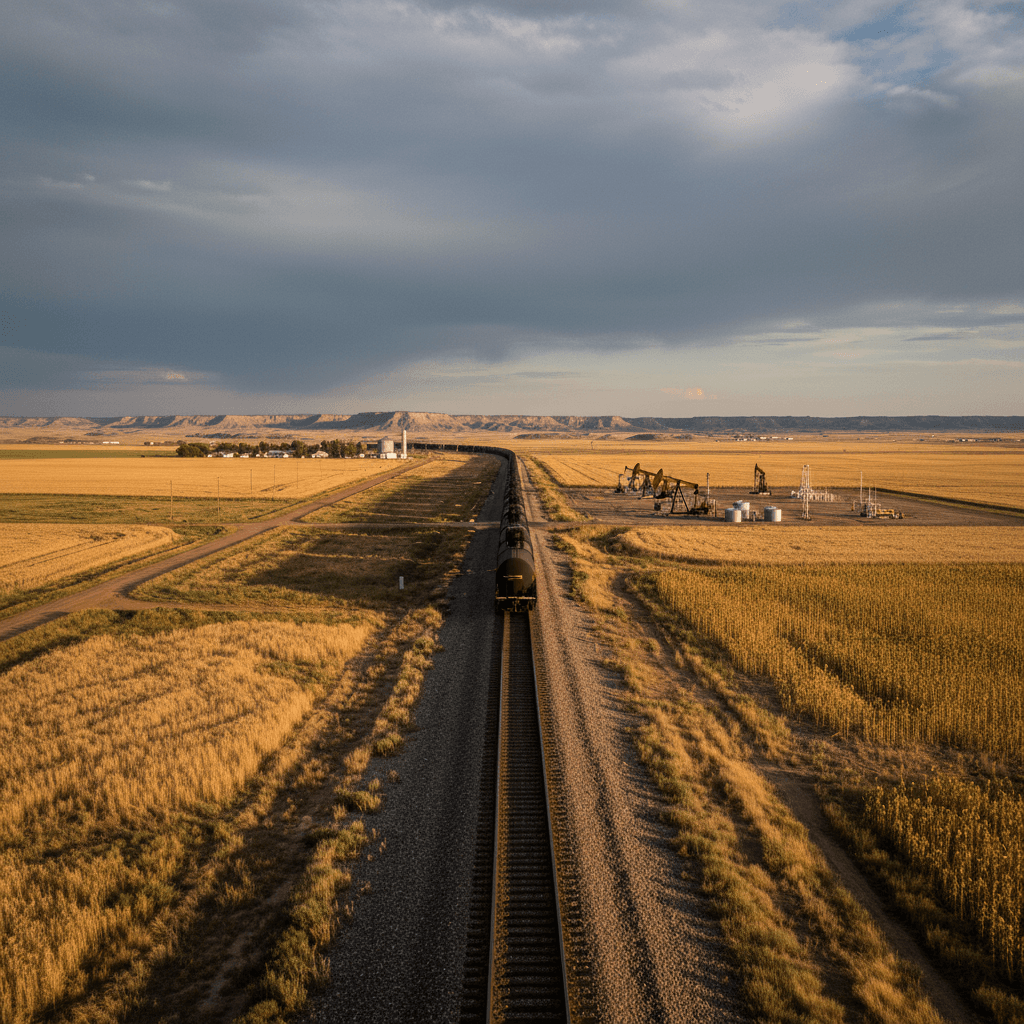
The U.S. oil and gas rig count rose for a fifth consecutive week, according to the latest Baker Hughes survey. The total number of active rigs increased by four to 562, marking its highest level in a year. This sustained increase in domestic drilling activity provides a steady backdrop for North Dakota operators amid shifting global energy narratives.
In Colombia, the approaching 2026 presidential election is generating significant concern for its oil industry. Current President Gustavo Petro's policies, including a ban on new exploration contracts and higher taxes, have contributed to a sharp decline in output. According to Colombia's National Hydrocarbon Agency (ANH), March 2026 oil production was 740,497 barrels per day, well below the 917,210 barrels daily produced a decade earlier for the same period. Natural gas output has also fallen to around 700 million cubic feet per day, among its lowest levels in decades, increasing the country's reliance on expensive LNG imports.
The election presents a potential pivot point for the Andean nation's most significant export, which earned $12.5 billion in 2025. The continuation candidate for Petro's party, Iván Cepeda, stated at an April rally that the country requires a policy "that diversifies the economy and avoids dependence on hydrocarbons," while promising a gradual transition. The outcome will be closely watched by global markets for signals on future supply.
Meanwhile, Morocco is emerging as a renewable energy powerhouse, leveraging its high solar insolation and proximity to Europe. The country, which still relies on coal for about 60% of its electricity, aims for a 52% renewable share in its power mix by 2030. By the end of 2025, it had an estimated 5.5 GW of operational renewable capacity, comprising 2.1 GW hydropower, 2.4 GW wind, and 961 MW solar.
Growth is accelerating, with solar technology imports rising around 46% in the first quarter of 2026. The Moroccan Agency for Sustainable Energy (MASEN) has authorized approximately 66 renewable projects totaling 6 GW since 2021. MASEN and the national utility ONEE plan to add 4.4 GW of new capacity by 2030, including 2.5 GW of solar and 1.9 GW of wind, supported by private investment.
Major international players are involved. Saudi Arabia's ACWA Power was awarded the 400 MW Noor Midelt II and III solar projects with battery storage. A consortium including France’s EDF and Masdar was selected for an 800-MW solar complex. In May, China's Jinko Solar announced plans for a 90 MW plant in Morocco using modules designed for hot, dusty desert conditions.
These global developments underscore a dual reality: continued near-term demand for hydrocarbons driving U.S. drilling activity, alongside long-term strategic investments in alternative energy sources that could reshape future trade flows and competitive landscapes.
Source
OilPrice.com, OilPrice.com, Baker Hughes via Bing News

