Global Inventories Cushion Supply Shock, But Accessibility Concerns Mount
J.P. Morgan analysis finds 280 million barrels already drawn, while Chevron CEO warns of extreme stress on energy system from Hormuz closure.
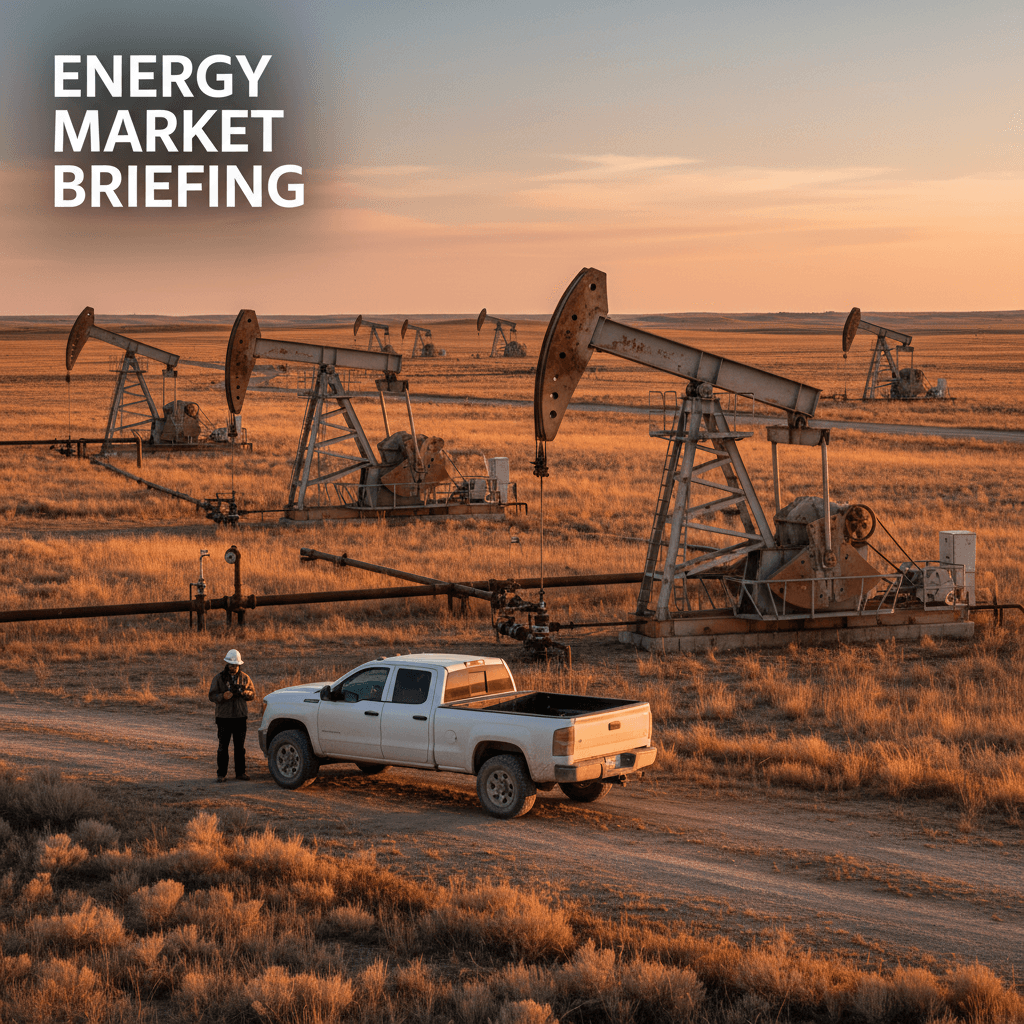
Global oil inventories are serving as the primary shock absorber for markets disrupted by ongoing conflict, but accessible supplies are limited, according to a new J.P. Morgan analysis. For Bakken operators, the dynamics underscore the critical role of global stockpiles in stabilizing prices amid supply uncertainty.
J.P. Morgan analysts, including head of global commodities strategy Natasha Kaneva, stated in a report that inventories have become the market's main balancing mechanism. "Unlike a typical disruption where spare production capacity can be mobilized quickly, the location of the shock and the scale of current supply losses mean the immediate adjustment has to come from barrels already in storage," the analysts said, according to Rigzone.
The report detailed that the world began 2026 with an estimated 8.4 billion barrels in total storage. However, the analysts warned that not every barrel is readily available. "Out of the 8.4 billion barrels in global inventories, we estimate only 0.8 billion barrels are realistically available without pushing the system into operational stress," the report stated. As of April 23, roughly 280 million barrels had already been consumed to cushion the impact of the conflict.
Concurrently, Chevron Corp. CEO Mike Wirth issued a stark warning about the strain on the system. In a CNBC interview on Friday, May 1, Wirth said the global energy system continues to be under "extreme stress" due to the effective closure of the Strait of Hormuz, a chokepoint for about 20% of the world's oil and liquefied natural gas. "If we don’t get supply reestablished, demand will have to come down across different sectors of the economy," Wirth said, according to Rigzone.
Wirth's concerns echo those of other major operators. ConocoPhillips warned on Thursday that "critical shortages" of oil for some import-dependent nations were imminent, Rigzone reported. Wirth added that Chevron is speaking with the Trump administration on an "almost constant basis."
For the Bakken, a region responsive to global price signals shaped by inventory draws and geopolitical risk, the data presents a mixed picture. The J.P. Morgan report suggests a foundational buffer exists, with stocks having rebuilt in 2024 and 2025 after earlier draws. Of the 8.4 billion barrels in global storage, about 5.2 billion are crude and 3.2 billion are refined products. However, accessibility is key; the analysts noted that only about 580 million barrels of onshore inventories are readily accessible, with much of the rest "effectively locked."
The ongoing draw on these buffers—280 million barrels and counting—combined with executive warnings of systemic stress, points to a tightening physical market. This environment could support Bakken drilling economics but also increases volatility and the risk of demand destruction, a concern explicitly highlighted by the Chevron CEO.
Source
Analysis from J.P. Morgan reported by Rigzone on May 1, 2026; Statements from Chevron CEO Mike Wirth and ConocoPhillips reported by Rigzone on May 2, 2026.