WTI Crude--
Brent Crude--
Natural Gas--
ND Rig Count--
WTI Crude--
Brent Crude--
Natural Gas--
ND Rig Count--
Global LNG, China Demand Shifts Signal Mixed Signals for Bakken - Bakken Wire
Global Markets

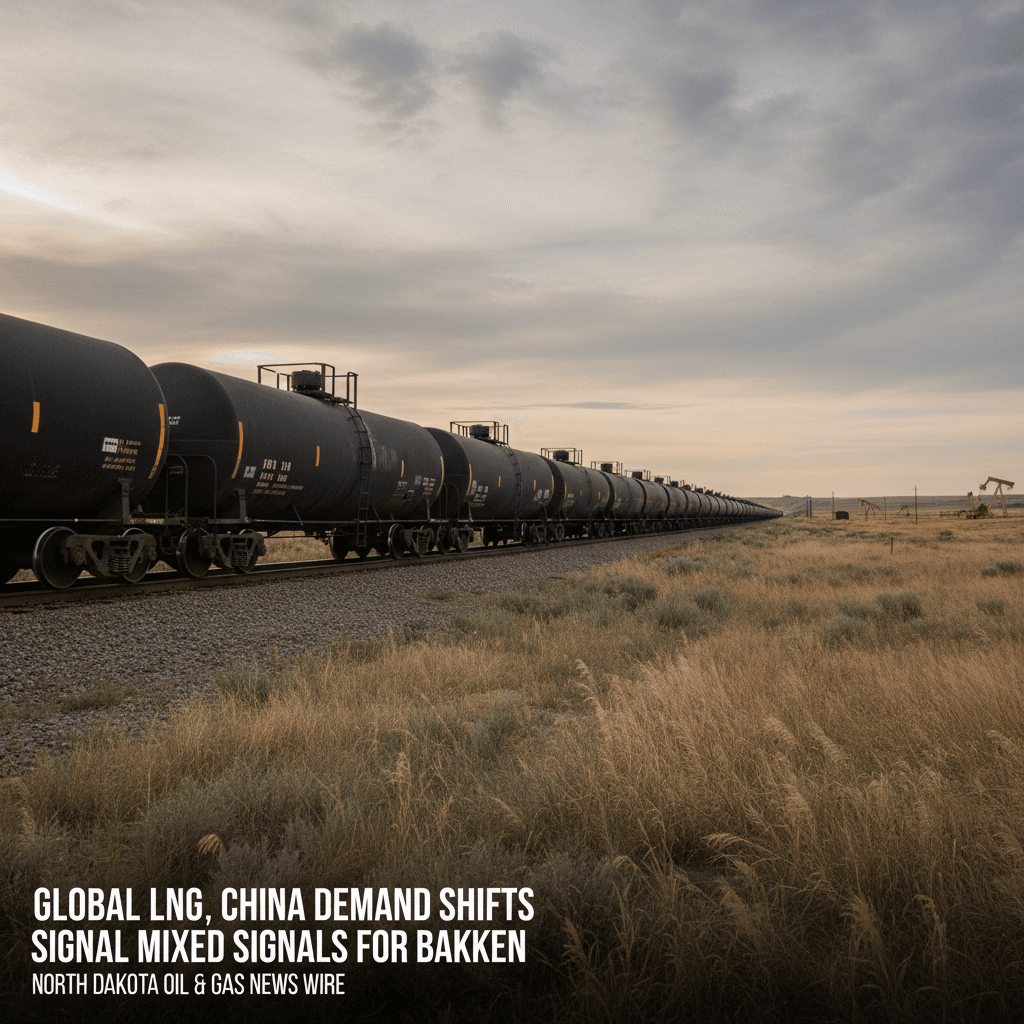
Global LNG, China Demand Shifts Signal Mixed Signals for Bakken

Long-term LNG supply deals contrast with faltering Chinese demand, influencing the global oil and gas balance that sets Bakken prices.

Bakken Wire Staff·🔆Midday Wire·

Two major long-term liquefied natural gas (LNG) supply agreements were announced Wednesday, according to Rigzone, creating a potential floor for global gas markets that can influence associated gas economics in the Bakken. Cheniere Energy secured a 22-year contract to supply LNG to Brazil's state-owned Petrobras, Rigzone reported. Separately, Sempra announced a 20-year agreement to supply approximately 0.8 million metric tons per annum of LNG to the same Brazilian company.

These deals signal sustained international demand for natural gas, which can support global gas prices. For Bakken producers, whose wells often produce significant volumes of associated natural gas alongside crude oil, stronger global gas fundamentals can improve the economics of gas capture and reduce flaring pressures in North Dakota.

However, the oil market outlook faced a headwind as a nascent recovery in Chinese oil demand has begun to falter, Rigzone reported in a separate story. China is a key global oil consumer, and softening demand there can weigh on international crude benchmarks like Brent and WTI, which directly set the price for Bakken crude.

In another development affecting global gas supply, Chevron's local partners in Israel's Leviathan gas field canceled a potential $6.7 billion domestic supply deal, according to Rigzone. The scrapped contract would have supplied gas from the Mediterranean project to two planned Israeli power plants. This decision could keep more Leviathan gas available for the global LNG market, potentially adding to supply and moderating price gains from the new Brazilian contracts.

For Bakken operators, the day's news presents a mixed picture: supportive long-term gas demand against immediate concerns over oil demand growth. The net effect on wellhead economics will depend on which force dominates the volatile global market. Royalty owners and drillers watch these international signals closely, as they ultimately dictate cash flow and drilling activity levels in the Williston Basin.

Source

Rigzone (Cheniere Notches 22-Year LNG Contract to Supply Petrobras; China Oil Comeback Loses Steam; Leviathan's Israeli Owners Cancel $6.7B Domestic Supply Deal)

global marketslngoil demandnatural gascrude prices

Share this article

Related Articles

The Midday Take - Energy Market Briefing
Global Markets

Energy Market Briefing

Daily Energy Market Briefing Wednesday, September 30, 2026 1. Headlines Oil prices are sharply higher today, with WTI up 2.17% to $91.32 and Brent up 2.72% to $98.78. The rally is attributed to a combination of rising analyst price forecasts, ongoing tensions around the Strait of Hormuz, and a tightening global diesel market. A new Reuters poll shows analysts have raised their 2026 average Brent forecast to $89.05 and WTI to $83.90, citing expectations that Hormuz disruptions will persist. Meanwhile, Iran issued a direct threat, warning via state TV that "no energy infrastructure will be safe" if it cannot sell its oil. The physical market is showing clear signs of tightness. The U.S. EIA reported a modest crude inventory build of 900,000 barrels, but distillate stocks fell by 2.3 million barrels and are now 14% below the five-year average. This comes as Russia extended its ban on most diesel exports...

🔆Midday Wire·Sep 30
The Morning Take - Energy Market Briefing
Global Markets

Energy Market Briefing

Energy Market Briefing Wednesday, September 30, 2026 1. Headlines Oil prices are higher this morning, with WTI at $90.85 and Brent at $97.90. The move follows a prior session decline reported by Rigzone, attributed to easing fears over Saudi supply shortages. The market is digesting conflicting data on the health of global crude flows. Analysts at consultancies FGE NexantECA and Energy Aspects have cut their forecasts for China’s Q4 crude imports by approximately 400,000 barrels per day, according to OilPrice.com. The analysts cite high prices above $100 Brent and the effective elimination of cheap Iranian and Venezuelan supply due to U.S. policy as reasons for the downgrade. Meanwhile, India is shifting its import patterns, boosting Middle East crude purchases to pre-war levels while reducing Russian flows, according to Kpler data cited by OilPrice.com. In other news, Russia has extended its ban on most diesel exports through October, as reported by...

☀️Morning Wire·Sep 30
Global Markets

Global Trade Shifts, Supply Moves Pressure Bakken Oil Pricing

Global crude trade flows are shifting as India, a major market, increases imports from the Middle East while reducing purchases of Russian oil, according to data from Kpler reported by OilPrice.com. This realignment, alongside new Russian export restrictions, creates a mixed pricing environment for Bakken crude as winter demand approaches. India imported an average of 3 million barrels per day from the Middle East in September, a return to pre-war levels, while its daily average for Russian crude fell to 1.75 million barrels from 2.1 million in August, OilPrice.com reported. Despite the decline, Russia remains India's largest single supplier, and Kpler analyst Sumit Ritolia stated, "Russia remains a central part of India’s crude import basket, and we do not see the latest decline as India moving away from Russian barrels altogether." India's total crude imports rose to 5.3 million barrels daily in September. The shift comes as the U.S. threatens...

☀️Morning Wire·Sep 30