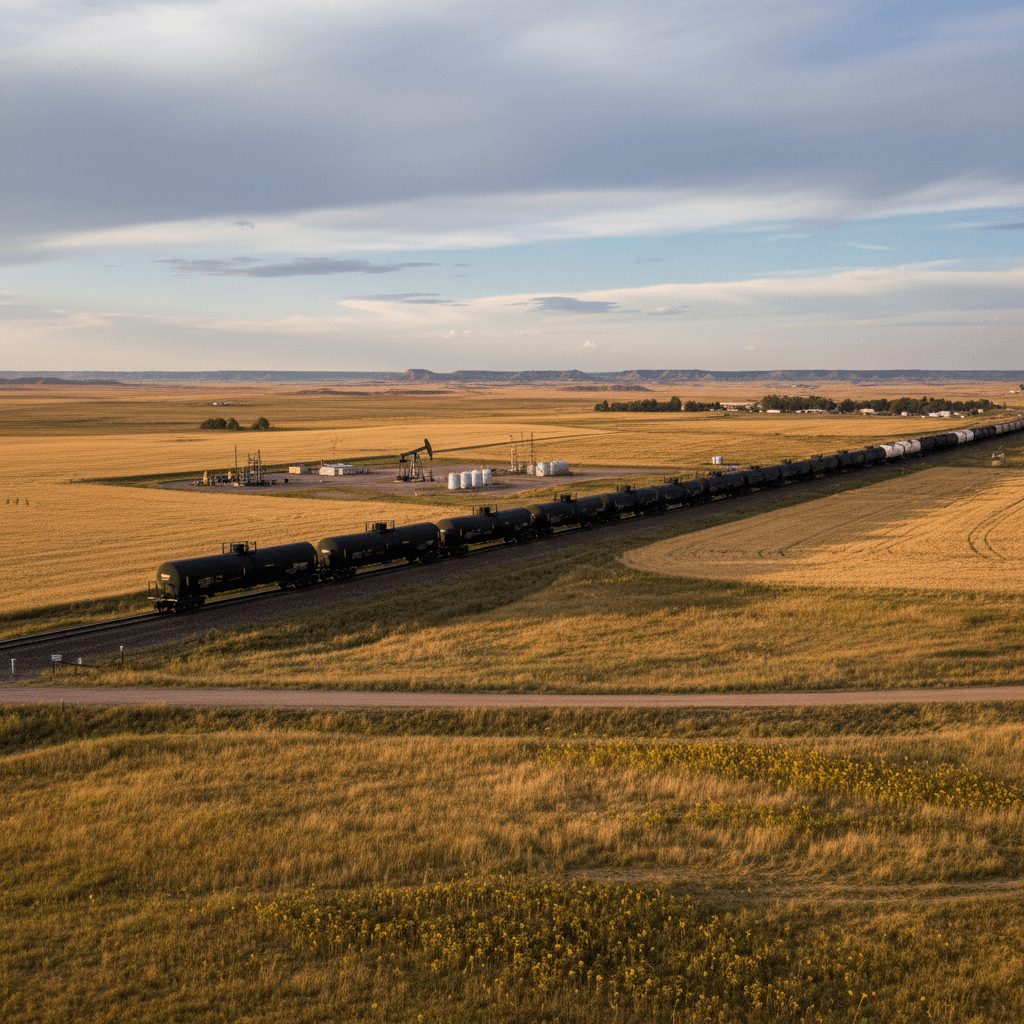
Global LNG, Coal Shifts Underline Bakken's Competitive Landscape
Russia expands sanctioned LNG exports via shadow fleet as China's coal production dips and clean energy investment surges, shaping long-term demand dynamics for U.S. oil and gas.
Russia has quietly added four liquefied natural gas (LNG) carriers to its "dark fleet" used to export sanctioned cargoes from the Arctic LNG 2 project, according to a Bloomberg analysis reported by OilPrice.com. The carriers Kosmos, Merkuriy, Orion, and Luch recently changed ownership and management to obscure companies, with the Kosmos now flying a Russian flag and docking at a floating storage unit for the sanctioned project. This expansion highlights Russia's continued ability to move sanctioned energy commodities, primarily to China, using a shadow fleet that now numbers about 20 vessels.
The ongoing flow of Russian LNG to China, facilitated by specialized ice-class tankers like the Christophe De Margerie, maintains a supply of competing natural gas in a key global market. For Bakken operators, this underscores the persistent global competition for market share, even under sanctions, and the importance of cost-efficient production to compete with other global supply sources.
Concurrently, China's energy landscape is shifting. According to OilPrice.com, China's coal production in April inched down by 1% month-on-month to 385.63 million tons, following an all-time high in March. Coal imports for the month fell 14% year-on-year to 33.1 million tons. Despite this recent dip, domestic production remains robust, and thermal power generation rose 3.6% year-on-year in April as China substitutes gas with coal amid tight global gas supplies caused by the Middle East conflict.
These trends have mixed implications for Bakken hydrocarbons. Increased Chinese coal use for power generation could soften global LNG demand growth, a potential headwind for associated gas from the Bakken. However, the Middle East war, cited across sources as causing a "major oil and gas supply shock" and the loss of 1 billion barrels of global oil supply, continues to underpin a tighter overall crude market, supporting Bakken oil economics.
Separately, a massive financial bet on China's clean energy exports signals a accelerating long-term energy transition. HSBC has established a $4 billion "Sustainability and Transition Credit Facility" to fund Chinese companies in wind, solar, electric vehicles, and AI, OilPrice.com reported. China's clean tech exports surged to a record $25.77 billion in March 2026, up more than 50% from March 2025.
"China is home to some of the world's most dynamic low-carbon companies," HSBC's Natalie Blyth told Reuters, as quoted by OilPrice.com. This large-scale financing commitment accelerates the global push towards alternatives, reinforcing the imperative for Bakken operators to focus on operational efficiency and cost reduction to remain competitive in a decarbonizing world economy.
Source
OilPrice.com reports from May 18, 2026, on Russia's LNG dark fleet, HSBC's $4B China clean energy fund, and China's coal production and import data.

