WTI Crude--
Brent Crude--
Natural Gas--
ND Rig Count--
WTI Crude--
Brent Crude--
Natural Gas--
ND Rig Count--
Global Refining Shifts, Attacks Tighten Fuel Markets, Impacting Bakken - Bakken Wire
Global Markets

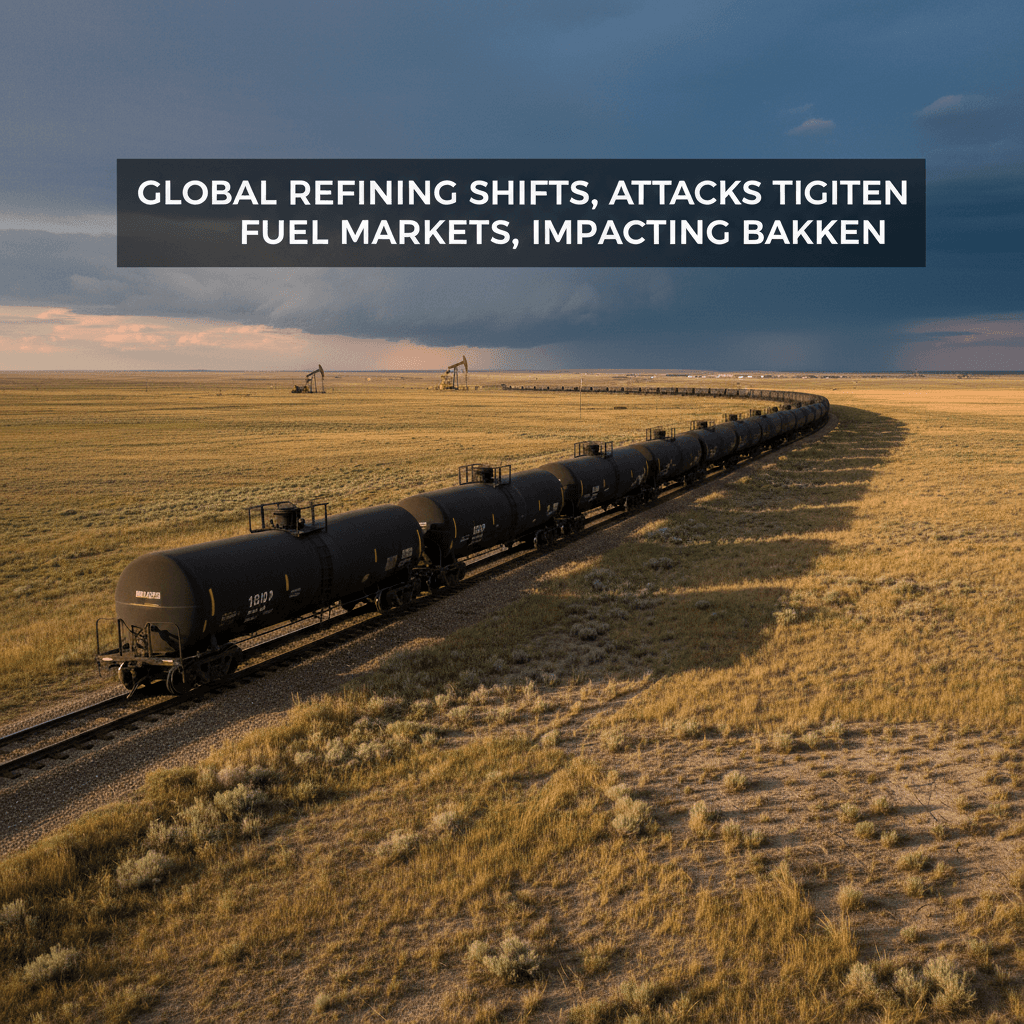
Global Refining Shifts, Attacks Tighten Fuel Markets, Impacting Bakken

Sinopec's pivot from fuels and ongoing Ukrainian drone strikes on Russian refineries create competing pressures on global distillate supplies, critical to Bakken crude pricing.

Bakken Wire Staff·🔆Midday Wire·

China's largest oil refiner is planning a major business transformation as domestic fuel sales collapse, while Ukrainian drone attacks continue to disrupt Russian refining capacity, creating a complex global market for fuels that ultimately influences Bakken crude oil prices.

Sinopec, the world's biggest refiner, reported that domestic consumption of refined products in China fell 8.6% year-on-year in the first half of 2026, according to a company release cited by OilPrice.com. Gasoline demand dropped 7.9% and diesel fell 11.5%, a decline the company attributed to high prices and accelerated substitution by new energy vehicles. In response, Chairman Hou Qijun stated the company will allocate more capital to new energy and chemicals by decade's end. "Gasoline was made for cars, yet half of new cars no longer need fuel ... Under these circumstances, how can producing more gasoline and diesel continue to generate revenue?" Hou told analysts, according to the source.

Concurrently, Ukrainian forces struck the 180,000-barrel-per-day Afipsky refinery in Russia's Krasnodar region on Monday night, causing a fire, as reported by OilPrice.com. This is part of a near-daily campaign targeting Russian refining infrastructure, which has contributed to a domestic fuel crunch in Russia, including fuel rationing and long gas station queues. Rigzone also reported Ukraine attacked an oil refinery and a gas plant in Russia overnight.

The attacks have severely impacted Russian fuel exports. Russia's diesel and gasoil exports have crashed to their lowest in years this month, tightening the global middle distillate market, according to OilPrice.com. Russian Deputy Prime Minister Alexander Novak said some refineries have resumed operations after repairs, which could soon raise domestic supply.

For Bakken operators and North Dakota royalty owners, these dual global developments present a mixed picture. A prolonged reduction in Chinese demand for traditional transportation fuels could weigh on long-term global crude oil consumption forecasts. However, the immediate and sustained disruption to Russian refining capacity is constricting global supplies of diesel and other distillates, providing support for fuel cracks and, by extension, the crude oils used to produce them.

The Bakken formation produces a light, sweet crude that yields a high proportion of diesel and gasoline. Therefore, market tightness in distillates, particularly diesel, can enhance the relative value of Bakken crude compared to heavier benchmarks. The ongoing attacks introduce a persistent risk premium and supply uncertainty into the global refined products market, potentially benefiting Bakken producers in the near to medium term.

The contrasting trends—structural demand decline in the world's largest oil importer versus acute supply disruption from a major exporter—will be key factors for Bakken operators monitoring the differentials and export economics for North Dakota crude.

Source

OilPrice.com (Sinopec transformation, Russian refinery attack details), Rigzone (summary of Ukraine attacks on Russian energy infrastructure)
global marketsrefiningdieselbakken crudeexportschinarussiageopolitics

Share this article

Related Articles

The Midday Take - Energy Market Briefing
Global Markets

Energy Market Briefing

Daily Energy Market Briefing Tuesday, August 25, iii 1. Headlines Oil prices are sharply lower today. As of midday, WTI crude is trading at $82.21, down 3.29% (-$2.80), while Brent crude is at $87.45, down 3.41% (-$3.09). Natural gas is at $2.80, down $0.04. The Bakken differential to WTI is -$3.42. The primary narrative driving the sell-off, according to reports from both OilPrice.com and Rigzone, is a market reassessment of the latest U.S. sanctions pressure on Iran. While U.S. Treasury Secretary Scott Bessent unveiled a new campaign dubbed "Operation Economic Outcast" on August 24, the immediate lack of action against major Chinese financial institutions has traders speculating that diplomatic negotiations, potentially involving Pakistani mediation, could offer a path to de-escalation. This has offset earlier bullish momentum, with Rigzone noting crude prices declined as traders "weighed new US sanctions pressure." Other reported market factors include ongoing Ukrainian drone strikes on Russian...

🔆Midday Wire·Aug 25
The Morning Take - Energy Market Briefing
Global Markets

Energy Market Briefing

Energy Market Briefing for Bakken Wire Date: Tuesday, August 25, 2026 1. Headlines Oil prices are under significant pressure today. As of this morning, WTI crude is trading at $81.84, down $3.17 (-3.73%), while Brent crude is at $87.53, down $3.01 (-3.32%). Natural gas is also slightly lower at $2.81. According to Rigzone, this retreat comes as traders weigh new U.S. sanctions pressure on Iran, announced on Monday. The geopolitical backdrop remains tense. OilPrice.com reports that the U.S. Treasury has launched "Operation Economic Outcast," sanctioning 60 individuals, entities, and tankers involved with Iran's oil trade. In response, Iran's economy minister has threatened retaliation, stating, "Our defense is no longer so defensive; the enemies should wait for an attack." Meanwhile, the physical market is showing strain: Asian refiners are on course to nearly double their purchases of U.S. crude for September, a move Rigzone notes could squeeze domestic U.S. fuel makers...

☀️Morning Wire·Aug 25
Global Markets

Iran Sanctions, China Demand Peak Shape Global Oil Outlook

Geopolitical tensions surrounding Iran and a major downward revision to China's oil demand outlook are creating a mixed global backdrop for Bakken crude prices. While new U.S. sanctions threaten supply, emerging demand concerns could cap gains. The U.S. Treasury announced new sanctions on Monday, August 24, targeting Iran's trade partners under "Operation Economic Outcast," according to a report from OilPrice.com. The action sanctioned 60 individuals, entities, and tankers, with oil trade remaining a prime target. In response, Iran's economy minister Ali Madanizadeh threatened an aggressive retaliation, stating, "Our defense is no longer so defensive; the enemies should wait for an attack." However, analysts noted the latest sanction list did not include major Chinese financial institutions suspected of facilitating Iran's oil trade, as the U.S. is reportedly unwilling to risk Chinese retaliation. China is the biggest buyer of Iranian crude, taking in over 80% of the country's exports. The ongoing Strait...

☀️Morning Wire·Aug 25