Global Roundup: New Funding for Australia Gas, UK Restructuring, and Russian Arctic Oil
Developments in Australia, the UK, and Russia highlight global capital flows, corporate restructuring, and the ongoing push into complex reservoirs.
Buru Energy Ltd. has secured a new funding commitment for a major gas project in Australia, highlighting ongoing global capital formation for long-term hydrocarbon developments. According to Rigzone, the company received a commitment for a two-tranche institutional share offering expected to raise approximately AUD 5.3 million ($3.8 million) for its Rafael Gas Project in Western Australia's Canning Basin. The onshore project, targeting a high-confidence resource of about 85 billion cubic feet of gas and 1.8 million stock tank barrels of liquids, is now slated for a 2029 production start. Buru's CEO cited recent engineering studies that "significantly enhanced the project’s economics" by identifying additional liquids streams, leading the company to push back its drilling timeline to capture the increased value in final funding deals.
In the UK, Spirit Energy has proposed a significant corporate restructuring, separating its operations from its carbon capture business. Rigzone reported the company plans to split into a Barrow-based operating company to manage the Morecambe Hub gas fields and an Aberdeen-based development company to advance the Morecambe Net Zero carbon storage project. Spirit Energy stated the move is necessary following its agreement to sell a portfolio of Southern North Sea assets to Serica Energy, a deal expected to close in the second half of 2026. The transaction, with an effective date of January 1, 2025, involves an upfront consideration of GBP 57 million and includes Serica acquiring a 15% interest in the large Cygnus gas field.
Meanwhile, Russia's state-owned Gazprom has begun commercial oil production from a new, technically challenging block in the Arctic. The company started production from Block 6A of the Achimov deposits at the giant Urengoyskoye field in West Siberia, Rigzone reported. Gazprom noted the Achimov deposits are characterized by extreme depth, complex geology, low permeability, and high pressure, requiring high-tech solutions like 3D modeling, long horizontal wells, and multi-stage hydraulic fracturing to achieve cost-effective production. The company plans to drill more than 40 wells for the full-scale development of the block. The Urengoy field, originally a massive gas discovery, has seen progressive development of its Achimov formations for both oil and gas over the past two decades.
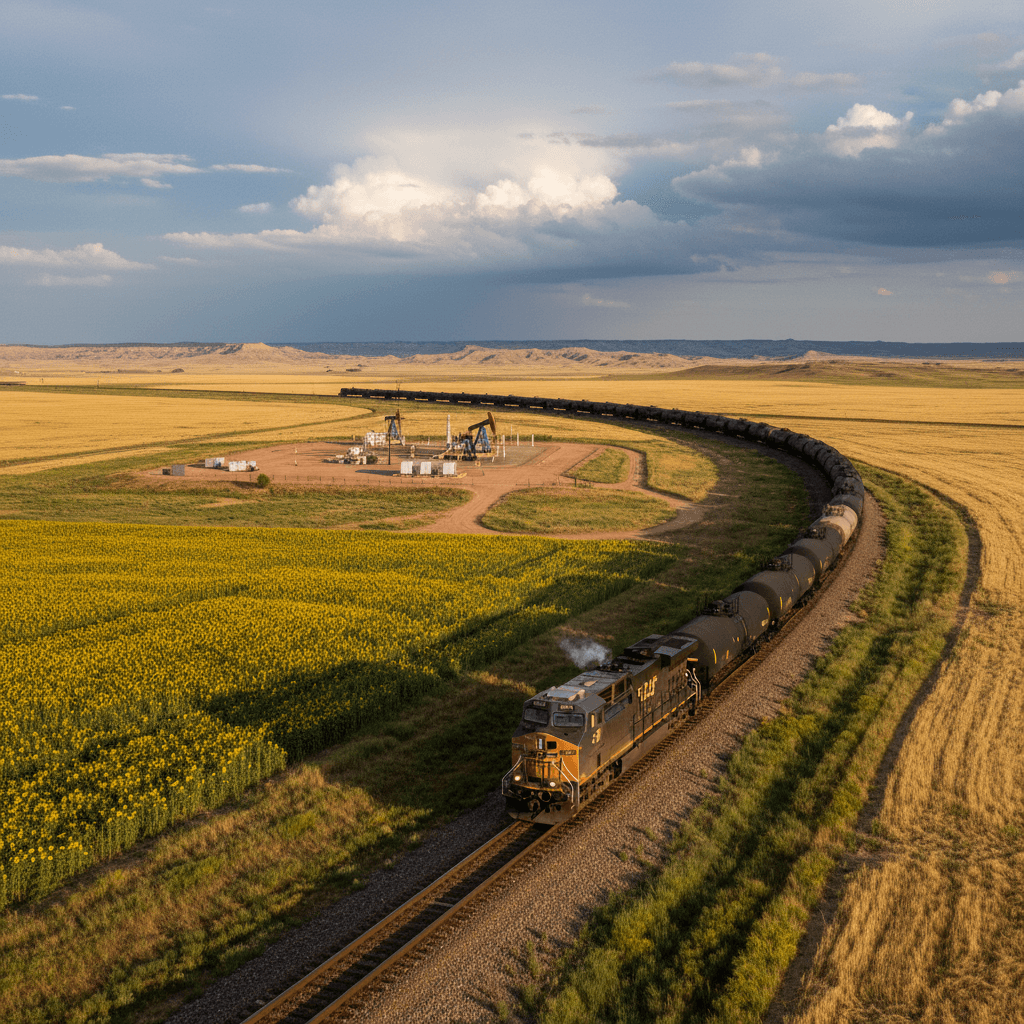
Bakken Context: For North Dakota operators, these global developments underscore several familiar themes: the critical role of advanced drilling and completion technology in unlocking complex, tight reservoirs; the ongoing corporate maneuvering and portfolio optimization as companies separate legacy hydrocarbon assets from new energy ventures; and the continued international competition for capital to fund large-scale, long-cycle projects. The technical description of the Achimov deposits—deep, tight, and requiring multi-stage fracturing—parallels the engineering challenges historically overcome in the Bakken formation.
Source
According to reports from Rigzone on April 17, 2026.

