WTI Crude--
Brent Crude--
Natural Gas--
ND Rig Count--
WTI Crude--
Brent Crude--
Natural Gas--
ND Rig Count--
Global Markets

Hormuez Crisis Tightens Global Fuel Supply, Adding Cost Pressure to Bakken Logistics

Disruptions to shipping fuel markets from Middle East conflict and refinery attacks threaten to increase transportation costs for North Dakota's oil and gas sector.

Bakken Wire Staff·🌅Afternoon Wire·

The ongoing crisis around the Strait of Hormuz is escalating into a global supply crisis for marine fuel, a development that threatens to increase logistics costs and complicate export timing for Bakken crude and refined products, according to an analysis from OilPrice.com. While the focus is often on crude oil flows, the tightening bunker fuel market directly impacts the shipping networks that move North Dakota's energy to market.

The disruption is quantifiable. OilPrice.com reported that as of October 16, commodity trader Vitol estimated high-sulfur fuel oil flows through Hormuz, which includes Iranian supplies, remained at least 800,000 tons per month below February levels. Concurrently, Ukrainian attacks on Russian refineries have removed an estimated additional million tons monthly from the global market. This has created a constrained product pool that global shipping is now competing for, despite some support for low-sulfur supplies from increased exports from China and Nigeria.

For Bakken operators, this translates into a less reliable and potentially more expensive shipping environment. The report states that securing the right grade of fuel at the right port within a commercially workable window is becoming harder. Delayed deliveries and uncertain replenishment are threatening voyage schedules, which can ripple back to wellhead economics and working capital for producers relying on timely exports. The pressure stems not just from aggregate production but from broken links in the distribution chain, where fuel can be stranded behind disrupted routes.

The market's fragility is illustrated by the port of Fujairah. While third-quarter fuel oil imports recovered to 2.6 million tons from 845,000 tons in the second quarter, September imports remained about half of February’s level, according to a Reuters report cited by OilPrice.com. This indicates a supply system still operating well below capacity and vulnerable to renewed interruption.

The spreading conflict in the Middle East, including around the Bab El Mandeb strait and Saudi Arabia, is only intensifying these logistical pressures. The report concludes that the current security situation in and around Hormuz and the Gulf of Oman "doesn’t bode well" for establishing dependable bunker availability. For North Dakota, a state heavily dependent on efficiently moving crude by rail to coastal ports and shipping finished products like diesel, a protracted marine fuel crisis adds a new layer of cost and uncertainty atop existing midstream challenges.

Source

Analysis based on reporting from OilPrice.com, published October 18, 2026.

global marketslogisticsshippingstrait of hormuzbunker fuelexportstransportation costs

Share this article

Related Articles

The Afternoon Take - Energy Market Briefing
Global Markets

Energy Market Briefing

Energy Market Briefing Sunday, October 18, 2026 1. Headlines Oil markets are holding steady at elevated levels, with Brent crude at $109.86 and WTI at $99.02, according to price data from today. The primary focus remains on mounting supply risks in the Middle East, with Rigzone reporting that Brent recently hit $110 as tensions rise. The International Energy Agency (IEA) has agreed to complete the release of an outstanding 100 million barrels of oil from a March intervention, as reported by Rigzone on October 16. Beyond crude, the disruption in the Strait of Hormuz is creating a severe squeeze on shipping fuel. OilPrice.com reports today that constrained high-sulfur fuel oil (HSFO) supplies, exacerbated by the Hormuz crisis and Ukrainian attacks on Russian refineries, are threatening global shipping logistics and profitability. On the demand side, Rigzone notes that Oxford Economics suggests India may raise fuel prices moderately in November ahead of...

🌅Afternoon Wire·Oct 18
The Midday Take - Energy Market Briefing
Global Markets

Energy Market Briefing

Energy Market Briefing Sunday, October 18, 2026 1. Headlines Oil prices are sharply higher today, with Brent crude pushing above $109 per barrel and WTI nearing $99, according to price data. Mainstream reports from Rigzone attribute the surge to mounting Middle East supply risks and a significant drawdown in U.S. commercial crude inventories, which fell by almost 9 million barrels last week. The International Energy Agency (IEA) has announced member countries agreed to complete the release of 100 million barrels of oil still outstanding from a March intervention, and will begin releasing more than 20 million barrels of diesel from collective inventory to address tight fuel supplies. The forward price curve reveals markets are pricing in a protracted period of tight supply. According to an OilPrice.com report, the ICE Brent futures contract for January 2027 is trading above $102, with contracts through December 2027 remaining above $84, suggesting traders see...

🔆Midday Wire·Oct 18
Global Energy Moves May Influence Bakken Crude, Gas Outlook - Bakken Wire
Global Markets

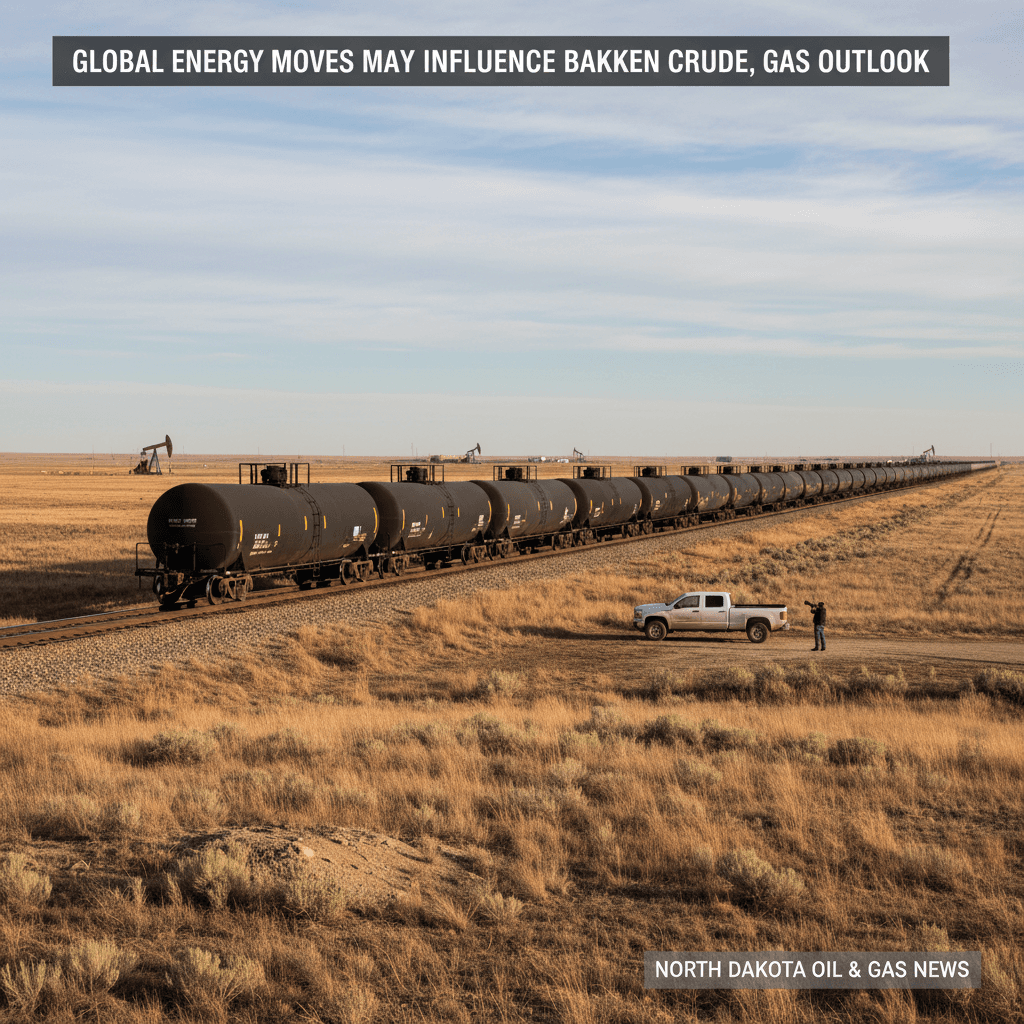
Global Energy Moves May Influence Bakken Crude, Gas Outlook

Global energy developments this week are setting a tone that could influence pricing and sentiment for Bakken operators. Key factors include a meeting of the OPEC+ producer group and China's preparations for winter natural gas demand. Ministers from the OPEC+ alliance reviewed market conditions during a meeting on the sidelines of a conference in Saudi Arabia, according to a statement posted on OPEC's website cited by Rigzone. The group, which includes major oil exporters like Saudi Arabia and Russia, periodically adjusts its production targets to manage global supply. While the October 16 statement did not announce any policy changes, such meetings are closely watched by the market for signals that could impact the price of international benchmark crudes, which Bakken crude competes with. Separately, analysts report that China has stockpiled enough natural gas to meet its winter demand, Rigzone reported on October 16. As the world's largest importer of liquefied...

🔆Midday Wire·Oct 18