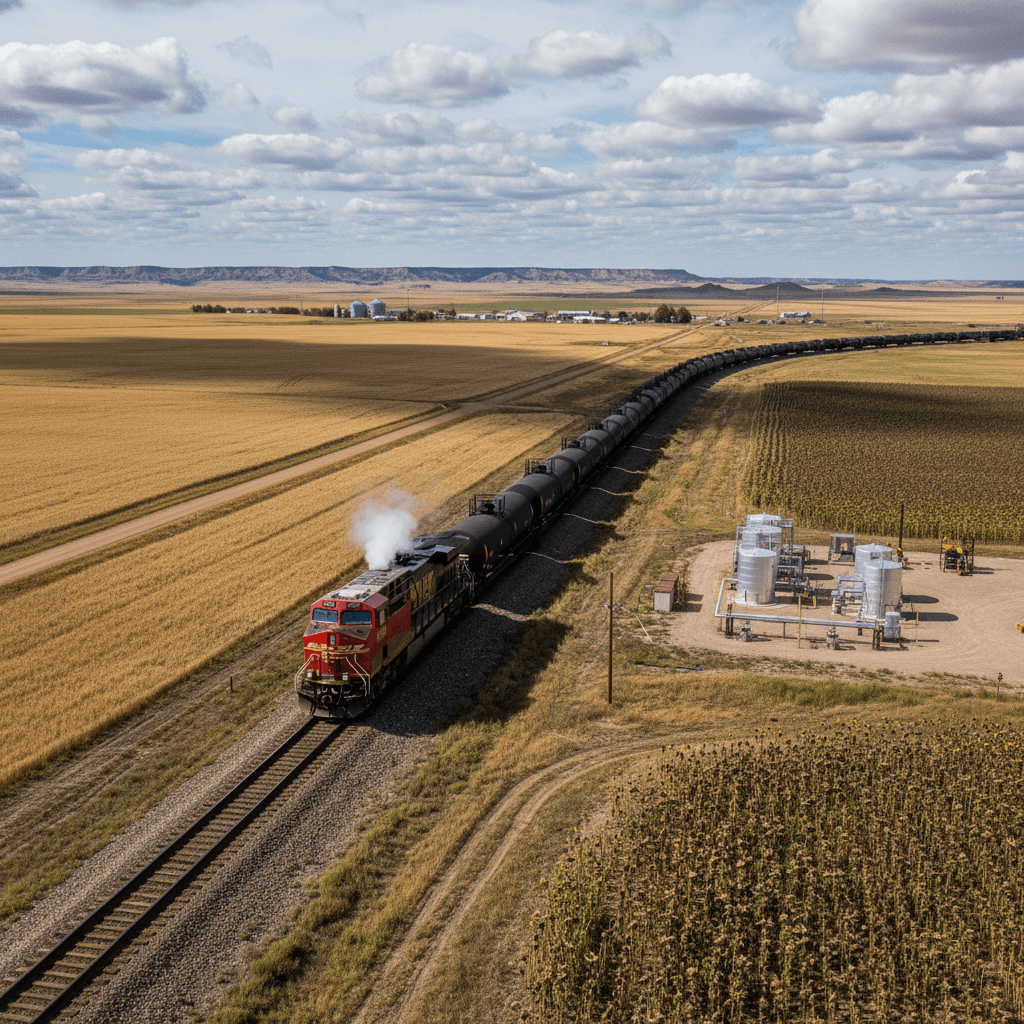
North Dakota Hits Record Active Wells as Global Turmoil Boosts Bakken
State production rises amid Middle East disruptions, while industry invests over $100 million in enhanced recovery research.
North Dakota's oil industry is accelerating as global supply disruptions create new opportunities for Bakken crude. The state set a new record with 19,639 active producing wells in March, according to the Department of Mineral Resources' monthly briefing. This marked an increase of 224 wells from February.
The increased activity comes as the closure of the Strait of Hormuz has severely constrained global oil flows. According to OilPrice.com, Iraq's crude oil production collapsed to an average of just 1.389 million barrels per day in April, down from over 4.1 million bpd prior to the U.S./Israel-Iran War that began February 28. This disruption has supported higher prices, with North Dakota's crude selling for $84.33 per barrel in March, up sharply from $57.74 in February.
Continental Resources founder Harold Hamm announced his company will resume drilling new rigs in North Dakota, reversing a January decision to halt new drilling due to low oil prices. The price of West Texas Intermediate crude was $101.02 per barrel on May 22, compared to around $60 per barrel in January. "Companies are taking advantage of the higher oil prices," said Mark Bohrer, assistant director of the Oil and Gas Division, during the briefing.
State production in March was 35.4 million barrels, or 1.142 million barrels per day. This was a nearly 1% increase from February but about 1% below the state revenue forecast, which was built on 1.15 million barrels per day. The current rig count in the state is 25, but is expected to rise.
Concurrently, industry leaders are focused on the long-term future of the Bakken. At the recent Williston Basin Petroleum Conference in Bismarck, a combined investment exceeding $100 million from the state of North Dakota, the Department of Energy, and private industry was highlighted as fueling major research into enhanced oil recovery, according to a column from the conference. The goal is to develop technologies to improve recovery rates, which currently stand at less than 15% of the oil in place.
The conference emphasized innovations using CO2, surfactant chemicals, advanced seismic imaging, artificial intelligence, and new drilling methods to unlock "Bakken 2.0." Since 2010, more than six billion barrels of oil have been produced from the Bakken formation.
The situation in Iraq underscores the strategic value of stable, domestic production. With over 90% of its budget historically from oil, Iraq's existential crisis, caused by the Strait of Hormuz blockade, highlights the risks of concentrated global transit chokepoints. This contrast reinforces the North Dakota industry's focus on both immediate operational responses to higher prices and long-term technological investments to secure the basin's future.
Source
Bing News (Hennen column, May 23, 2026; Yahoo News article, May 23, 2026), OilPrice.com (May 25, 2026)

