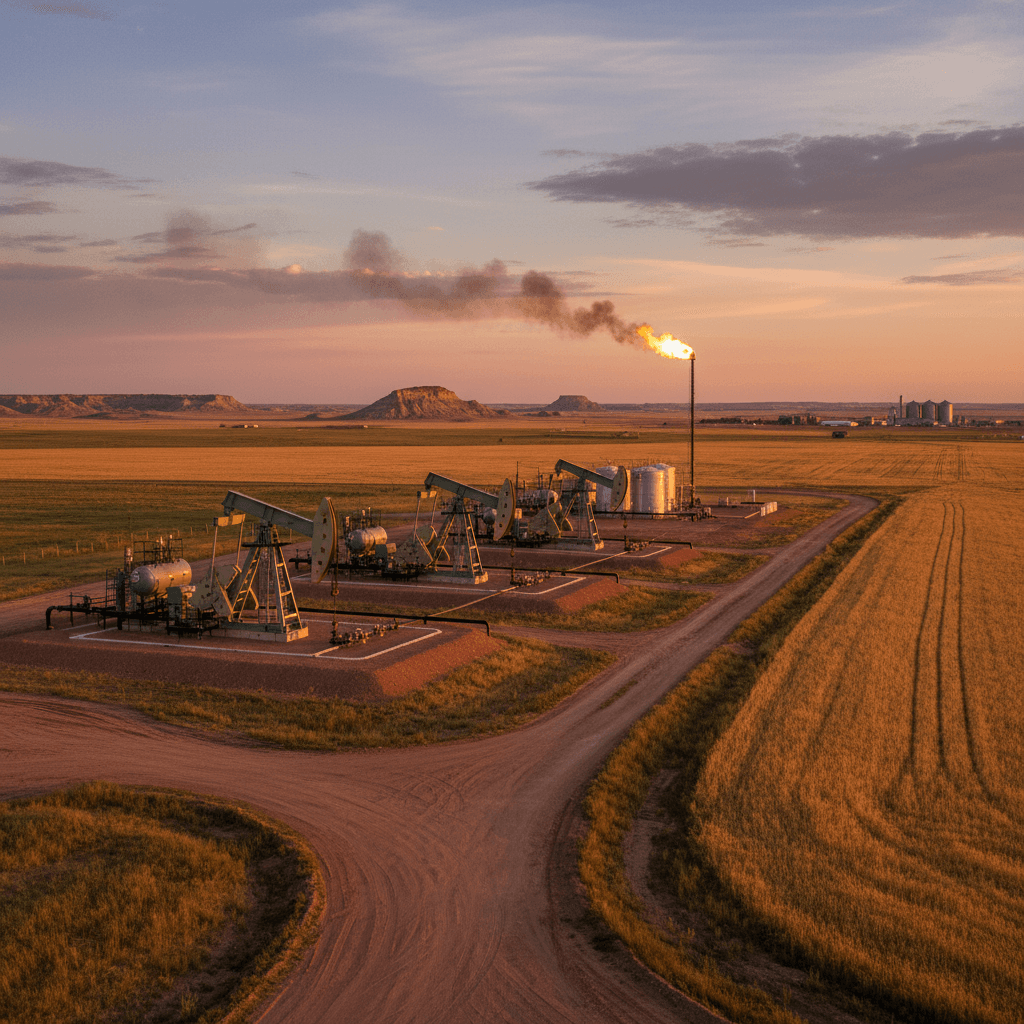
North Dakota Rig Count Holds at 22 as Oil Prices Retreat Sharply
Bakken operators face a potential slowdown as WTI crude drops over 7%, though a stable rig fleet suggests near-term production remains supported.
North Dakota's active drilling rig count held steady at 22 on Tuesday, even as a sharp sell-off in oil markets raised questions about the sustainability of current activity levels. According to live data from Bakken Wire, the benchmark West Texas Intermediate (WTI) crude price fell $7.36 to $91.72 per barrel, a drop of 7.43%. The international Brent benchmark also declined, down $4.36 to $95.00.
The stability of the rig count, a key leading indicator for future oil production, suggests operators in the Bakken formation are maintaining their current drilling programs in the near term. However, the dramatic single-day price plunge introduces significant uncertainty for capital expenditure plans if lower prices persist. Natural gas prices, a secondary revenue stream for many Bakken wells, were recorded at $2.60 per MMBtu.
Historically, the number of active drilling rigs in North Dakota has been a strong predictor of oil production levels approximately six to nine months later. A stable or growing rig count typically leads to increased production, while a sustained decline in rigs precedes a production downturn. The current count of 22 rigs, while low compared to boom periods exceeding 200, has been sufficient in recent years to maintain North Dakota's output at over 1 million barrels per day due to improved drilling efficiency and well productivity.
The immediate production outlook for the Bakken remains largely tied to the existing inventory of drilled but uncompleted wells (DUCs) and the completion pace for recently drilled wells. The current rig fleet will determine the new well supply for the latter half of 2026. The steep drop in oil prices, if it marks the beginning of a sustained lower price environment, could lead operators to reconsider plans and potentially idle rigs, which would impact 2027 production.
For royalty owners and service companies in the Williston Basin, the focus will be on whether operators view the price drop as a temporary correction or a longer-term trend. The Bakken formation remains one of the nation's most prolific oil-producing regions, but its economics are acutely sensitive to changes in the WTI price. The coming weeks will be critical in assessing whether the steady operational tempo indicated by the 22-rig count can withstand the new price pressure.
Source
Bakken Wire Live Data as of Tuesday, April 14, 2026