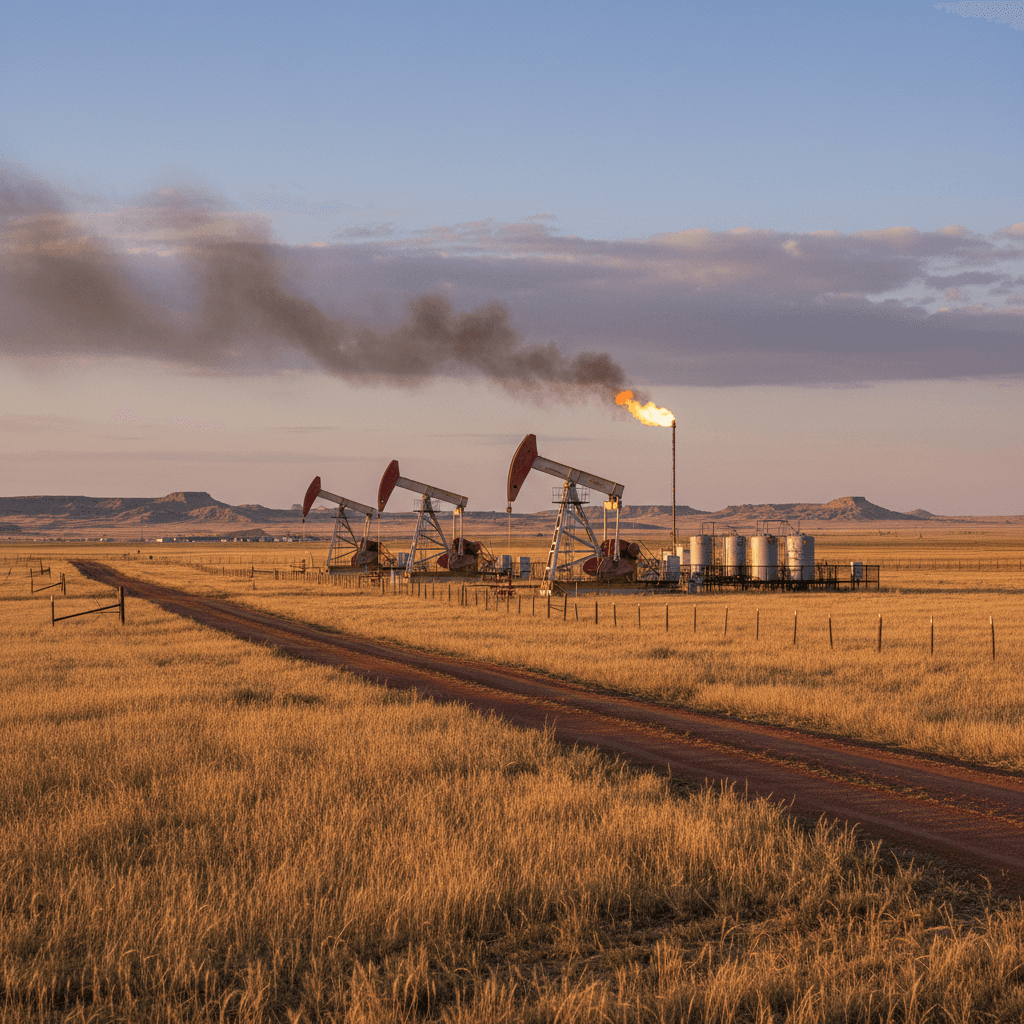
North Dakota Rig Count Holds at 22 as Oil Prices Surge Above $100
Sustained high prices may eventually spur more drilling activity, but current rig levels suggest near-term Bakken production will remain flat.
North Dakota's active drilling rig count held steady at 22 on Saturday, even as global crude benchmarks surged past the $100-per-barrel mark. The price of West Texas Intermediate (WTI) crude settled at $101.02, a gain of $4.10 or 4.23% for the day, according to live Bakken data. The international Brent benchmark also rose sharply to $109.26.
The persistent low rig count, a key indicator of future production, suggests that near-term oil output from the Bakken formation is unlikely to see significant growth. For over a decade, the rig count has served as a leading indicator for production trends in the state, with a typical lag of several months between an increase in drilling activity and a resultant rise in output.
The Bakken's discount to the primary benchmark widened slightly, with Bakken crude priced at a $3.42 per barrel discount to WTI. Natural gas prices were reported at $2.96 per MMBtu.
Historically, a rig count in the low 20s is associated with maintenance-level activity rather than growth. Operators have remained disciplined, focusing on capital returns to shareholders and maximizing production from existing, high-performing wells rather than launching large-scale new drilling campaigns. While oil prices above $100 provide strong cash flow, they have not yet triggered a decisive shift back to aggressive expansion in the basin.
The current environment presents a complex picture for Bakken operators and royalty owners. High prices bolster revenues and well economics, but the lack of a corresponding rise in the rig count indicates that companies are prioritizing financial resilience. Any substantial increase in North Dakota's production, which has plateaued in recent months, would require a sustained period of high prices to justify the significant capital investment needed to deploy more rigs.
For now, the data suggests a continuation of the status quo: strong commodity prices supporting operator balance sheets, but a cautious approach to adding new production capacity. Market watchers will monitor future rig count reports for signs that the high-price signal is finally translating into increased drilling activity in the Williston Basin.
Source
Live Bakken Data for May 16, 2026