WTI Crude--
Brent Crude--
Natural Gas--
ND Rig Count--
WTI Crude--
Brent Crude--
Natural Gas--
ND Rig Count--
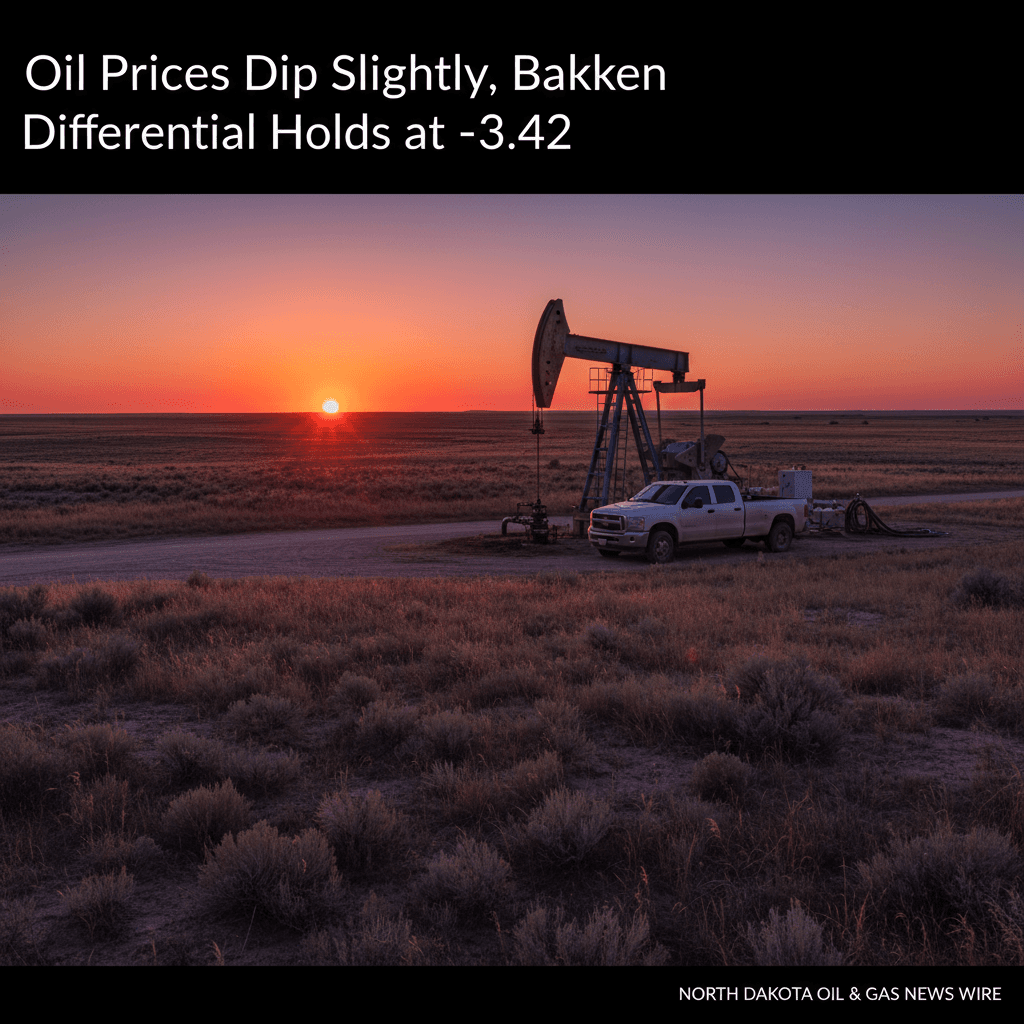
Oil Prices Dip Slightly, Bakken Differential Holds at -$3.42 - Bakken Wire
Oil Prices

Oil Prices Dip Slightly, Bakken Differential Holds at -$3.42

WTI and Brent crude see modest declines amid broader market pressure, while Bakken's pricing discount remains narrow.

Bakken Wire Staff·🔆Midday Wire·

Front-month WTI crude futures traded at $83.40 per barrel on Saturday, down $0.13 or 0.16% from the prior settlement. Global benchmark Brent crude fell to $88.10, a decline of $0.42 or 0.47%. Natural gas prices also edged lower, trading at $2.89, down $0.03.

The slight pullback in oil prices reflects a continuation of recent trading patterns, with markets balancing steady demand against ongoing global economic concerns. For Bakken producers, the key local price indicator—the Bakken differential—held steady at a discount of $3.42 per barrel versus the WTI benchmark. This relatively narrow differential is a positive signal for operator revenues, as it indicates strong demand and efficient takeaway capacity for North Dakota crude.

A narrow differential, such as the current -$3.42, means Bakken producers receive a price much closer to the national benchmark. When applied to the current WTI price of $83.40, it implies a wellhead price in the region of approximately $79.98 per barrel before further local adjustments. At this level, the majority of drilling in the core Bakken formation remains economically viable, supporting stable production and cash flow for operators and royalty owners.

The price movement comes as traders monitor fundamental indicators including U.S. crude inventory levels and OPEC+ production policy. While not explicitly moving markets today, the overarching supply discipline from major producers has helped establish a floor under prices in the low-$80s for WTI. Natural gas prices remain subdued, continuing a trend of weak pricing that limits the economic incentive for gas-directed drilling in the Bakken, where production is primarily oil-weighted.

For North Dakota, sustained oil prices above $80 per barrel, coupled with a stable differential, support state tax revenues and county-level budgets that are heavily dependent on oil extraction taxes and royalties. The current price environment is conducive to maintaining the state's production plateau, which has hovered around 1.3 million barrels per day in recent months, without triggering a significant new wave of aggressive drilling expansion.

Source

Bakken Wire Live Price Data
wtibrentbakken differentialoil pricesnatural gasbakken operatorsnorth dakota

Share this article

Related Articles

Oil Prices Surge as OPEC+ Signals Production Discipline - Bakken Wire
Oil Prices

Oil Prices Surge as OPEC+ Signals Production Discipline

Oil prices posted strong gains in Monday trading, with West Texas Intermediate (WTI) crude climbing nearly 2% to settle above $101 per barrel. The rally was driven by signals from OPEC+ that the producer group would maintain its current output restraint, tightening the outlook for global supply. The front-month WTI contract settled at $101.94 per barrel, a gain of $1.89 or 1.89% on the day, according to live price data. The international benchmark Brent crude rose $1.71 to $106.32 per barrel. The price strength comes as OPEC+ ministers, meeting this week, are expected to reaffirm their existing production cuts. This discipline is seen as a key factor supporting prices amid uncertain global demand growth. For Bakken producers, the higher benchmark price is a positive signal, though the region's crude continues to trade at a discount. The Bakken differential to WTI was quoted at -$3.42 per barrel on Monday. This means...

🌅Afternoon Wire·Sep 14
Oil Prices Surge Over $102 Amid Supply Risks, Record Shipping Costs - Bakken Wire
Oil Prices

Oil Prices Surge Over $102 Amid Supply Risks, Record Shipping Costs

Oil prices rallied strongly on Monday, with West Texas Intermediate crude trading at $102.84 per barrel, a midday gain of $2.79 or 2.79%, according to live price data. Brent crude followed, rising 2.65% to $107.38. The Bakken crude differential held at a discount of $3.42 versus WTI. A key driver of the price surge is escalating supply chain costs and risks for non-U.S. crude. According to OilPrice.com, record-high freight costs are squeezing Russia's Black Sea crude exports. Aframax tanker rates from the port of Novorossiysk to India and China rose for a seventh consecutive week, reaching all-time highs of $23.20 and $25.70 per barrel, respectively. The report attributes the soaring costs to a tanker shortage, heightened risks from Ukrainian attacks on export infrastructure, and increased insurance premiums. These logistical bottlenecks and geopolitical risks effectively tighten the global supply of seaborne crude, supporting higher benchmark prices. Meanwhile, the U.S. Energy Information...

🔆Midday Wire·Sep 14
Oil Prices Surge Past $100, Bakken Differential Holds at -$3.42 - Bakken Wire
Oil Prices

Oil Prices Surge Past $100, Bakken Differential Holds at -$3.42

Oil prices surged sharply higher on Monday, with West Texas Intermediate (WTI) crude trading above $103 per barrel. The front-month WTI contract was at $103.36, a gain of $3.31 or 3.31% for the session, according to live price data. The global benchmark, Brent crude, traded at $108.36, up $3.75. The price for Bakken crude at the Clearbrook, Minnesota, hub held a differential of -$3.42 per barrel versus WTI. The rally extends significant gains from last week, with OilPrice.com reporting a weekly gain of 8%. The conflict in the Middle East continues to be the primary driver, with Saxo Bank, cited by Rigzone, noting Brent spiked to $108.49 per barrel at the Asian market opening. "People are finally waking up to the risk that the Iran war will be prolonged, and so relief is no longer in sight for energy prices," MPA Macro analyst Derek Tang told OilPrice.com. Fundamental data is...

☀️Morning Wire·Sep 14