WTI Crude--
Brent Crude--
Natural Gas--
ND Rig Count--
WTI Crude--
Brent Crude--
Natural Gas--
ND Rig Count--
Oil Prices Drop Over 1.5% as Saudi Arabia Restarts Red Sea Loadings - Bakken Wire
Oil Prices

Oil Prices Drop Over 1.5% as Saudi Arabia Restarts Red Sea Loadings

WTI falls to $91.13 amid easing Middle East supply concerns; Bakken differential holds at -$3.42.

Bakken Wire Staff·☀️Morning Wire·

Oil prices fell sharply in Tuesday morning trading as the restart of a key Saudi Arabian export route eased global supply concerns. West Texas Intermediate (WTI) crude was down $1.47, or 1.59%, to trade at $91.13 per barrel, according to live price data. The international benchmark Brent crude declined $1.42 (-1.45%) to $96.41.

The price decline follows news that Saudi Arabia has restarted crude oil loadings at the Yanbu port on the Red Sea. According to a report from OilPrice.com, the resumption came after the East-West pipeline resumed partial service. The pipeline, which helps Saudi Arabia bypass the Strait of Hormuz, had been shut down for two weeks following drone attacks on pumping stations on September 10.

The restart is increasing global oil supply. Satellite imagery from Sunday showed Saudi Arabia loading nearly 10 million barrels of crude oil at Yanbu and the Al Muajjiz terminal, according to TankerTrackers.com cited in the report. Crude oil loadings at Yanbu have been around 2 million barrels per day since last week, according to trade source estimates.

For Bakken operators, the price drop directly impacts the realized price for their crude. The Bakken differential—the discount at which Bakken crude trades versus WTI at the Cushing, Oklahoma hub—was holding at -$3.42 on Tuesday morning. This means Bakken crude is priced at approximately $87.71 per barrel, factoring in the wider market decline.

The easing of the supply disruption from Saudi Arabia is a primary driver behind Tuesday's price pressure. Before the restart, the outage had contributed to a tighter global market and supported higher prices. The report notes that full resumption of the pipeline's flows, which can reach about 4 million barrels per day, will likely take weeks. However, the immediate return of Red Sea loadings is a bearish signal for the market.

The development underscores the continued sensitivity of global oil prices to geopolitical events and supply logistics in key producing regions. While the situation in the Middle East remains fluid with continued Houthi threats to shipping, the immediate restart of this critical export route has provided relief to physical markets.

For North Dakota producers, the dip in the overall benchmark price narrows revenue margins. Operators will watch whether the downward move is sustained or if other factors, such as U.S. inventory levels or broader OPEC+ policy, provide renewed support. The stable Bakken differential suggests regional pipeline and rail logistics are functioning normally, with the local price moving in lockstep with the national benchmark's decline.

Source

Live Price Data, OilPrice.com report citing Reuters, TankerTrackers.com, and Kpler.
oil priceswtibrentbakken differentialsaudi arabiared seasupply disruptiongeopolitics

Share this article

Related Articles

Oil Prices Climb Over 1% as OPEC+ Signals Extended Cuts - Bakken Wire
Oil Prices

Oil Prices Climb Over 1% as OPEC+ Signals Extended Cuts

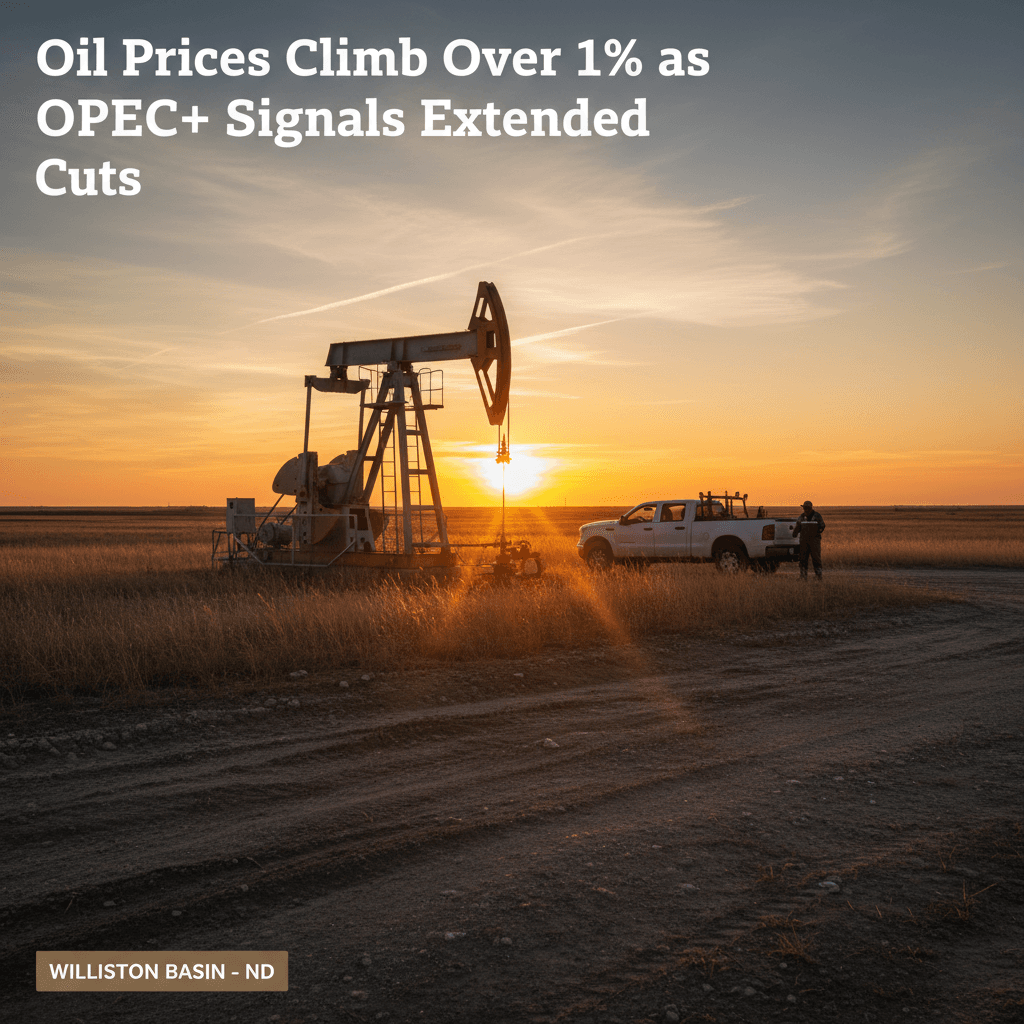
Front-month crude oil futures rallied more than 1% in Monday trading, with global benchmark Brent crude nearing the $99 per barrel mark. The gains were fueled by expectations that the OPEC+ producer group will maintain its current output restraints. According to live price data, West Texas Intermediate (WTI) crude for November delivery settled at $93.43 per barrel, an increase of $1.02 or 1.1%. The international benchmark, Brent crude, rose $1.26 to $98.70 per barrel, a gain of 1.29%. The rally was underpinned by signals from OPEC+ delegates that the coalition is likely to extend its current production cuts into the fourth quarter when it meets in early October. This ongoing supply discipline continues to tighten the global market, providing a floor under prices. For Bakken operators, the price received at the wellhead is typically priced at a discount to WTI at the Clearbrook, Minnesota, or Guernsey, Wyoming, hubs. The live...

🌅Afternoon Wire·Sep 28
Oil Prices Surge Past $94, Brent Nears $100 as OPEC+ Extends Cuts - Bakken Wire
Oil Prices

Oil Prices Surge Past $94, Brent Nears $100 as OPEC+ Extends Cuts

Front-month WTI crude futures surged 2.62% to $94.83 per barrel in midday trading Monday, while Brent crude climbed 2.25% to $99.63, according to live price data. The rally brings Brent within striking distance of the $100 psychological threshold. The sharp price increase follows the official confirmation over the weekend that the OPEC+ alliance will extend its current production cuts through the end of the year. The group, which includes Saudi Arabia and Russia, is maintaining a reduction of nearly 2 million barrels per day from the market in an effort to bolster prices. The price jump provides an immediate revenue boost for Bakken shale operators. The discount for Bakken crude at the wellhead, known as the differential, was recorded at $3.42 below WTI, according to midday data. This means Bakken crude is priced at approximately $91.41 per barrel. A strong WTI price directly translates to higher realizations for local producers,...

🔆Midday Wire·Sep 28
WTI Surges Past $95, Brent Tops $100 on Geopolitical Tensions - Bakken Wire
Oil Prices

WTI Surges Past $95, Brent Tops $100 on Geopolitical Tensions

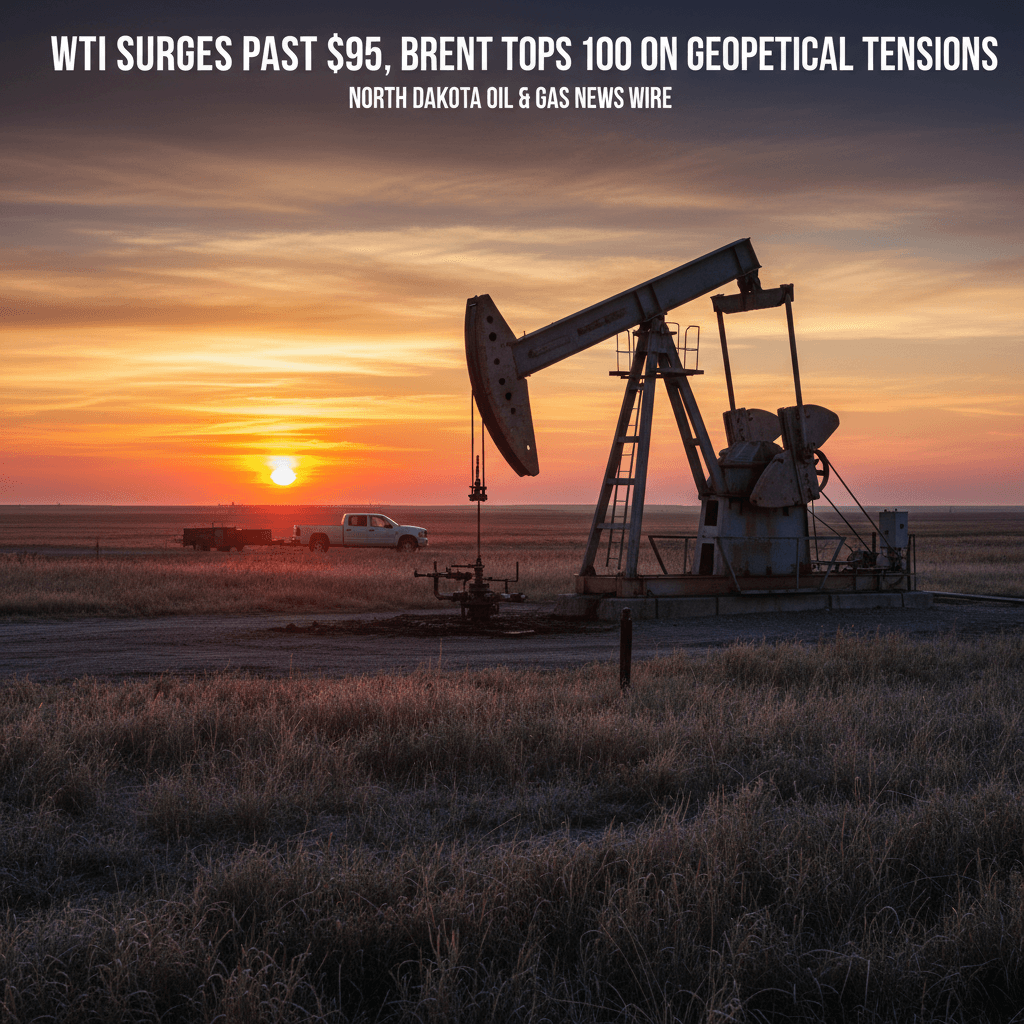
Oil prices surged in early Monday trading, with West Texas Intermediate (WTI) crude crossing the $95 per barrel mark as renewed geopolitical friction and supply concerns bolstered the market. WTI settled at $95.74, a gain of $3.33 or 3.6% for the day. The global benchmark, Brent crude, broke through the $100 threshold to $100.52, up $3.08 or 3.16%. The primary driver of the rally was a stalemate between the United States and Iran over negotiations to reopen the Strait of Hormuz, a critical chokepoint for global energy shipments. According to OilPrice.com, U.S. President Donald Trump rejected an Iranian proposal to begin peace talks over the weekend, rekindling fears that liquefied natural gas (LNG) and oil supply through the strait would not return to normal soon. This comes as Europe approaches winter with historically low gas storage levels. The price move was reflected in intraday trading, with Rigzone reporting Brent oil...

☀️Morning Wire·Sep 28