WTI Crude--
Brent Crude--
Natural Gas--
ND Rig Count--
WTI Crude--
Brent Crude--
Natural Gas--
ND Rig Count--
Oil Prices Drop Sharply as Demand Concerns Weigh on Market - Bakken Wire
Oil Prices

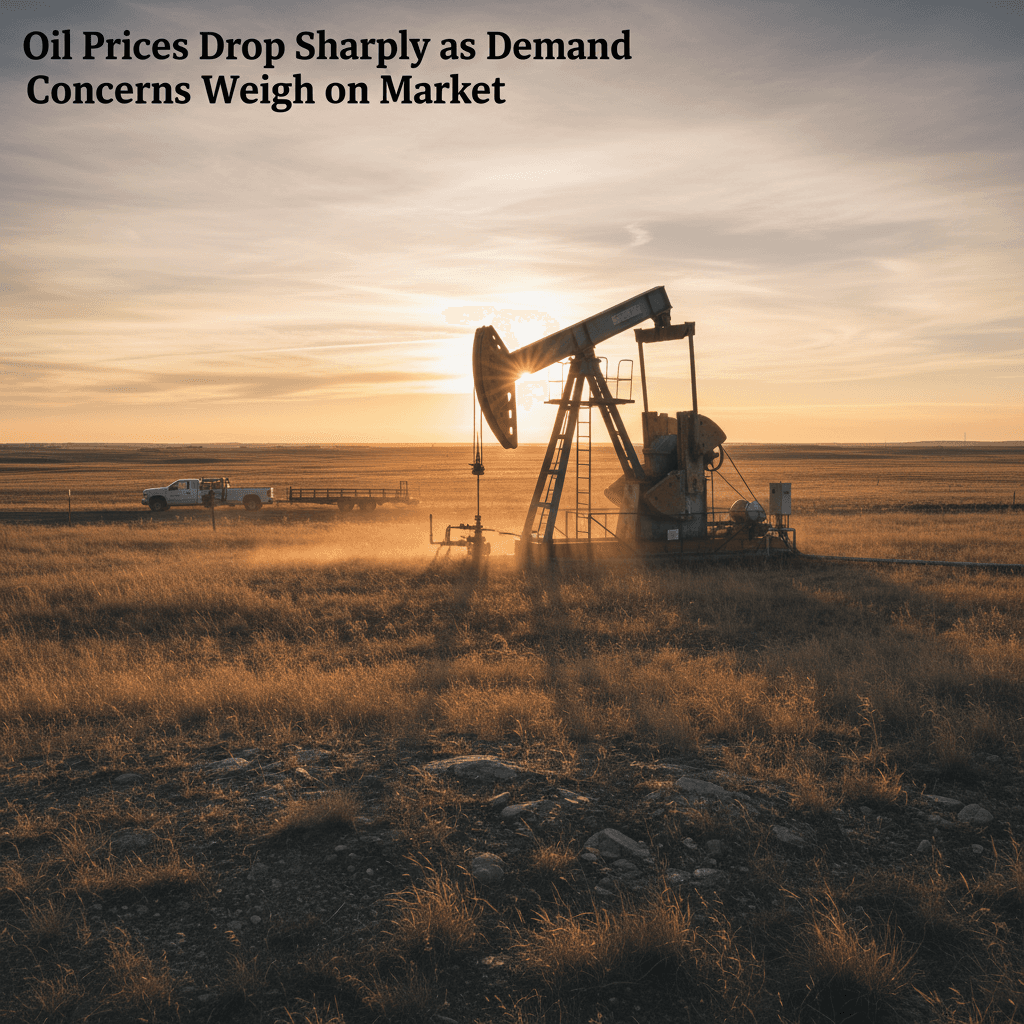
Oil Prices Drop Sharply as Demand Concerns Weigh on Market

WTI crude fell over 2% to $90.50, with the Bakken discount widening to $3.42 per barrel below the benchmark.

Bakken Wire Staff·🔆Midday Wire·

Oil prices retreated sharply in midday trading Tuesday, with the U.S. benchmark falling over 2% amid growing concerns over the strength of global fuel demand. West Texas Intermediate (WTI) crude for November delivery was trading at $90.50 per barrel, down $2.10 or 2.27% on the day. The international benchmark, Brent crude, was at $96.53, a decline of $1.33 per barrel.

The price drop pressured the local Bakken crude differential. According to live price data, Bakken crude was priced at a discount of $3.42 per barrel versus WTI at midday. This represents a weakening from recent levels and directly impacts the wellhead revenue for producers in the North Dakota shale play.

The midday sell-off was primarily attributed to heightened anxiety over economic growth and its impact on oil consumption. Market analysts pointed to renewed fears of a potential slowdown, which could erode demand for gasoline, diesel, and other petroleum products. This sentiment outweighed ongoing geopolitical tensions that have previously supported prices.

For Bakken operators, the price movement underscores the volatile and sentiment-driven nature of the current market. A nearly $3 per barrel contraction in the Bakken differential, combined with the significant drop in the underlying WTI price, translates to a direct hit to cash flow. Operators with unhedged production are most exposed to these intraday swings.

Natural gas prices also edged lower Tuesday, with the front-month contract trading at $3.06 per MMBtu, down $0.05. While less dramatic than the oil move, the softer gas price provides limited upside for operators focusing on associated gas production from Bakken wells.

The broader price decline comes despite production discipline from major oil-producing nations and generally tight global inventories. However, these supportive fundamentals were overshadowed Tuesday by the dominant narrative of demand uncertainty. Traders are closely monitoring for any signs of weakening consumption data or downward revisions to economic forecasts.

The midday price action serves as a reminder to the Bakken industry of the market's sensitivity to macroeconomic headlines. While prices remain at historically robust levels, rapid corrections can quickly alter drilling economics and operational plans. Operators will be watching for whether this sell-off represents a short-term adjustment or the beginning of a more sustained downtrend.

Source

Bakken Wire Live Price Data
oil priceswtibrent crudebakken differentialnatural gas pricesmarket updatebakken operators

Share this article

Related Articles

WTI Rises to $88.7 as Brent Advances to $95.8 - Bakken Wire
Oil Prices

WTI Rises to $88.7 as Brent Advances to $95.8

Oil markets moved higher in Thursday afternoon pricing, with WTI crude at $88.7, up $2.17, or 2.51%, according to live market data. Brent crude rose $3.04, or 3.28%, to $95.8. Natural gas also advanced, gaining $0.15 to $3.37. The Bakken differential was quoted at -$3.42 against WTI, indicating that North Dakota barrels were trading at a discount to the U.S. benchmark. Applying the quoted differential to WTI implies a Bakken reference price of $85.28. For Bakken operators, the move higher in both WTI and Brent improves the revenue environment for oil production, while the natural gas gain supports value from associated gas streams. For royalty owners, higher benchmark prices generally raise the value of produced volumes, though the local discount can reduce the realized price compared with the WTI quote. The price move was not attributed in the available market data to a specific inventory, OPEC or policy catalyst. The...

🌅Afternoon Wire·Nov 12
Oil Prices Rise as EIA Lifts 2026, 2027 Forecasts - Bakken Wire
Oil Prices

Oil Prices Rise as EIA Lifts 2026, 2027 Forecasts

Oil prices moved higher Thursday morning in North Dakota and national benchmark trading as the U.S. Energy Information Administration raised its Brent oil spot price forecasts for 2026 and 2027 yet again, according to Rigzone. At midday, WTI crude was $86.92 a barrel, up $0.39, or 0.45%. Brent crude was $93.83, up $1.07, or 1.15%. The spread between Brent and WTI stood at $6.91, based on the midday quotes. Natural gas was $3.30, up $0.09. Rigzone reported the EIA update in its latest short-term energy outlook. The report did not detail the new forecast levels in the summary provided to Bakken Wire, but the agency’s repeated increases in 2026 and 2027 Brent spot price forecasts were the most prominent news item in the midday tape. For Bakken operators, the price action has two sides. Higher benchmark crude prices and revised EIA forecasts improve the revenue outlook for producers selling oil...

🔆Midday Wire·Nov 12
Oil Prices Dip as Supply Disruptions Ease, Bakken Differential Holds at -$3.42 - Bakken Wire
Oil Prices

Oil Prices Dip as Supply Disruptions Ease, Bakken Differential Holds at -$3.42

Oil prices declined in morning trading on Thursday, with West Texas Intermediate (WTI) crude down 0.86% to $85.79 per barrel. The international benchmark Brent crude also fell, dropping 0.67% to $92.14, according to live price data. The price of Bakken crude, a key grade for North Dakota producers, traded at a discount of $3.42 per barrel below WTI. The modest price pullback coincides with reports that crude supply routes from the Persian Gulf are materially recovering. According to a report from OilPrice.com, India has imported more oil from the Persian Gulf than from Russia so far in November—the first time since the Iran war began nine months ago. Data from Kpler cited by Bloomberg shows India imported an estimated 2.1 million barrels per day (bpd) from the Gulf this month, compared to 1.8 million bpd from Russia. This shift signals a significant rebound in shipments through the critical Strait of...

☀️Morning Wire·Nov 12