WTI Crude--
Brent Crude--
Natural Gas--
ND Rig Count--
WTI Crude--
Brent Crude--
Natural Gas--
ND Rig Count--
Oil Prices Edge Higher; Bakken Crude Still Discounts WTI - Bakken Wire
Oil Prices

Oil Prices Edge Higher; Bakken Crude Still Discounts WTI

WTI gains 39 cents to $91.85, while the Williston Basin differential remains minus $3.42.

Bakken Wire Staff·🔆Midday Wire·

Oil prices moved modestly higher in midday data on Saturday, Oct. 10, 2026, with U.S. benchmark WTI crude at $91.85 per barrel and international benchmark Brent crude at $104.72 per barrel.

WTI rose $0.36, or 0.39%, according to Bakken Wire price data. Brent increased $0.44, or 0.42%. Natural gas was priced at $3.22 per million British thermal units, up $0.05 from the prior reading.

For North Dakota producers, the most closely watched number may be the Bakken differential, which stood at minus $3.42 against WTI. That spread means Bakken crude is selling at a discount to the U.S. benchmark. Applying the differential to WTI implies a Bakken netback of roughly $88.43 per barrel before transportation, processing, marketing and royalty deductions.

The discount is a familiar feature of Williston Basin crude markets. Bakken barrels can trade below WTI because of regional logistics, refinery configurations and the balance between local production and takeaway capacity. For operators, the size of the differential can matter as much as the headline WTI price. A stable discount preserves the gap between benchmark and realized revenue; a widening discount would compress margins, while a narrowing discount would improve cash flow per barrel.

At $91.85 WTI and an $88.43 implied Bakken netback, producers are operating in a high-price environment compared with many recent cycles, but the differential remains a drag on basin-level realizations. The $3.42 spread equals about 3.7% of WTI. In a large field, that difference can translate into meaningful lost revenue for operators and royalty owners, particularly when multiplied across thousands of barrels produced each day.

Natural gas added a smaller supportive note. The $3.22 price, up 5 cents, matters in the Williston Basin because much of the region’s production is oilfield-associated gas. For Bakken operators, gas sales can help offset pipeline, compression and processing costs tied to producing oil. A firmer gas price can also improve the economics of gathering, treating and transporting associated gas to market.

The data did not point to a single named catalyst, but the direction of the benchmarks and the natural gas price was uniformly higher. For Bakken producers, the immediate takeaway is that oil prices are firming, but basin discounts remain in place. Royalty owners and operators will be watching whether the Bakken differential tightens as regional demand, infrastructure and market access evolve.

In practical terms, the Saturday midday picture leaves WTI above $90, Brent above $100, natural gas above $3 and Bakken crude at a measurable discount. Those levels support cash flow across the Williston Basin, but they also underscore why regional price differentials are a central part of North Dakota oil economics.

Source

Bakken Wire midday live price data

oil priceswtibrentnatural gasbakken differentialwilliston basinnorth dakota

Share this article

Related Articles

Oil Prices Edge Higher Amid Global Diesel Crunch, Strategic Stock Releases - Bakken Wire
Oil Prices

Oil Prices Edge Higher Amid Global Diesel Crunch, Strategic Stock Releases

Front-month crude oil futures posted modest gains in early trading Saturday, with West Texas Intermediate (WTI) at $91.85 per barrel and Brent crude at $104.72. The price for Bakken crude at the Clearbrook, Minnesota, hub is estimated at a $3.42 discount to WTI, trading around $88.43. The incremental price rise occurs against a backdrop of tightening refined product markets, particularly for diesel. According to a report from OilPrice.com, the United States is on track to produce a record 13.8 million barrels per day (bpd) of crude in 2026, yet distillate inventories remain critically low. The Energy Information Administration (EIA) expects these stocks to stay below the five-year range through much of 2027, potentially falling below 100 million barrels for the first time in over two decades. This diesel shortage persists despite high refinery runs, with U.S. facilities operating at roughly 96% of capacity in the third quarter. The bottleneck, OilPrice.com...

☀️Morning Wire·Oct 10
Oil Prices Hold Near 2026 Highs as Bakken Differential Widens - Bakken Wire
Oil Prices

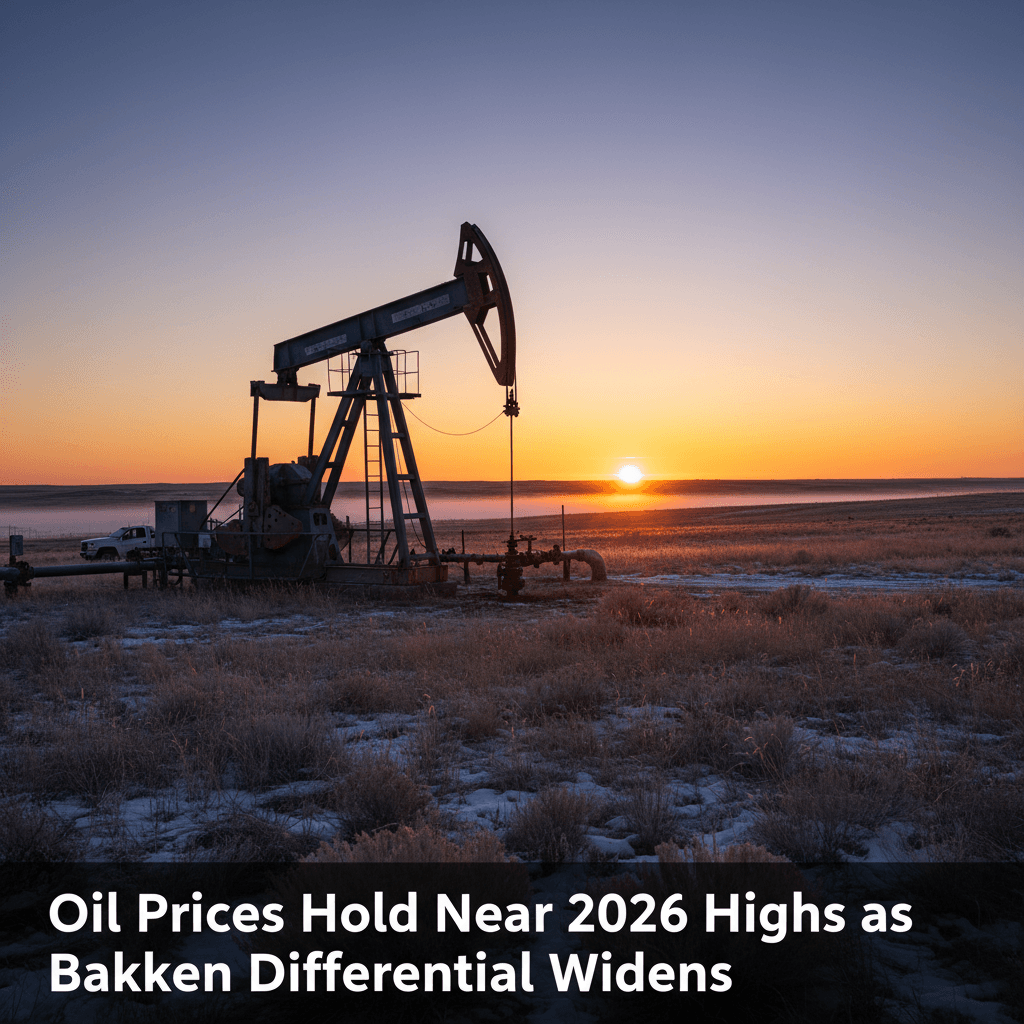
Oil Prices Hold Near 2026 Highs as Bakken Differential Widens

Oil prices held steady at multi-year highs on Friday, October 9, 2026, with global supply concerns continuing to provide a floor for the market. West Texas Intermediate (WTI) crude for November delivery settled at $91.61 per barrel, a gain of $0.12 (0.13%). The global benchmark, Brent crude, added $0.02 to reach $104.30 per barrel. The price strength leaves both benchmarks near their highest levels since 2022, a positive sign for producer cash flow. However, the discount for Bakken crude at the wellhead expanded. The Bakken differential was quoted at -$3.42 per barrel versus WTI, meaning Bakken barrels are fetching approximately $88.19. Natural gas prices also saw a slight uptick, rising $0.03 to $3.20 per MMBtu. The sustained high price environment is primarily driven by ongoing geopolitical tensions and disciplined production management from major exporting nations. Market analysts point to continued OPEC+ supply restraint and persistent concerns over potential disruptions to...

🌅Afternoon Wire·Oct 9
WTI, Brent Hold Above $91 and $104 as U.S. Crude Stocks Decline - Bakken Wire
Oil Prices

WTI, Brent Hold Above $91 and $104 as U.S. Crude Stocks Decline

Crude oil prices held firm in midday trading Friday, with West Texas Intermediate and Brent crude maintaining levels above $91 and $104 per barrel, respectively. According to live price data, WTI was trading at $91.88, a gain of $0.39 or 0.43% on the day. The global benchmark, Brent crude, was at $104.48, up $0.20. The price support follows a U.S. government report showing a significant drawdown in commercial crude inventories. According to Rigzone, citing data from the Energy Information Administration, commercial crude oil stocks, excluding the Strategic Petroleum Reserve, fell to 424.134 million barrels for the week ending October 2. This represents a drop of over 3 million barrels from the prior week. This larger-than-expected inventory decline is a key fundamental driver for prices, indicating stronger demand or tighter supply than anticipated. The draw has helped offset other macroeconomic concerns, keeping crude futures in positive territory. For Bakken producers, the...

🔆Midday Wire·Oct 9