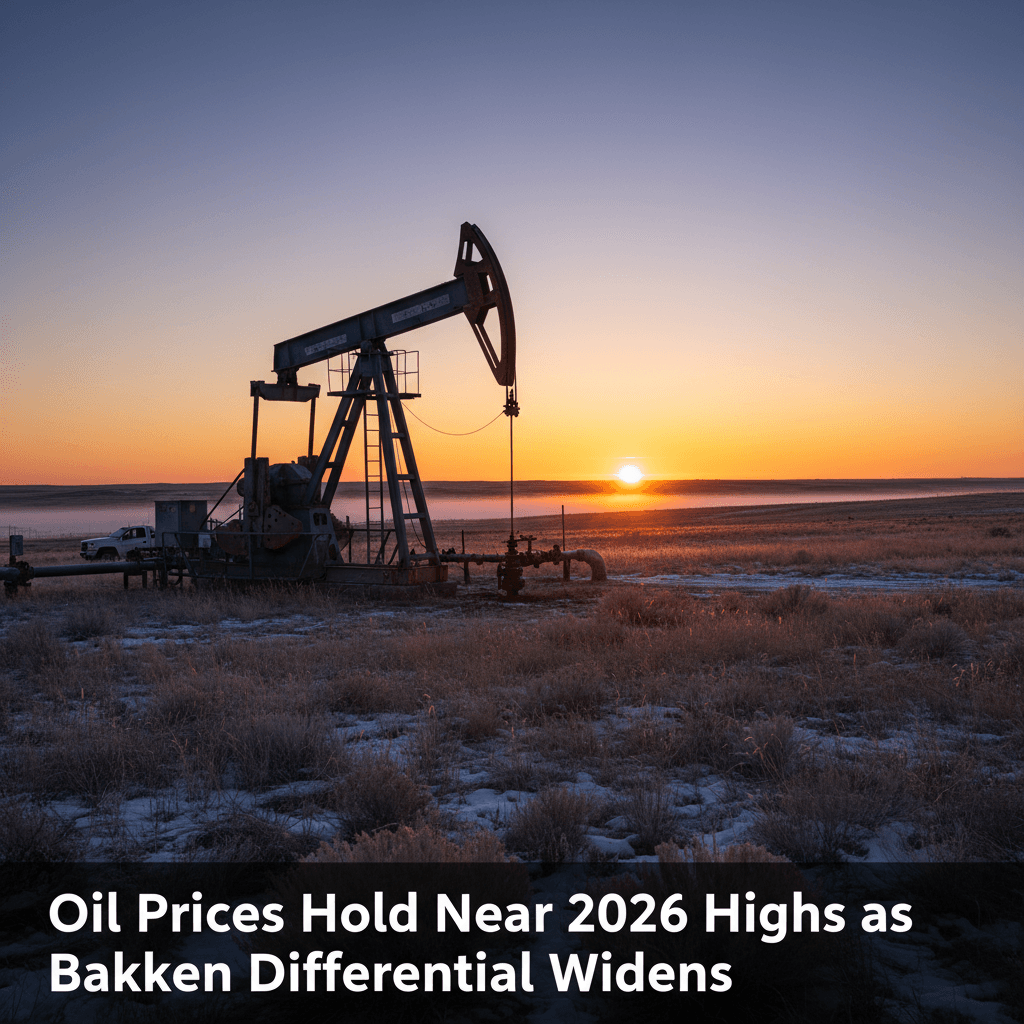
Oil Prices Hold Near 2026 Highs as Bakken Differential Widens
WTI and Brent crude post modest gains while the Bakken discount to the benchmark expands, pressuring local wellhead revenues.
Oil prices held steady at multi-year highs on Friday, October 9, 2026, with global supply concerns continuing to provide a floor for the market. West Texas Intermediate (WTI) crude for November delivery settled at $91.61 per barrel, a gain of $0.12 (0.13%). The global benchmark, Brent crude, added $0.02 to reach $104.30 per barrel.
The price strength leaves both benchmarks near their highest levels since 2022, a positive sign for producer cash flow. However, the discount for Bakken crude at the wellhead expanded. The Bakken differential was quoted at -$3.42 per barrel versus WTI, meaning Bakken barrels are fetching approximately $88.19.
Natural gas prices also saw a slight uptick, rising $0.03 to $3.20 per MMBtu.
The sustained high price environment is primarily driven by ongoing geopolitical tensions and disciplined production management from major exporting nations. Market analysts point to continued OPEC+ supply restraint and persistent concerns over potential disruptions to Middle Eastern shipments as key bullish factors. These elements have helped offset worries about slowing global economic growth and its impact on future fuel demand.
For Bakken operators, the wide differential presents a mixed picture. While benchmark prices above $90 are highly supportive for drilling budgets and shareholder returns, the larger-than-usual discount directly impacts the price received at the wellhead. A differential of -$3.42 per barrel represents a more significant haircut compared to historical norms, squeezing margins for some producers.
The widened spread can be attributed to several regional factors, including pipeline maintenance schedules, fluctuations in regional refinery demand, and competition with Canadian crude imports into the U.S. Midwest. Transportation constraints, while less severe than in the past, can still periodically pressure local prices when takeaway capacity is temporarily limited.
Despite the differential, the overall high price environment remains a net positive for the North Dakota oil patch. Prices at these levels support active drilling programs and can make even marginal wells economically viable. The state's rig count and production levels are likely to remain stable as operators capitalize on strong revenues.
Market participants will be closely watching upcoming inventory reports from the U.S. Energy Information Administration and any developments from the next OPEC+ meeting for signals on the market's next move. For now, the backdrop of tight global supply continues to underpin prices.
Source
Bakken Wire Live Price Data