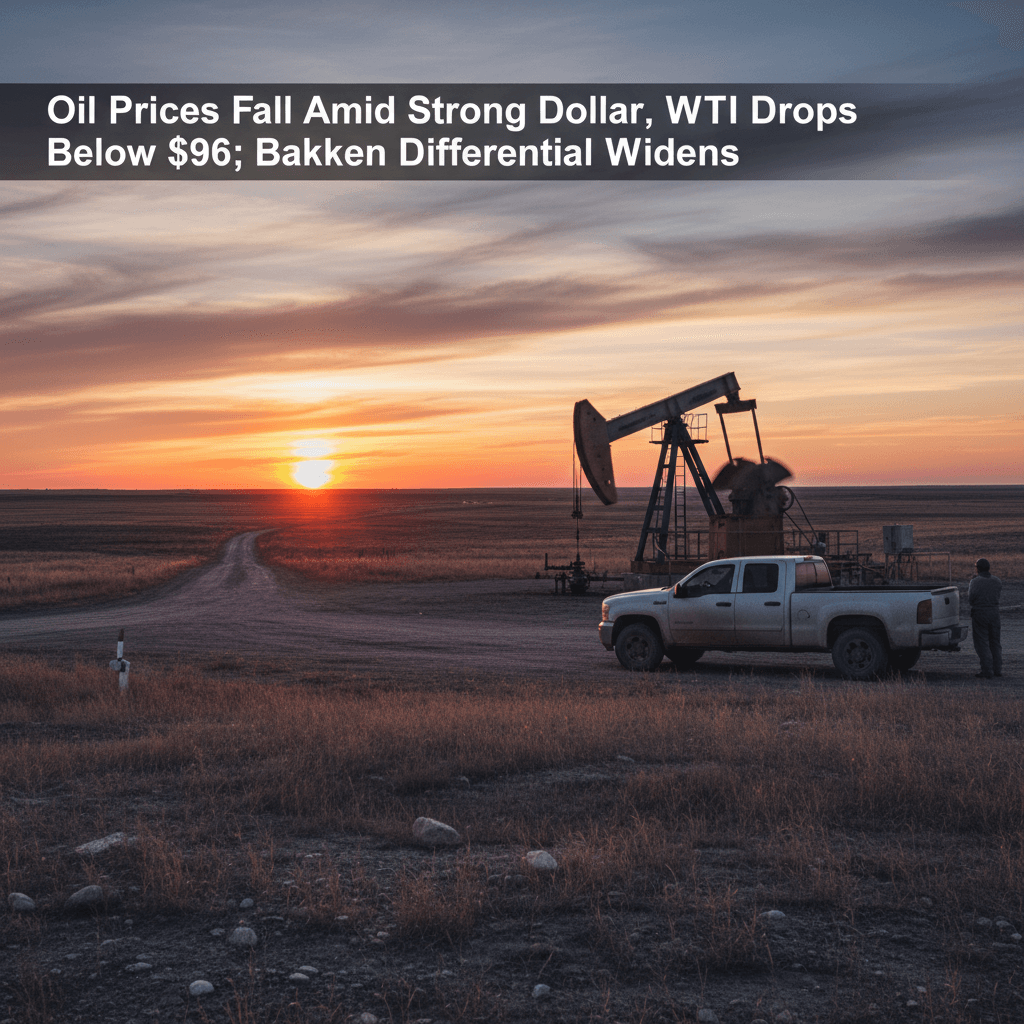
Oil Prices Fall Amid Strong Dollar, WTI Drops Below $96; Bakken Differential Widens
Brent holds near $99 as a rising U.S. dollar pressures crude, while Bakken crude trades at a wider discount to the benchmark.
Oil prices retreated in early trading Saturday, with the U.S. benchmark pressured by a strengthening dollar. West Texas Intermediate crude fell 1.18% to trade at $96.08 per barrel, down $1.15 from the prior settlement. The global benchmark Brent crude was also lower, down $0.64 to $99.29 per barrel, according to live price data.
The movement comes as the U.S. dollar index has climbed to multi-month highs, making dollar-priced crude more expensive for holders of other currencies and typically dampening demand. This financial market pressure is outweighing otherwise supportive fundamentals for the physical market, including ongoing OPEC+ production restraint and firm seasonal demand.
For Bakken producers, the local price realized is directly tied to the WTI benchmark minus a regional differential. That differential widened slightly, with Bakken crude priced at a discount of $3.42 per barrel below WTI. This means Bakken wellhead pricing is effectively around $92.66 per barrel based on the current WTI price.
The price environment remains highly constructive for operators in the Williston Basin, with both benchmarks holding well above levels needed to support economic drilling and completion activity. However, the widening differential highlights the ongoing logistical and quality adjustments inherent in marketing Bakken crude, which must be transported to major hubs.
Natural gas prices showed minimal movement, edging up one cent to $2.91 per MMBtu. This continued low price environment for natural gas provides little incentive for increased gas-directed drilling in the region, keeping operator focus squarely on crude oil production from the Bakken and Three Forks formations.
While the daily dip is notable, the overall price trajectory for the quarter remains strong. Sustained prices above $90 per barrel for WTI support robust cash flows for North Dakota operators, enabling continued activity to hold production steady and potentially fund modest growth in the core of the play. Market participants will be watching for the weekly U.S. inventory data next week for further signals on supply and demand balance.
Source
Live Price Data