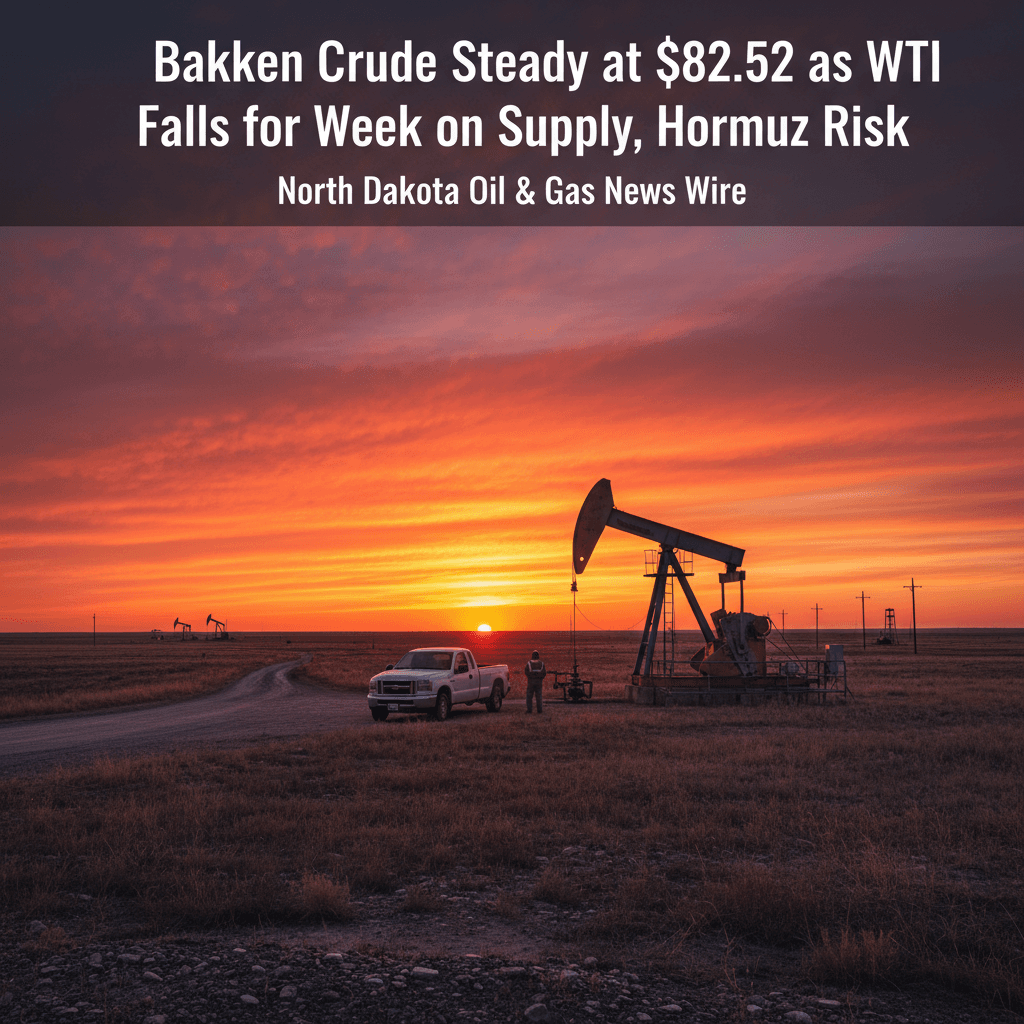
Oil Prices Mixed as Crude Stocks Build, Bakken Differential Holds at -$3.42
WTI crude edges higher despite a reported weekly inventory increase, while natural gas prices slip lower.
Oil prices were mixed in midday trading Friday, November 20, 2026, as a reported increase in U.S. crude inventories weighed on the market. West Texas Intermediate (WTI) crude was trading at $82.47 per barrel, a marginal gain of three cents, according to live price data. The international benchmark Brent crude fell 49 cents to $89.00.
The price for Bakken crude, a key grade for North Dakota producers, held at a discount of $3.42 per barrel below WTI. This differential is a critical metric for local operators' realized prices and revenue.
A key factor pressuring the market was data showing a rise in U.S. commercial crude stocks. According to a report from Rigzone citing the U.S. Energy Information Administration's (EIA) latest weekly petroleum status report, commercial crude oil inventories, excluding the Strategic Petroleum Reserve, increased to 417.797 million barrels for the week ending November 13.
In other market news, Rigzone reported that the "war premium" for U.S. sour crude has vanished, indicating a potential easing of certain geopolitical supply concerns that had previously supported certain crude grades.
The natural gas market also saw downward pressure. The Henry Hub spot price was trading at $3.66 per barrel, down two cents. This aligns with a broader outlook from the EIA, which, according to a separate Rigzone report, projected that the Henry Hub spot price will drop in both 2026 and 2027 in its latest Short-Term Energy Outlook.
For Bakken operators, the stable but narrow WTI price combined with a persistent negative differential underscores the continued importance of transportation and market access costs. The inventory build suggests robust domestic production or softening demand, which could cap significant price rallies in the near term. The projected decline in natural gas prices could also impact the economics of gas capture and processing operations in the region, where associated gas is a significant byproduct of oil production.
The marginal daily movement indicates a market in equilibrium, digesting fresh fundamental data. Traders are weighing the bearish signal from rising inventories against other supportive factors to keep prices near recent ranges.
Source
Live price data; Rigzone reports on U.S. crude oil stocks rise (published 2026-11-20), U.S. sour crude's war premium (published 2026-11-20), and EIA Henry Hub price projection (published 2026-11-20).