WTI Crude--
Brent Crude--
Natural Gas--
ND Rig Count--
WTI Crude--
Brent Crude--
Natural Gas--
ND Rig Count--
Oil Prices Mixed as G7 Reserve Release Plans Meet Middle East Risks - Bakken Wire
Oil Prices

Oil Prices Mixed as G7 Reserve Release Plans Meet Middle East Risks

WTI falls near $90 as G7 pledges stockpile release, while Brent holds above $102; Bakken operators watch diesel margins and supply chain costs.

Bakken Wire Staff·☀️Morning Wire·

Front-month WTI crude oil futures fell 0.76% to trade at $90.42 per barrel in early Monday trading, according to live price data, while the global Brent benchmark rose 0.45% to $102.71, highlighting a diverging market sentiment.

The primary pressure on U.S. benchmark prices came from a coordinated government stockpile release announced by G7 nations. On Friday, the group pledged to release 100 million barrels of crude oil and diesel from strategic reserves over the next four months, according to OilPrice.com. The plan includes a "frontloaded substantial diesel release" within the first 20 days. However, Japan, a key G7 member, stated on Monday it has "no plans for a further release at this stage," with Chief Cabinet Secretary Minoru Kihara noting the country had already participated in earlier reserve draws.

The announced release immediately impacted refining economics. The ICE gasoil crack spread—a key indicator of diesel refining margins—fell to about $70 per barrel from as high as $85 a barrel last week, OilPrice.com reported, citing analysis from ING. While still historically high, the drop reflects expectations for increased diesel supply. For Bakken operators, whose production yields a significant portion of high-value distillates, narrowing crack spreads can signal potential pressure on wellhead realizations for crude streams priced against diesel.

Offsetting some downward price pressure are ongoing supply risks in the Middle East. Attacks on commercial vessels around the Strait of Hormuz have increased, with seven strikes reported since September 28, according to OilPrice.com. This has severely disrupted logistics, sending freight costs for Very Large Crude Carriers (VLCCs) from the Persian Gulf to an all-time high of $1.3 million per day. These costs now add approximately $33 to the price of a barrel shipped from the region, compared to $1.73 per barrel in January.

The soaring transport costs are reshaping global crude pricing. Saudi Aramco's official selling prices for November reflect this, according to OilPrice.com. The state oil giant cut its key Arab Light grade for Asian buyers to a $5 per barrel discount to the Dubai/Oman benchmark, the lowest price in six years, while raising prices for Europe by $3 per barrel. Prices for U.S.-bound cargoes were left unchanged. The deep discount to Asia is a direct response to the surge in shipping costs from the Persian Gulf, as Saudi Arabia employs complex and expensive ship-to-ship transfers to mitigate the risk of Iranian attacks.

For Bakken producers, the mixed global picture presents a complex backdrop. Sustained high Brent prices support a strong global market, while the dip in WTI may reflect near-term U.S. supply expectations from the reserve release. The critical Bakken differential to WTI was not defined in early Monday trading. The focus for local operators will be on whether the G7's diesel release tempers the high refining margins that have benefited the region's crude slate and on monitoring any escalation in Middle East tensions that could further tighten global supply.

Source

Live price data; OilPrice.com articles "Japan Rules Out More Reserve Releases After G7 Pledges 100 Million Barrels," "Aramco Cuts Asia Oil Prices to Six-Year Low, Raises Prices for Europe," and "Diesel Margins Slide as G7 Announces 100 Million Barrel Stocks Release" published October 5, 2026.


oil priceswtibrentbakken differentialstrategic petroleum reservedieselstrait of hormuzshipping costsaramco

Share this article

Related Articles

Oil Prices Hold Steady as Markets Await Direction - Bakken Wire
Oil Prices

Oil Prices Hold Steady as Markets Await Direction

Front-month futures contracts for global oil benchmarks showed no change in Sunday electronic trading, with markets appearing to hold their breath ahead of the new trading week. West Texas Intermediate (WTI) crude was flat at $91.11 per barrel, while international benchmark Brent crude also held steady at $102.25 per barrel, according to Bakken Wire's live price data. The lack of price movement reflects typical subdued Sunday trading activity, with many physical markets closed and traders awaiting fresh catalysts. The price stability follows a volatile quarter where geopolitical tensions and OPEC+ supply management have been primary market drivers. The significant $11.14 per barrel spread between WTI and Brent remains a focal point for U.S. exporters. Natural gas prices also showed no movement, holding at $3.04 per million British thermal units (MMBtu). The Bakken differential to WTI was not defined in Sunday's data set, a common occurrence during weekend trading when physical...

🌅Afternoon Wire·Oct 4
WTI Crude Falls Sharply While Bakken Differential Widens - Bakken Wire
Oil Prices

WTI Crude Falls Sharply While Bakken Differential Widens

West Texas Intermediate crude oil prices fell sharply in midday trading Sunday, October 4, 2026, dropping $1.76 to $91.11 per barrel, a decline of 1.9%. The international benchmark Brent crude saw a more modest decrease, falling $0.06 to $102.25 per barrel, according to live price data. The price drop for the U.S. benchmark puts pressure on Bakken producers, as the discount for Bakken crude at the Clearbrook, Minnesota, hub widened to $3.42 per barrel below WTI. This means Bakken crude is effectively trading at approximately $87.69 per barrel. In contrast to the crude market, natural gas prices showed strength, rising $0.07 to $3.04 per million British thermal units. The midday slump in WTI prices comes amid broader market pressures. The significant spread between WTI and Brent, which now exceeds $11 per barrel, highlights regional market dynamics and logistical factors affecting U.S. crude. A wider Brent-WTI spread can sometimes indicate ample...

🔆Midday Wire·Oct 4
WTI Crude Falls Nearly 2%, Bakken Oil Prices Follow Lower - Bakken Wire
Oil Prices

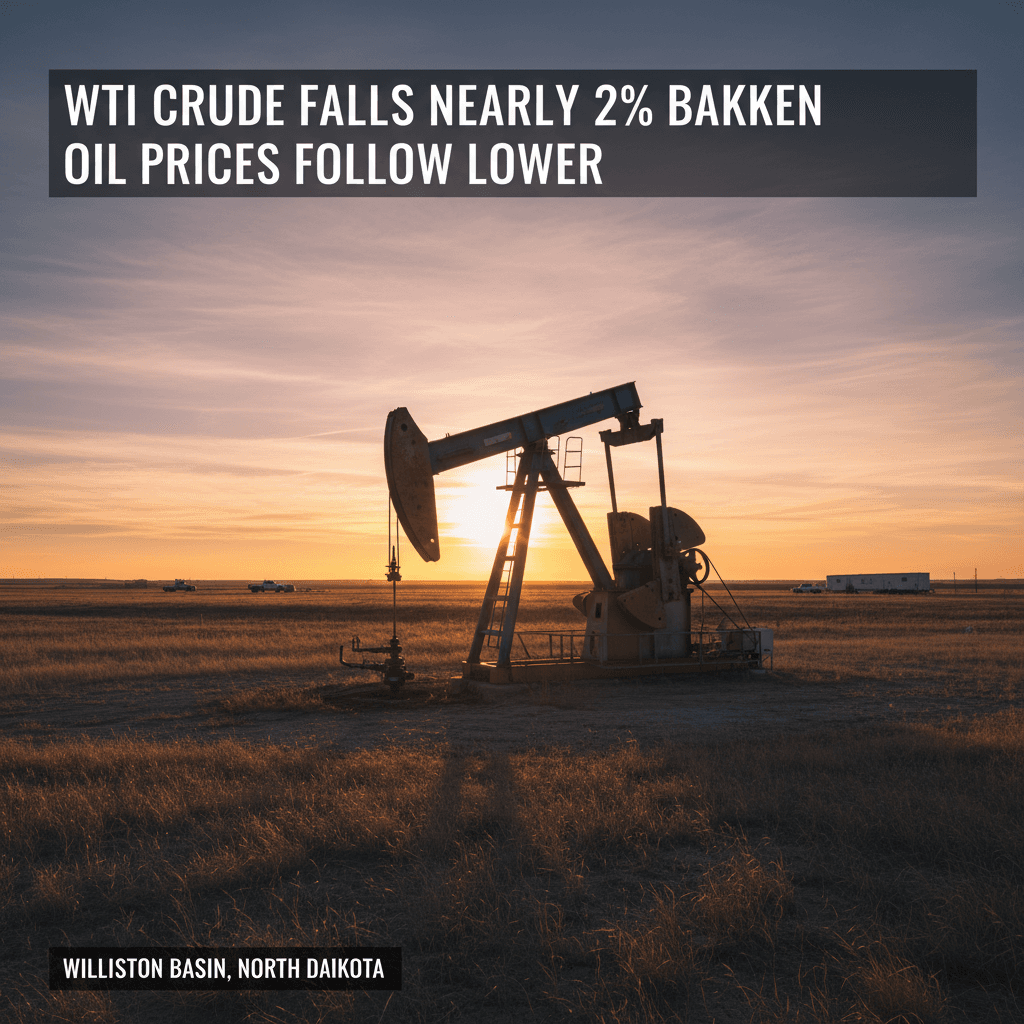
WTI Crude Falls Nearly 2%, Bakken Oil Prices Follow Lower

West Texas Intermediate crude oil prices fell sharply in early trading, dropping below the Bakken region's key benchmark. The front-month WTI contract was trading at $91.11 per barrel Sunday morning, a decline of $1.76 or 1.9 percent from its previous close. The international Brent crude benchmark showed relative stability at $102.25, down just six cents. The price weakness in the U.S. benchmark follows a reported build in domestic commercial crude inventories. According to Rigzone, citing the U.S. Energy Information Administration's latest weekly report, commercial crude oil stocks, excluding the Strategic Petroleum Reserve, rose to 427.320 million barrels for the week ending September 25. This increase of nearly one million barrels week-over-week suggests a slight loosening in domestic supply fundamentals. Analysts have pointed to broader market pressures heading into the final quarter of the year. In a separate report also published October 2, Rigzone noted that analysts at BMI, a unit...

☀️Morning Wire·Oct 4