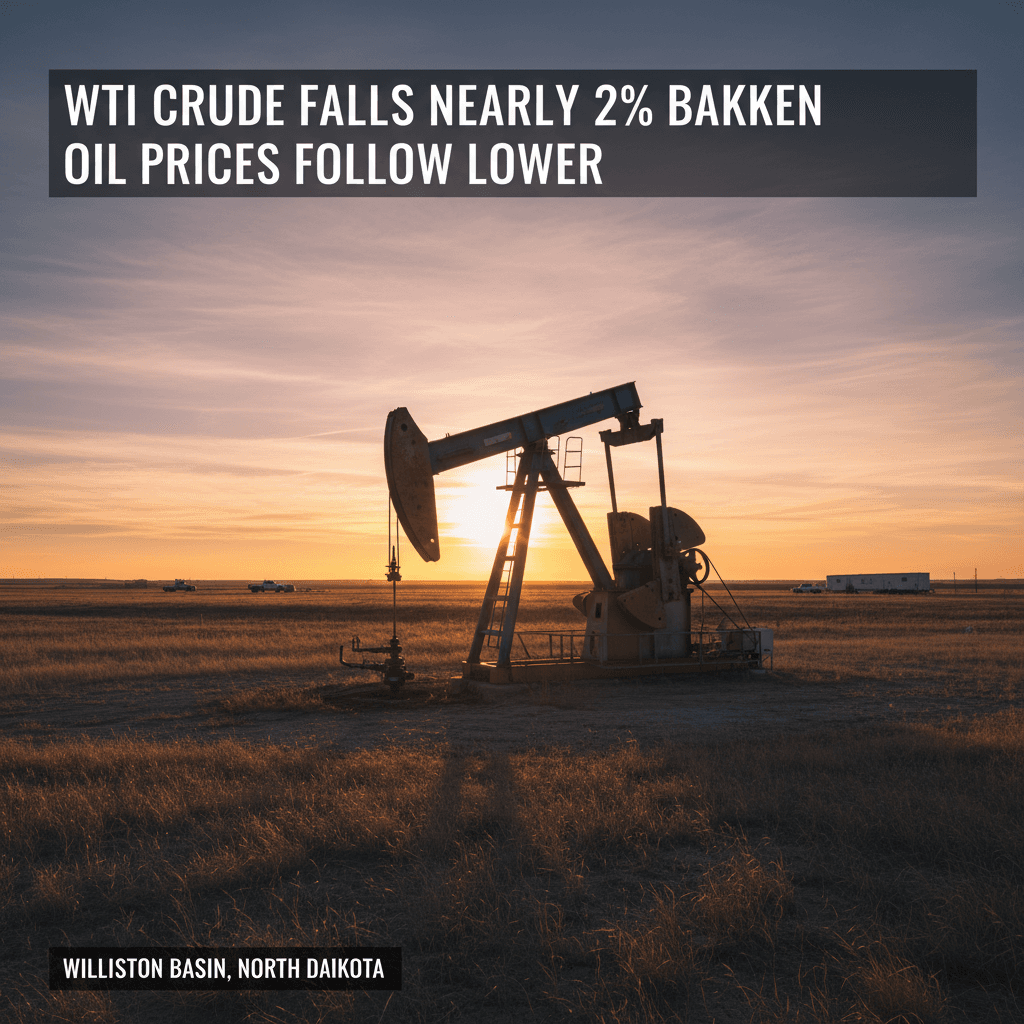
WTI Crude Falls Sharply While Bakken Differential Widens
Midday trading sees WTI down nearly 2% to $91.11, with Bakken crude trading at a steeper discount amid broader market pressures.
West Texas Intermediate crude oil prices fell sharply in midday trading Sunday, October 4, 2026, dropping $1.76 to $91.11 per barrel, a decline of 1.9%. The international benchmark Brent crude saw a more modest decrease, falling $0.06 to $102.25 per barrel, according to live price data.
The price drop for the U.S. benchmark puts pressure on Bakken producers, as the discount for Bakken crude at the Clearbrook, Minnesota, hub widened to $3.42 per barrel below WTI. This means Bakken crude is effectively trading at approximately $87.69 per barrel.
In contrast to the crude market, natural gas prices showed strength, rising $0.07 to $3.04 per million British thermal units.
The midday slump in WTI prices comes amid broader market pressures. The significant spread between WTI and Brent, which now exceeds $11 per barrel, highlights regional market dynamics and logistical factors affecting U.S. crude. A wider Brent-WTI spread can sometimes indicate ample supply in the U.S. domestic market or constraints in moving crude from inland basins like the Bakken to coastal export terminals.
For Bakken operators, the combination of a lower overall WTI price and a wider local differential directly impacts wellhead economics. The effective price in the high-$80s range may pressure margins for some higher-cost producers, particularly those with significant hedging obligations that have rolled off. The price movement will be closely watched by royalty owners and service companies across North Dakota's Williston Basin.
The strength in natural gas prices offers a slight counterbalance for operators with significant gas production or those utilizing gas for on-site operations. However, oil remains the primary economic driver for the Bakken formation.
Traders will continue to monitor for any official commentary from OPEC+ regarding production policy, as well as weekly U.S. inventory data, for further direction. The current price action suggests a focus on domestic supply factors and demand concerns weighing on the U.S. benchmark.
Source
Live Price Data