WTI Crude--
Brent Crude--
Natural Gas--
ND Rig Count--
WTI Crude--
Brent Crude--
Natural Gas--
ND Rig Count--
Oil Prices Plunge Over 2% as Demand Concerns Weigh on Market - Bakken Wire
Oil Prices

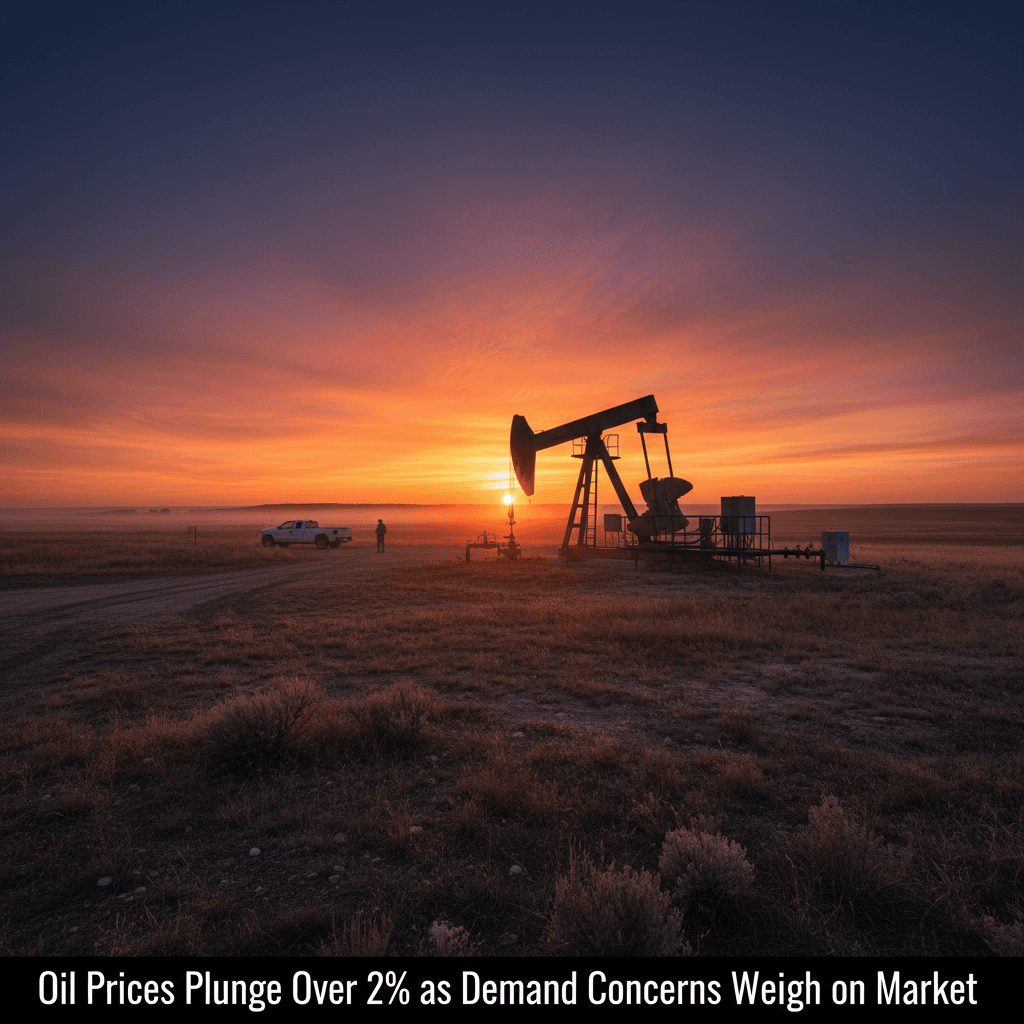
Oil Prices Plunge Over 2% as Demand Concerns Weigh on Market

WTI falls below $101, with Bakken crude trading at a $3.42 discount, pressuring producer revenues.

Bakken Wire Staff·🔆Midday Wire·

Oil prices dropped sharply in midday trading Sunday, September 13, with global benchmark Brent crude falling more than U.S. West Texas Intermediate. The decline pressures profit margins for operators in North Dakota's Bakken formation.

West Texas Intermediate (WTI) crude was trading at $100.05 per barrel, down $2.43 or 2.37% for the session. The international benchmark, Brent crude, was at $104.61 per barrel, down $3.02 or 2.81%. The Bakken crude differential, the discount at which the region's oil trades versus WTI, stood at $-3.42 per barrel. Natural gas prices held steady at $2.83 per MMBtu.

The midday sell-off reflects growing market anxiety over the strength of global oil demand. Economic headwinds in major consuming regions are prompting traders to reassess consumption forecasts, leading to a broad risk-off move in the commodities complex.

For Bakken operators, the price drop directly impacts the wellhead revenue for each barrel produced. With Bakken crude priced at a $3.42 discount to WTI, the effective price for many North Dakota barrels is approximately $96.63 per barrel. This narrowing margin environment could influence decisions on the pace of drilling and completion activity, particularly for operators with higher breakeven costs.

The price movement comes amid a fragile macroeconomic outlook and ongoing uncertainty over OPEC+ production policy. While not reflected in today's specific price change, broader market sentiment continues to be shaped by the balance between coordinated supply management from the producer group and the trajectory of global economic growth.

The steady natural gas price offers little offset for producers, as associated gas from oil wells in the Bakken often contributes a smaller portion of overall revenue compared to crude. The price action underscores the commodity-driven nature of the Bakken play, where operator cash flow and state tax revenues remain tightly correlated to volatile crude markets.

Source

Bakken Wire Live Price Data

oil priceswtibrentbakken differentialcommoditiesbakken operatorsnorth dakota

Share this article

Related Articles

Oil Prices Fall Amid Demand Concerns as EU EV Sales Hit Record - Bakken Wire
Oil Prices

Oil Prices Fall Amid Demand Concerns as EU EV Sales Hit Record

Crude oil prices declined in midday trading Monday, with both major benchmarks falling approximately 1% as record electric vehicle sales in Europe highlighted growing long-term demand pressures. West Texas Intermediate (WTI) crude traded at $90.2 per barrel, down $0.91 for the session. The global benchmark, Brent crude, fell $1.06 to $101.19 per barrel. The price retreat coincides with a report showing a structural shift in European transportation demand. According to a Monday report from advocacy group Transport & Environment cited by OilPrice.com, battery electric vehicle (BEV) sales in the European Union soared 45% year-over-year in the first eight months of 2026, reaching 1.64 million units. For the first time, BEVs outsold gasoline-fueled cars over a full quarter in Q2 2026. The shift is being driven directly by high fuel prices. The report's authors stated, "Petrol and diesel drivers pay the price of Europe's oil dependency, electric drivers do not," noting...

🔆Midday Wire·Oct 5
Oil Prices Mixed as G7 Reserve Release Plans Meet Middle East Risks - Bakken Wire
Oil Prices

Oil Prices Mixed as G7 Reserve Release Plans Meet Middle East Risks

Front-month WTI crude oil futures fell 0.76% to trade at $90.42 per barrel in early Monday trading, according to live price data, while the global Brent benchmark rose 0.45% to $102.71, highlighting a diverging market sentiment. The primary pressure on U.S. benchmark prices came from a coordinated government stockpile release announced by G7 nations. On Friday, the group pledged to release 100 million barrels of crude oil and diesel from strategic reserves over the next four months, according to OilPrice.com. The plan includes a "frontloaded substantial diesel release" within the first 20 days. However, Japan, a key G7 member, stated on Monday it has "no plans for a further release at this stage," with Chief Cabinet Secretary Minoru Kihara noting the country had already participated in earlier reserve draws. The announced release immediately impacted refining economics. The ICE gasoil crack spread—a key indicator of diesel refining margins—fell to about $70...

☀️Morning Wire·Oct 5
Oil Prices Hold Steady as Markets Await Direction - Bakken Wire
Oil Prices

Oil Prices Hold Steady as Markets Await Direction

Front-month futures contracts for global oil benchmarks showed no change in Sunday electronic trading, with markets appearing to hold their breath ahead of the new trading week. West Texas Intermediate (WTI) crude was flat at $91.11 per barrel, while international benchmark Brent crude also held steady at $102.25 per barrel, according to Bakken Wire's live price data. The lack of price movement reflects typical subdued Sunday trading activity, with many physical markets closed and traders awaiting fresh catalysts. The price stability follows a volatile quarter where geopolitical tensions and OPEC+ supply management have been primary market drivers. The significant $11.14 per barrel spread between WTI and Brent remains a focal point for U.S. exporters. Natural gas prices also showed no movement, holding at $3.04 per million British thermal units (MMBtu). The Bakken differential to WTI was not defined in Sunday's data set, a common occurrence during weekend trading when physical...

🌅Afternoon Wire·Oct 4