WTI Crude--
Brent Crude--
Natural Gas--
ND Rig Count--
WTI Crude--
Brent Crude--
Natural Gas--
ND Rig Count--
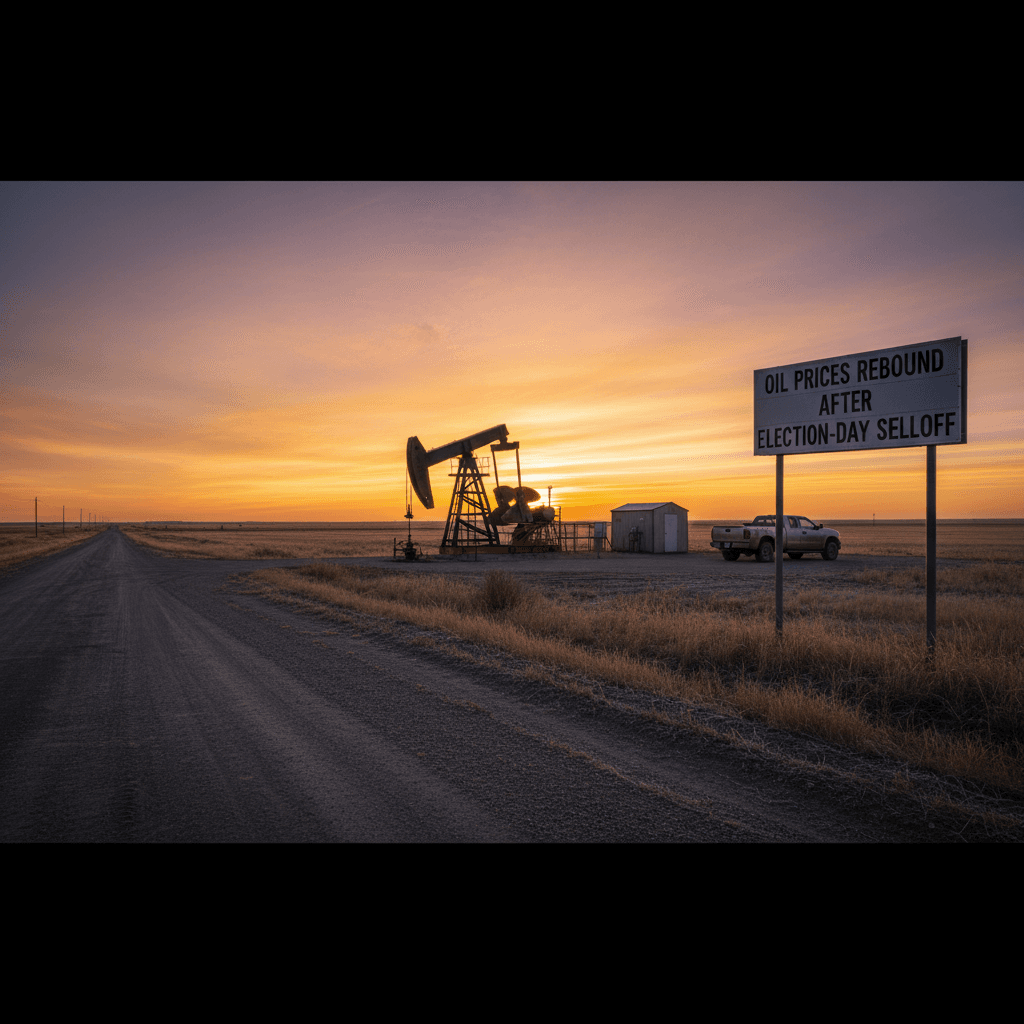
Oil Prices Rebound After Election-Day Selloff - Bakken Wire
Oil Prices

Oil Prices Rebound After Election-Day Selloff

WTI and Brent rose Thursday after a reported 8% drop following U.S. midterm elections, while Bakken crude remained at a discount.

Bakken Wire Staff·☀️Morning Wire·

Oil prices moved higher Thursday after a sharp election-day decline, according to live market data and a Rigzone report citing Saxo Bank.

WTI crude was trading at $89.50, up $1.38, or 1.57%. Brent crude was at $96.97, up $2.35, or 2.48%. Natural gas was at $2.95, down $0.01.

The Bakken differential was listed at -$3.42 versus WTI. The Brent-WTI spread was $7.47, with Brent trading at a premium to the U.S. benchmark.

The only immediate context provided in the source material concerned the prior day. Rigzone reported that Saxo Bank highlighted that oil prices “tumbled” eight percent yesterday following the U.S. midterm elections.

The live prices show WTI and Brent rising Thursday after that drop. The Brent-WTI spread is a common reference point for global crude markets, but the live data did not provide further context for today’s move.

For Bakken producers, the key question is how the benchmark move and the regional discount affect wellhead revenue. The Bakken differential of -$3.42 against WTI implies a Bakken crude reference price of $86.08, based on the live WTI quote.

That spread matters in North Dakota’s primary oil-producing region, where operators sell crude that may not fetch the same price as the national WTI benchmark. A higher WTI price generally improves the revenue environment for oil producers, especially if the gain offsets prior weakness.

But the Bakken discount means operators and royalty owners receive less per barrel than the headline WTI number. If the discount widens, it can erode wellhead value even when benchmark prices rise.

If it narrows, it can amplify the benefit of a higher benchmark. The flat-to-slightly-lower natural gas price was $2.95, down $0.01, offering little near-term support to gas producers in the Williston Basin.

For Bakken operators with associated gas production, a steady gas price can help keep the overall production package more balanced, particularly when crude prices are volatile. The market’s reaction to the U.S. midterm elections, as reported by Rigzone citing Saxo Bank, underscores how political outcomes can move crude prices quickly.

That volatility is relevant to Bakken operators, royalty owners and North Dakota producers because daily price swings can affect hedging decisions, cash flow timing and the economic threshold for drilling activity. The live data shows a rebound in crude benchmarks Thursday, while the Bakken differential remains negative.

For North Dakota producers, the practical takeaway is that benchmark strength alone does not determine realized revenue. The regional discount and natural gas price continue to shape what flows from wellhead to royalty checks.

Source

Rigzone; live price data
oil priceswtibrentbakkennorth dakotamidterm electionsnatural gas

Share this article

Related Articles

WTI Falls Nearly 8.3% as Bakken Crude Trades $3.42 Below Benchmark - Bakken Wire
Oil Prices

WTI Falls Nearly 8.3% as Bakken Crude Trades $3.42 Below Benchmark

Bakken operators faced a steep crude price decline Wednesday, with WTI at $88.14, down $7.95, or 8.27%, according to Bakken Wire live price data. Brent crude fell $8.90, or 8.59%, to $94.70, reinforcing a broad repricing of global oil benchmarks rather than a region-specific move. The Bakken differential was reported at -$3.42 versus WTI, meaning Bakken crude traded below the main U.S. benchmark by $3.42 per barrel. Based on the live WTI price, that places an implied Bakken benchmark level near $84.72. For Williston Basin producers, the combination of a lower WTI reference and a negative regional spread cuts into realized oil prices at the field and pipeline trading points. Natural gas moved in the opposite direction. Natural gas data in the live pricing feed showed gas at $2.95, up $0.05. The modest gain offered some offset to operators with associated gas production, but the decline in crude revenue was...

🌅Afternoon Wire·Nov 4
Bakken Crude Slides as WTI, Brent Tumble on U.S.-Iran Deal Bets - Bakken Wire
Oil Prices

Bakken Crude Slides as WTI, Brent Tumble on U.S.-Iran Deal Bets

North Dakota crude prices came under sharp pressure Wednesday, with WTI sliding $7.13, or 7.42%, to $88.96 per barrel and Brent dropping $8.52, or 8.22%, to $95.08, according to live market data. The Bakken differential was quoted at minus $3.42 against WTI, putting Bakken barrels around $85.54. Natural gas rose modestly to $2.96 per million British thermal units, up $0.06. The move came as oil traders increasingly priced the possibility of a U.S.-Iran settlement, according to OilPrice.com. Earlier in the session, OilPrice.com reported Brent had fallen to $100.60 and WTI to $93.23, before live data showed deeper declines. President Trump told the Financial Times that Washington has no immediate plans to strike Iran, saying, “We seem to be getting everything we want.” Vice President JD Vance said Monday that the two sides had “certainly made some progress.” A senior Iranian official said Tehran could reopen the Strait of Hormuz within...

🔆Midday Wire·Nov 4
Oil Prices Ease as Iran Signals and Midterm Result Weigh - Bakken Wire
Oil Prices

Oil Prices Ease as Iran Signals and Midterm Result Weigh

WTI crude was $95.01 per barrel, down $1.08, or 1.12%, according to live Bakken Wire price data. Brent crude was $102.23, down $1.37, or 1.32%. Natural gas was $2.92, up $0.03. The Bakken differential was minus $3.42 against WTI. That combination left North Dakota producers with a benchmark that was lower on the day but gas slightly firmer, while local crude continued to trade below the WTI benchmark. Using the live differential, the implied Bakken crude price was about $91.59 per barrel. The price move came as oil markets continued to process conflicting signals from the Middle East. Rigzone reported that traders weighed Iran war risks against improving regional supply, a mix that kept prices volatile. The publication’s Nov. 3 wire story, “Oil Prices Swing on Conflicting Iran Signals,” said markets remained unsettled as supply concerns and geopolitical risk pulled in different directions. On Nov. 4, Rigzone said oil markets...

☀️Morning Wire·Nov 4