
WTI Crude--
Brent Crude--
Natural Gas--
ND Rig Count--
WTI Crude--
Brent Crude--
Natural Gas--
ND Rig Count--
Oil Prices Slide Despite Global LNG Supply Crisis - Bakken Wire
Oil Prices

Oil Prices Slide Despite Global LNG Supply Crisis

WTI falls below $101 as Bakken discount holds steady; soaring natural gas prices spark demand destruction concerns in Asia.

Bakken Wire Staff·☀️Morning Wire·

Oil prices declined in early trading Thursday, with West Texas Intermediate crude falling 1.64% to $100.75 per barrel. Brent crude also dropped, trading at $99.34. The price for Bakken crude at the wellhead held a differential of $3.42 below WTI, according to live price data.

The downward move in crude contrasts sharply with extreme volatility and record-high prices in the global liquefied natural gas market. According to OilPrice.com, spot LNG prices in Northeast Asia have jumped to $28.40 per million British thermal units this week, up $2.70 from last week. Analysts warn prices could surge to $40 per MMBtu in a cold winter, a level equivalent to roughly $240 per barrel of Brent crude.

The primary driver is a severe supply crunch stemming from the Middle East conflict. LNG exports from Qatar and the United Arab Emirates remain largely trapped in the Persian Gulf due to geopolitical tensions, tightening the global market. Europe is entering the winter season with gas storage sites less than 70% full, compared to a five-year average of above 80% for this time of year, OilPrice.com reported.

This fierce competition for non-Middle Eastern LNG cargoes between Europe and Asia is pushing prices higher. However, the soaring cost is beginning to destroy demand. A separate report from OilPrice.com indicates Asian LNG demand is set to decline by 3% to 10% this year, which would be its second consecutive annual drop. Analysts cited by Reuters note that high prices are causing China, the world's top LNG importer, to delay discretionary stockpiling.

For Bakken operators, the current price environment presents a mixed picture. While crude prices remain elevated above $100, the persistent discount for Bakken crude versus the WTI benchmark affects local wellhead economics. The global natural gas crisis has a more indirect impact; associated gas produced from Bakken oil wells is primarily moved via pipeline, not as LNG. However, sustained high global gas prices could eventually influence broader North American gas markets and provide marginal support for gas revenues.

The ripple effects of the energy supply disruption are being felt by consumers. Gasoline prices jumped in every U.S. state this week with "no relief in sight," according to a summary from Rigzone.

Market observers warn the real test is yet to come. "A cold winter would be the real stress test for the market as flows through Hormuz are not expected to pick up materially by the end of the year," according to the OilPrice.com analysis.

Source

Live Price Data, OilPrice.com, Rigzone
wtibrentbakken differentiallngnatural gaspricesmiddle eastsupply disruption

Share this article

Related Articles

WTI Rises to $88.7 as Brent Advances to $95.8 - Bakken Wire
Oil Prices

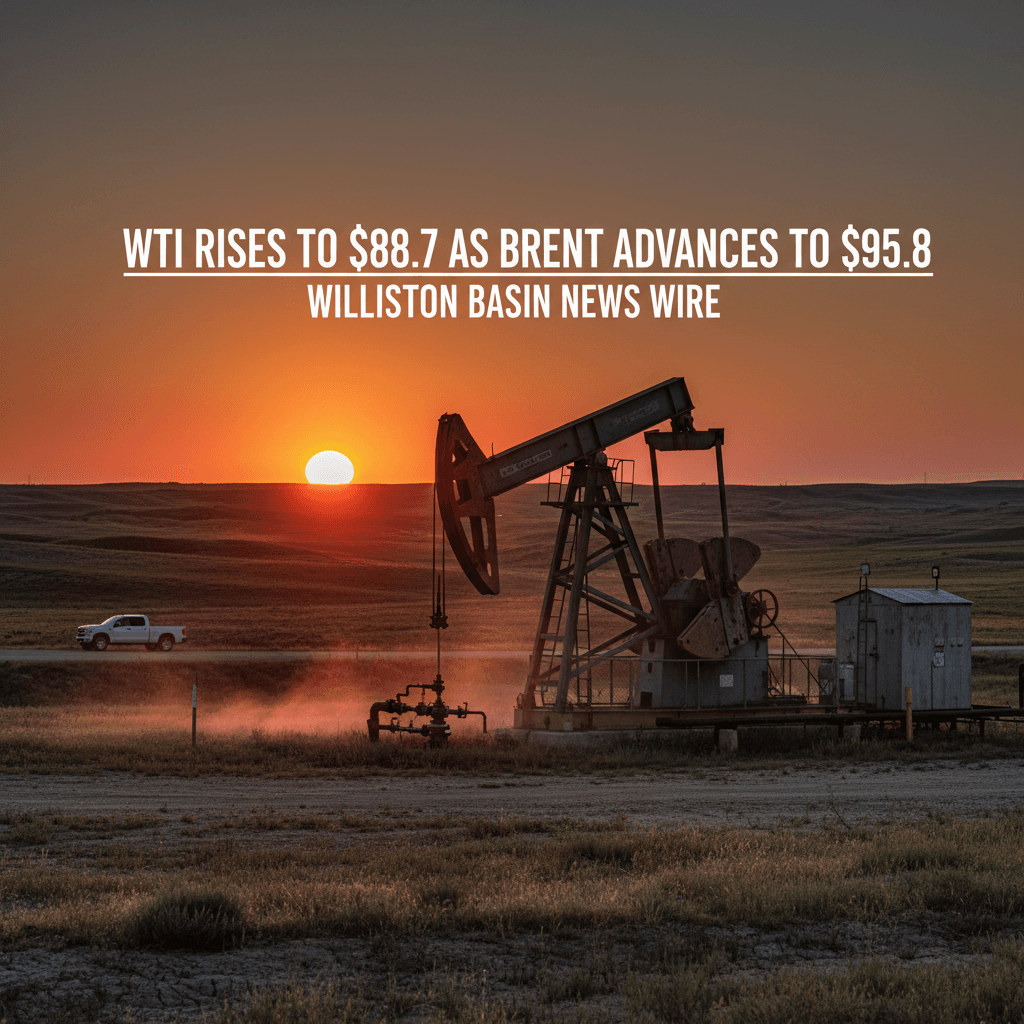
WTI Rises to $88.7 as Brent Advances to $95.8

Oil markets moved higher in Thursday afternoon pricing, with WTI crude at $88.7, up $2.17, or 2.51%, according to live market data. Brent crude rose $3.04, or 3.28%, to $95.8. Natural gas also advanced, gaining $0.15 to $3.37. The Bakken differential was quoted at -$3.42 against WTI, indicating that North Dakota barrels were trading at a discount to the U.S. benchmark. Applying the quoted differential to WTI implies a Bakken reference price of $85.28. For Bakken operators, the move higher in both WTI and Brent improves the revenue environment for oil production, while the natural gas gain supports value from associated gas streams. For royalty owners, higher benchmark prices generally raise the value of produced volumes, though the local discount can reduce the realized price compared with the WTI quote. The price move was not attributed in the available market data to a specific inventory, OPEC or policy catalyst. The...

🌅Afternoon Wire·Nov 12
Oil Prices Rise as EIA Lifts 2026, 2027 Forecasts - Bakken Wire
Oil Prices

Oil Prices Rise as EIA Lifts 2026, 2027 Forecasts

Oil prices moved higher Thursday morning in North Dakota and national benchmark trading as the U.S. Energy Information Administration raised its Brent oil spot price forecasts for 2026 and 2027 yet again, according to Rigzone. At midday, WTI crude was $86.92 a barrel, up $0.39, or 0.45%. Brent crude was $93.83, up $1.07, or 1.15%. The spread between Brent and WTI stood at $6.91, based on the midday quotes. Natural gas was $3.30, up $0.09. Rigzone reported the EIA update in its latest short-term energy outlook. The report did not detail the new forecast levels in the summary provided to Bakken Wire, but the agency’s repeated increases in 2026 and 2027 Brent spot price forecasts were the most prominent news item in the midday tape. For Bakken operators, the price action has two sides. Higher benchmark crude prices and revised EIA forecasts improve the revenue outlook for producers selling oil...

🔆Midday Wire·Nov 12
Oil Prices Dip as Supply Disruptions Ease, Bakken Differential Holds at -$3.42 - Bakken Wire
Oil Prices

Oil Prices Dip as Supply Disruptions Ease, Bakken Differential Holds at -$3.42

Oil prices declined in morning trading on Thursday, with West Texas Intermediate (WTI) crude down 0.86% to $85.79 per barrel. The international benchmark Brent crude also fell, dropping 0.67% to $92.14, according to live price data. The price of Bakken crude, a key grade for North Dakota producers, traded at a discount of $3.42 per barrel below WTI. The modest price pullback coincides with reports that crude supply routes from the Persian Gulf are materially recovering. According to a report from OilPrice.com, India has imported more oil from the Persian Gulf than from Russia so far in November—the first time since the Iran war began nine months ago. Data from Kpler cited by Bloomberg shows India imported an estimated 2.1 million barrels per day (bpd) from the Gulf this month, compared to 1.8 million bpd from Russia. This shift signals a significant rebound in shipments through the critical Strait of...

☀️Morning Wire·Nov 12