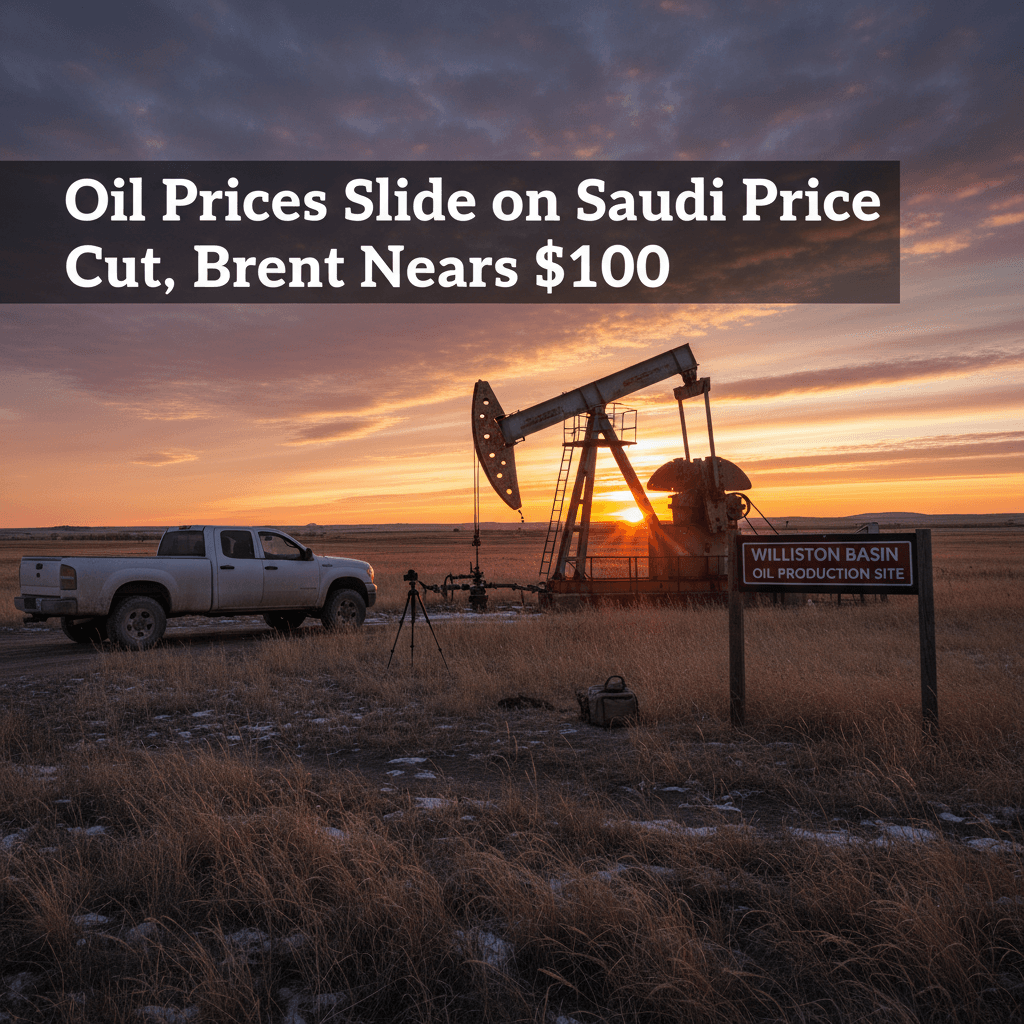
Oil Prices Slide on Saudi Price Cut, Brent Nears $100
WTI falls over 2% to $87.21 as Saudi Arabia reduces official selling prices for Asia, pressuring the market.
Crude oil prices fell sharply in Tuesday morning trading, with West Texas Intermediate (WTI) dropping 2.48 percent to settle at $87.21 per barrel. The global benchmark, Brent crude, declined by a similar margin to $97.83, continuing its struggle to hold above the $100 psychological mark.
The decline follows a move by Saudi Arabia, the world's top oil exporter, to cut its official selling prices for crude delivered to Asia in November. According to Rigzone, this price cut, coupled with reports of improved oil flows through the critical Strait of Hormuz, contributed to the market slide. The Brent benchmark is "once again toiling around $100 per barrel as its reasons for trading much beyond the psychological three-digit mark are being eroded," PVM Oil Associates Analyst John Evans told Rigzone.
For Bakken operators, the price of WTI is a primary determinant of revenue. Today's drop of over $2 per barrel represents a significant overnight decrease in the value of produced crude. The Bakken differential, the price adjustment for Bakken crude versus WTI at the Cushing, Oklahoma hub, was not defined in morning data, adding a layer of uncertainty for shippers. A widening differential can erode the netback price for producers, even if the benchmark holds steady.
Meanwhile, natural gas prices showed modest strength, rising by $0.03 to $3.10 per million British thermal units (MMBtu). This provides a minor counterbalance for operators with significant gas production, though natural gas remains a secondary revenue stream compared to oil in the Bakken formation.
The market focus remains on key geopolitical and supply factors. The Strait of Hormuz, a vital chokepoint for global oil shipments, has seen improved flows, alleviating some supply concerns. Saudi Arabia's pricing decisions are closely watched as an indicator of the kingdom's assessment of market strength and its competition for market share, particularly in Asia.
The pullback in prices underscores the fragile balance in the oil market, where bullish factors like ongoing geopolitical risk are being weighed against bearish signals like Saudi price adjustments. For North Dakota producers, the volatility highlights the importance of hedging strategies and cost discipline. With Brent hovering near $100, the global market remains tense, but any sustained retreat in WTI below the $85 level would pressure cash flows and drilling budgets in the Williston Basin.
Source
Live price data, Rigzone (Brent Once Again Toiling Around $100 Mark, published Oct 6, 2026), Rigzone (Oil Slides on Saudi Price Cut, published Oct 5, 2026)