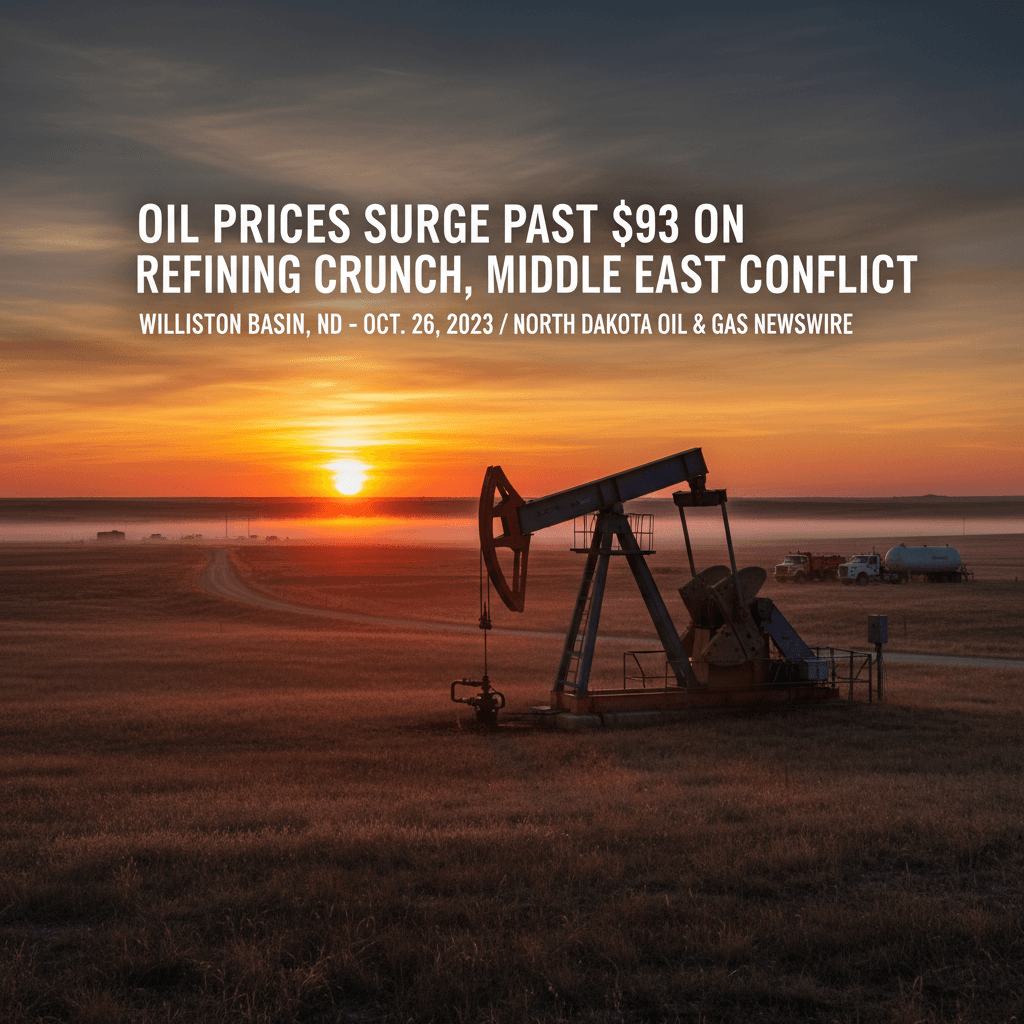
Oil Prices Surge Past $93 on Refining Crunch, Middle East Conflict
WTI crude rises over 2% as global refining bottlenecks tighten fuel markets, supporting Bakken crude despite a widening discount.
Oil prices climbed sharply on Thursday, with West Texas Intermediate (WTI) crude settling above $93 a barrel as a global shortage of refining capacity and escalating Middle East tensions tightened fuel markets. WTI for October delivery gained $2.01, or 2.21%, to close at $93.02 per barrel. The international benchmark Brent crude rose $1.62 to $97.25, according to live price data.
The rally is being driven by a severe refining bottleneck, according to industry analysts. Damaged refineries in the Middle East and Russia have removed millions of barrels per day of capacity from the global system, with insufficient capacity elsewhere to offset the losses, OilPrice.com reported. "Crude is surplus globally, but there is no refining capacity available to refine it and bring it to market," said Nikhil Agarwal of Globestar Energy.
The International Energy Agency (IEA) noted refinery crude throughputs in July remained nearly 5 million barrels per day below year-ago levels. Brian Mandell of Phillips 66 stated that approximately 7 million barrels per day of refineries are down in Asia and the Middle East, with another 1.4 million barrels per day offline in Russia. These disruptions are expected to keep global fuel prices elevated into 2027.
Geopolitical risks added further pressure. Spot LNG prices for Asia surged to nearly $26 per million British thermal units, their highest since 2022, following renewed U.S.-Iran strikes and an extended force majeure on Qatar's LNG deliveries. Meanwhile, Chinese refiners are paying record premiums of over $7 per barrel for Russia's ESPO crude to replace blocked Iranian supplies, highlighting tight physical markets.
For Bakken operators, the strong underlying crude price provides a supportive revenue environment. However, the Bakken crude differential to WTI widened to a discount of $3.42 per barrel on Thursday. This suggests regional takeaway capacity or quality differentials are absorbing some of the global price strength. The high global diesel prices resulting from the refining crunch could incentivize higher runs at U.S. refineries capable of processing Bakken crude.
Natural gas prices also saw a modest increase, with the benchmark rising $0.04 to $3.00 per MMBtu. The surge in global LNG prices, if sustained, could improve the economics for associated gas from the Bakken, though the local price remains disconnected from the international spot market spikes.
The combined factors of structural refining shortages and ongoing conflict point to continued volatility and firm price support in the near term, benefiting North Dakota producers despite regional basis differentials.
Source
Live Price Data, OilPrice.com (Global Refining Crunch Could Keep Fuel Prices High Into 2027, Chinese Refiners Pay Record Premiums for Russian ESPO Crude, Asian LNG Prices Surge to Highest Since 2022 as Iran War Escalates)