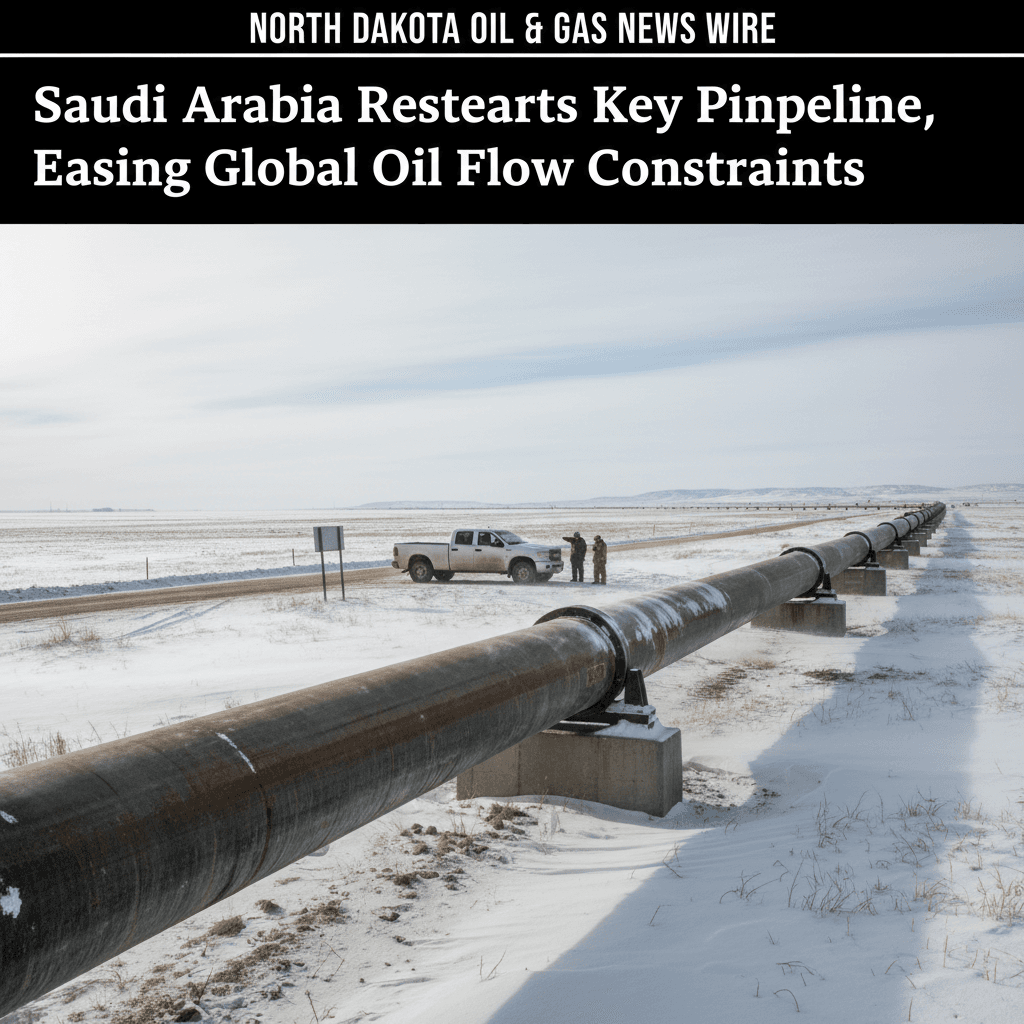
Saudi Arabia Restarts Key Pipeline, Easing Global Oil Flow Constraints
The restart of the East-West pipeline could soften global benchmarks, indirectly affecting Bakken crude pricing as Saudi supply routes normalize.
Saudi Arabia has restarted its vital East-West oil pipeline, a move that introduces fresh crude supply into global markets and puts downward pressure on international oil prices, according to reports from OilPrice.com and Rigzone. For Bakken producers, the development is a key factor in the global supply chain that influences the price they receive for their crude.
The pipeline is running at a low rate initially, with state oil giant Aramco working to return flows to its full capacity of roughly 4 million barrels per day, a process sources say could still take weeks. The 4-million-barrel-per-day route had been the kingdom's main alternative to shipping through the Strait of Hormuz before drone attacks forced its shutdown earlier this month, OilPrice.com reported.
The news triggered an immediate, though temporary, reaction in global oil markets. On Tuesday, the international Brent benchmark saw a dip of more than $2 per barrel to a two-week low, trading around $98, while West Texas Intermediate (WTI) dropped below $92 before rebounding slightly later in the morning. Bakken crude prices, which are typically discounted against these benchmarks, are sensitive to such global shifts.
The pipeline's restoration is critical for redirecting Saudi crude from the Persian Gulf to the Red Sea port of Yanbu. Before the outage, it was rerouting about 4 million bpd across the country to Yanbu. Without it, Aramco had to push more crude back toward the Persian Gulf for export through the constrained Strait of Hormuz, OilPrice.com reported. The restart means one cargo was scheduled to load at Yanbu for China on Tuesday.
For European customers, the pipeline's return is particularly significant. Aramco had reportedly told European term customers last week that their October crude allocations would be zero after the pipeline outage interrupted supplies normally moved from Yanbu through Egypt’s SUMED pipeline system to the Mediterranean. Traders are already preparing for that route to reopen, with tankers being moved toward Egypt’s Port Said and Sidi Kerir for ship-to-ship transfers, according to Reuters sources cited by OilPrice.com.
While the physical restart is underway, the global market still faces disruptions. Saudi pipeline flows remain well below normal, Hormuz traffic is still constrained, and diesel markets remain tight after refinery issues in Russia and the Middle East, the report noted. These ongoing constraints mean the full impact on global supply and pricing will unfold over the coming weeks.
For operators in the Bakken, the event underscores the interconnected nature of global oil logistics. Any easing of major maritime chokepoints and restoration of high-volume pipeline capacity can alter the flow of crude to key refining markets, influencing the competitive landscape for landlocked North Dakota oil.
Source
OilPrice.com, Rigzone