WTI Crude--
Brent Crude--
Natural Gas--
ND Rig Count--
WTI Crude--
Brent Crude--
Natural Gas--
ND Rig Count--
Pipeline & Infrastructure

Saudi Pipeline Outage Spurs Global Crude Market Scramble

Shutdown of key East-West artery forces spot sales, prompts Asian buyers to seek alternatives like Oman crude.

Bakken Wire Staff·☀️Morning Wire·

Saudi Arabia has shut down a critical oil pipeline and pivoted to spot market sales following drone attacks, creating immediate disruptions in global crude flows that could influence pricing and shipping patterns relevant to Bakken producers. The 750-mile East-West pipeline was taken offline late last week as a precaution after attacks launched from Iraqi territory near the Iranian border resulted in injuries, according to OilPrice.com.

The pipeline had become Saudi Arabia's primary route to bypass the Strait of Hormuz, which has been closed to shipping traffic due to ongoing Middle East conflict. Its outage has forced the kingdom to quickly adapt its sales strategy. According to OilPrice.com, Saudi Arabia has sold as much as 20 million barrels of crude in the spot market this week for pickup outside the Strait of Hormuz. Chinese refiners, both state-held and independent, along with processors in other East Asian nations, have been the main buyers.

These spot cargoes are being arranged for ship-to-ship transfers in the Gulf of Oman, a method perfected recently by the United Arab Emirates' ADNOC. This allows buyers to avoid sending tankers into the blocked Persian Gulf via Hormuz. Meanwhile, Saudi Aramco has reportedly canceled or delayed some September deliveries to European refiners due to the pipeline outage, OilPrice.com reported.

The uncertainty is driving alternative buying. Some Japanese refiners this week rushed to purchase Oman crude for earlier loadings following the Saudi pipeline shutdown, traders told Bloomberg. Asian refiners remain unsure how the shutdown will affect scheduled loadings at the Red Sea port of Yanbu, with at least four yet to receive clarification from Saudi Arabia as of Monday.

Official information on damage and repair timelines remains scarce. While U.S. Energy Secretary Chris Wright said on Tuesday the pipeline could be back in service within days, two regional officials briefed on the matter told The Associated Press that repairs could take three to five weeks. Saudi Arabia has not provided an official update.

For Bakken operators and North Dakota royalty owners, such global supply disruptions underscore the interconnected nature of the crude market. Any prolonged outage of a major export route like the East-West pipeline can tighten global supply balances and support international benchmark prices, which in turn influence the price differentials for Bakken crude delivered to coastal refineries. The shift to spot sales and alternative sourcing by Asian buyers also highlights the ongoing volatility in global shipping and logistics stemming from the Middle East conflict, factors that can affect the relative competitiveness of U.S. shale exports.

Source

According to reports from OilPrice.com citing Bloomberg and The Associated Press.
saudi arabiapipelinestrait of hormuzglobal oil marketspot marketexports

Share this article

Related Articles

Pipeline & Infrastructure

Houthis Claim New Attack on Key Saudi Pipeline, Renewing Supply Fears

The Iran-backed Houthi movement in Yemen on Monday claimed attacks on pumping stations along Saudi Arabia’s critical East-West crude oil pipeline, according to a report from OilPrice.com. The group also claimed an attack on Riyadh airport amid escalating regional hostilities. As of early Monday, Saudi authorities had not confirmed any attacks on the pipeline, which serves as the Kingdom's key export route bypassing the chokepoint Strait of Hormuz. The same pipeline was shuttered for two weeks in September following similar drone attacks that damaged pumping stations and halted loadings at the Red Sea port of Yanbu. For Bakken producers and North Dakota royalty owners, sustained instability around key global supply infrastructure provides underlying support for oil prices. The East-West Petroline is a major artery, capable of moving up to 5.8 million barrels per day away from the Persian Gulf. Any perceived threat to its operations can tighten global supply balances,...

☀️Morning Wire·Oct 26
Pipeline & Infrastructure

DOE Advances Constitution Pipeline, Citing Energy Security

The U.S. Department of Energy is advancing the long-delayed Constitution Pipeline project to strengthen national energy security, according to a report from Rigzone. The agency, under the Trump administration, stated the move is aimed at bolstering America's energy security. While the Constitution Pipeline is a Northeast natural gas project designed to move supply from Pennsylvania's Marcellus Shale to New York and New England, its federal advancement signals a broader supportive regulatory environment for pipeline infrastructure. For Bakken operators in North Dakota, major new interstate pipeline approvals can ease midstream constraints and improve market access for natural gas, which is often produced alongside crude oil. The Bakken formation is a significant producer of both oil and associated natural gas. Limited pipeline capacity in the region has historically led to increased flaring and wellhead price discounts. Federal momentum behind critical infrastructure projects, even in other basins, can create a more favorable climate...

☀️Morning Wire·Oct 25
DOE Advances Constitution Pipeline, Citing Energy Security - Bakken Wire
Pipeline & Infrastructure

DOE Advances Constitution Pipeline, Citing Energy Security

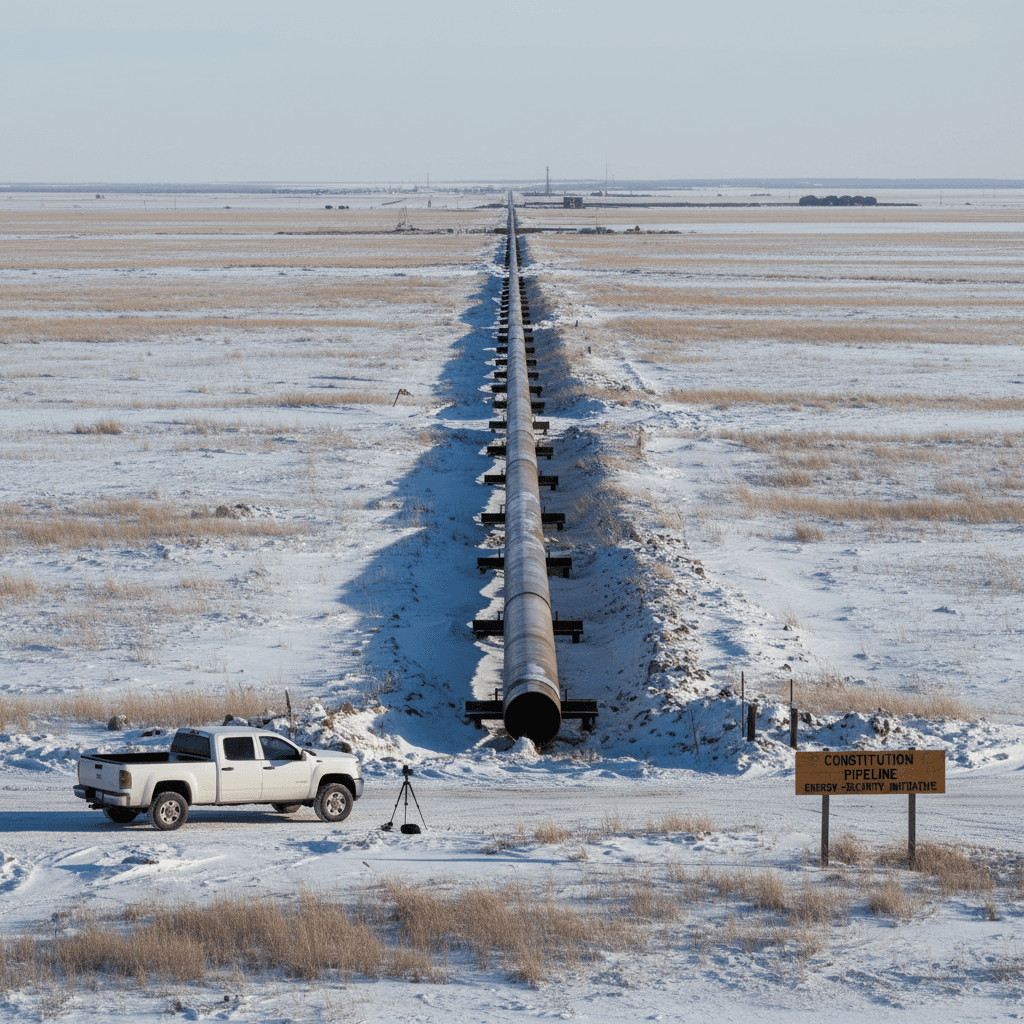
The U.S. Department of Energy is advancing the long-delayed Constitution natural gas pipeline to strengthen America's energy security, according to the agency. The development was reported by Rigzone on Friday, October 23. The Constitution Pipeline is a proposed 124-mile interstate natural gas pipeline designed to move gas from the Marcellus Shale region in northern Pennsylvania to markets in New York and New England. Its advancement by the federal government signals a priority for expanding pipeline infrastructure. For Bakken operators, new pipeline approvals in other regions can have a positive downstream effect on the national gas market. Increased takeaway capacity in the Northeast could help balance national supply and demand, indirectly supporting gas prices. While the Bakken formation is primarily an oil play, it also produces significant associated natural gas, which requires pipeline access to reach premium markets. The project has faced significant regulatory delays and legal challenges for nearly a...

🔆Midday Wire·Oct 24