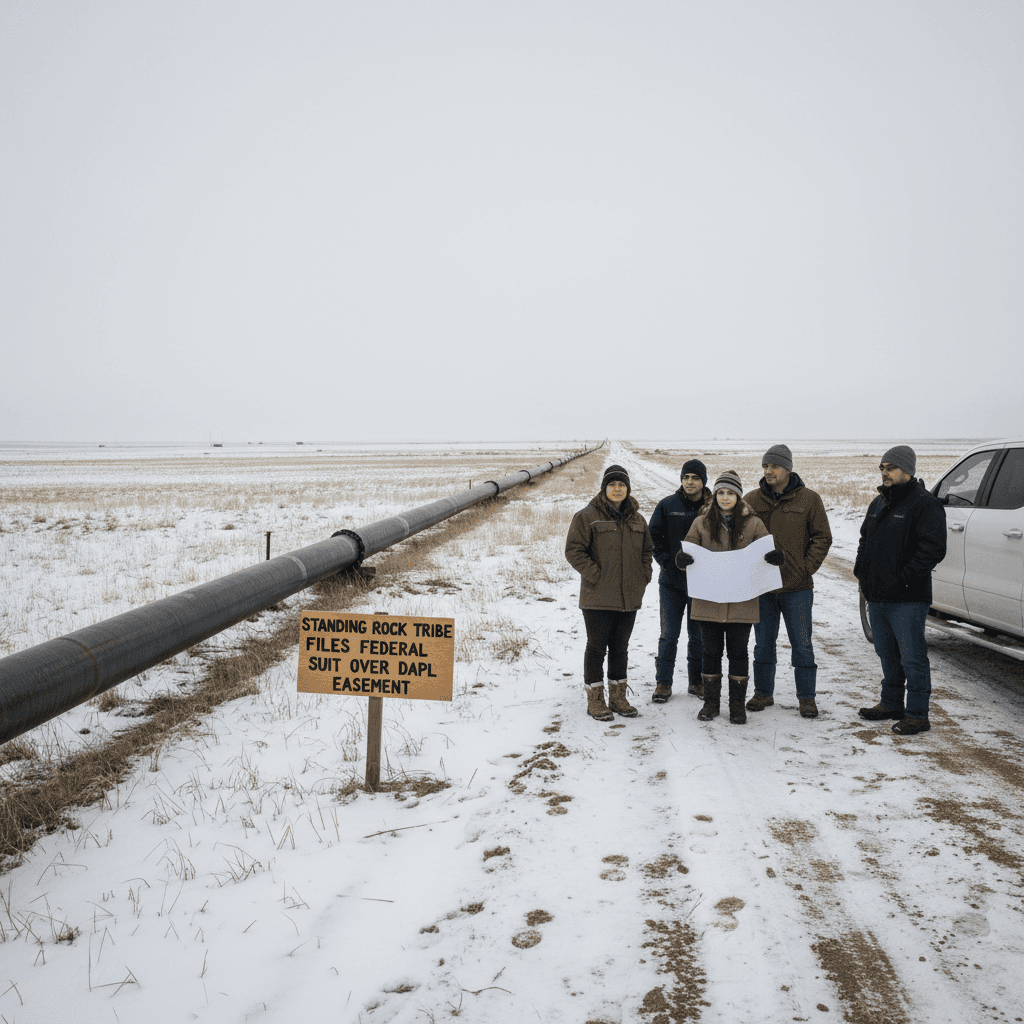
Standing Rock Tribe Files Federal Suit Over DAPL Easement
The Standing Rock Sioux Tribe has challenged the Army Corps’ approval of a new Dakota Access Pipeline easement beneath Lake Oahe.
The Standing Rock Sioux Tribe filed a federal lawsuit Friday, Oct. 9, challenging the U.S. Army Corps of Engineers’ approval of a new Dakota Access Pipeline easement beneath Lake Oahe, according to a report carried by Bing News. The filing revives a long-running legal and permitting dispute over a corridor that matters to crude oil transport from the Williston Basin.
The Bakken formation is North Dakota’s primary oil-producing region, and pipeline access remains a critical link between wellsites, storage hubs and downstream markets. DAPL is widely understood as a major crude takeaway route for Bakken production, making easement decisions and court filings a recurring concern for operators, royalty owners and local communities.
The lawsuit centers on the Army Corps’ approval of the new easement at Lake Oahe. Easements crossing federal water bodies or Corps-managed land typically involve questions about the agency’s permitting process, environmental review, tribal consultation and compliance with applicable law. Those questions can shape whether a crossing remains legally secure and how future infrastructure projects are approved in the region.
For Bakken producers, the practical significance is not only whether the pipeline is operating, but whether the legal foundation for its route is stable. Pipeline reliability is a factor in development decisions, contract negotiations, gathering and transportation planning, and the value of crude moving to market. Infrastructure disputes can add regulatory uncertainty, legal costs and reputational risk, even when production continues through existing systems.
North Dakota’s oil sector depends on a network of gathering lines, storage facilities, rail terminals and long-haul pipelines. When a major crossing faces renewed litigation, operators often review contingency routes and transportation options. The outcome of the case could influence how agencies evaluate easement applications for existing and future pipelines in the Williston Basin.
Legal disputes over pipeline easements often extend beyond the immediate crossing. They can influence how operators document compliance, how agencies handle consultation requirements and how courts review decisions affecting federally controlled waterways. For North Dakota producers, those broader standards can affect future infrastructure approvals across the Williston Basin, where oil development depends on a dense network of wells, gathering systems, storage terminals and long-haul lines.
The Standing Rock case is likely to be followed closely by participants in the Bakken supply chain because pipeline access remains one of the region’s key bottlenecks and opportunities. It also underscores how infrastructure permitting remains a central business issue for producers.
The report did not provide additional details about the tribe’s specific arguments beyond the challenge to the Army Corps’ approval.
Source
Bing News report (Native News Online)