WTI Crude--
Brent Crude--
Natural Gas--
ND Rig Count--
WTI Crude--
Brent Crude--
Natural Gas--
ND Rig Count--
U.S. Natural Gas Output, Demand Forecast to Hit Record Highs Through 2027 - Bakken Wire
Regulatory

U.S. Natural Gas Output, Demand Forecast to Hit Record Highs Through 2027

Surging production and demand, led by AI data center growth, signal robust market for Bakken gas, despite regulatory headwinds in power sector.

Bakken Wire Staff·🔆Midday Wire·

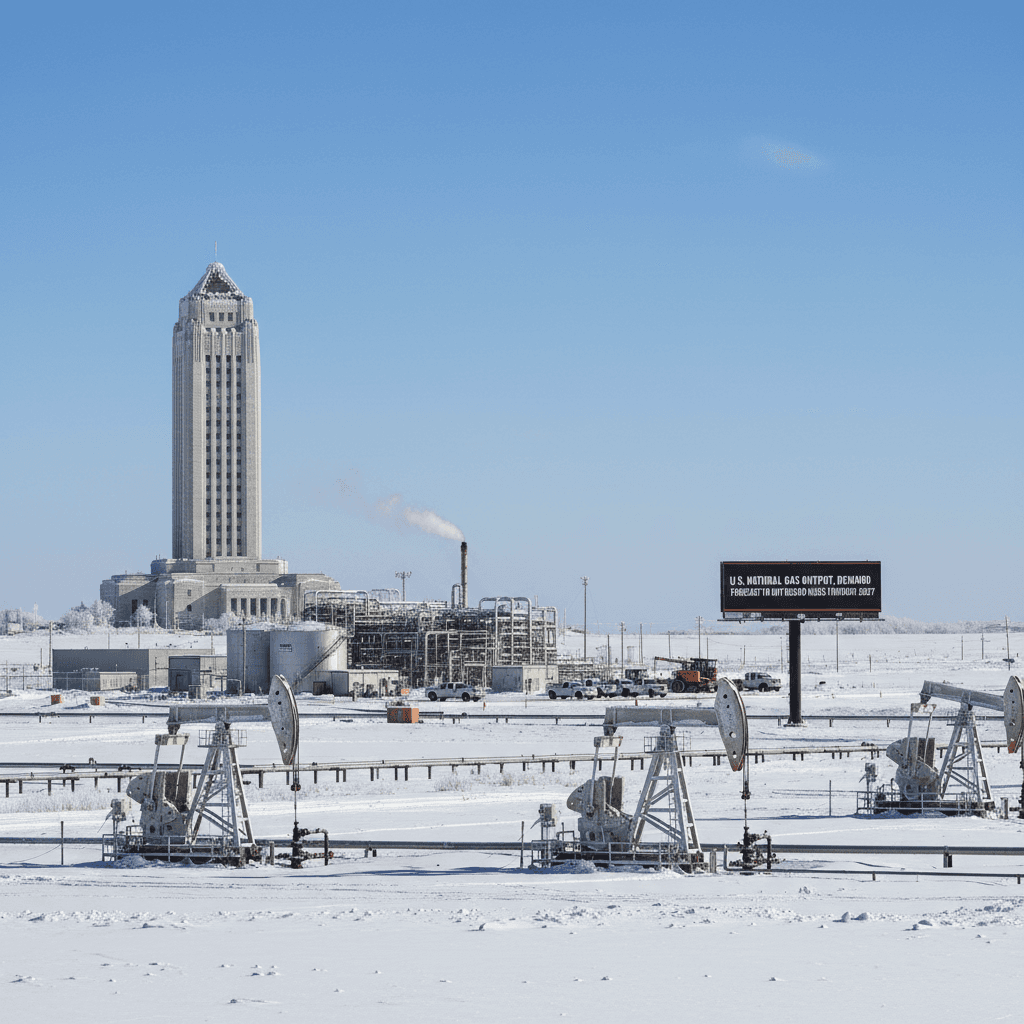
U.S. natural gas production and domestic consumption are forecast to reach record highs this year and next, according to the latest government data, signaling continued strong demand for gas produced in North Dakota's Bakken formation. The U.S. Energy Information Administration (EIA) projects dry gas production will rise from a record 107.6 billion cubic feet per day in 2025 to 111.7 bcfd in 2026 and 115.9 bcfd in 2027, according to OilPrice.com.

Domestic gas consumption is also projected to increase, from a record 91.9 bcfd in 2025 to 92.2 bcfd in 2026 and 94.3 bcfd in 2027. The EIA revised its predictions upwards in September compared to August forecasts. The agency also expects average U.S. liquefied natural gas exports to increase from a record 15.1 bcfd in 2025 to 17.4 bcfd in 2026 and 18.6 bcfd in 2027.

This robust demand outlook is being driven in part by a national construction boom in gas-fired power generation, much of it linked to powering artificial intelligence data centers. According to a Global Energy Monitor (GEM) report cited by OilPrice.com, the United States is now constructing around twice as much gas-fired capacity as China, and more than any other country worldwide. U.S. gas power capacity at any stage of development has risen by 50 percent since January.

“There has been an enormous surge in data centre proposals powered by gas in the past year, and the climate implications of that are huge,” said Jenny Martos, a project manager at Global Energy Monitor. “Building all of this gas for AI locks in decades of pollution, and it is also locking in dependence on a volatile fuel cost, which will get passed down to rate payers.”

Roughly half of the new capacity being developed is directly linked to data centers, with many operators opting for gas over renewable energy. This shift is expected to significantly increase U.S. carbon emissions over the next decade. The surge in development means U.S. spending on gas- and coal-fired power plants is expected to exceed China’s for the first time in several decades, according to the International Energy Agency.

However, this national build-out faces regulatory challenges. On September 26, a judge ruled that a Duke Energy gas power plant in North Carolina should not proceed, according to OilPrice.com. This highlights the potential permitting and legal hurdles that could impact the pace of new demand infrastructure coming online.

For Bakken operators, the record production and demand forecasts, coupled with rising LNG exports and a potential new demand source from data centers, point to a supportive long-term market for associated natural gas produced alongside the region's crude oil. The regulatory rejection in North Carolina serves as a reminder that the path to connecting supply with new demand centers can be complex.

Source

OilPrice.com

natural gaseiaproduction forecastdemandlng exportsai data centerspower generationregulation

Share this article

Related Articles

Regulatory

European Commission Proposes Energy Efficiency Rating for Data Centers

The European Commission has proposed an energy efficiency rating system for data centers, according to a report from Rigzone. Concurrently, the Commission launched a public consultation on minimum energy efficiency standards for such facilities. The proposed ratings and potential standards are part of broader European Union efforts to reduce energy consumption and carbon emissions. While the direct regulatory action is in Europe, it carries indirect implications for energy-producing regions like the Bakken. Data centers are significant consumers of electricity, and their power demand has been a growing market for natural gas-fired generation globally. Increased efficiency mandates in a major economic bloc like the EU could temper future growth in electricity demand. This, in turn, could influence long-term global projections for natural gas, a key commodity for Bakken producers. North Dakota's Bakken formation is a major producer of both oil and associated natural gas. The state has worked to reduce flaring...

🌅Afternoon Wire·Sep 23
North Dakota Oil Output Expected to Rise in August on Sustained Activity - Bakken Wire
Regulatory

North Dakota Oil Output Expected to Rise in August on Sustained Activity

North Dakota crude oil production is expected to have climbed in August and maintain momentum in the following months, according to state regulators. Sustained drilling activity and robust crude prices are supporting output across the state, the Department of Mineral Resources said. “Given activity levels and pricing, I suspect August will be a stronger month versus July,” Justin Kringstad, executive director of the North Dakota Pipeline Authority, told reporters during a monthly press briefing. Output in the United States’ third-largest oil-producing state rose marginally by 1,846 barrels per day to reach an average of 1.157 million bpd in July, according to the latest available production data. The state’s active rig count stood at 34 in September, unchanged from August. North Dakota also recorded nine active hydraulic fracturing crews and a record 20,072 producing wells in July. Gunther Harms, a treating plant manager at the Department of Mineral Resources, said rig...

🔆Midday Wire·Sep 23
Regulatory

North Dakota Oil Output Expected to Rise in August on Sustained Activity

North Dakota crude oil production is expected to have climbed in August and maintain momentum in the following months, according to state regulators. The forecast is based on sustained drilling activity and robust crude prices supporting output across the state, the Department of Mineral Resources said. Output in the United States’ third-largest oil-producing state rose marginally by 1,846 barrels per day to reach an average of 1.157 million barrels per day in July, according to the latest available production data released by the regulator. This exceeded the state’s forecast of 1.1 million bpd for the month. “Given activity levels and pricing, I suspect August will be a stronger month versus July,” Justin Kringstad, executive director of North Dakota’s Pipeline Authority, told reporters during a monthly press briefing. The state’s active rig count stood at 34 in September, unchanged from August, according to Department of Mineral Resources data. Gunther Harms, a...

🌅Afternoon Wire·Sep 22