WTI Crude--
Brent Crude--
Natural Gas--
ND Rig Count--
WTI Crude--
Brent Crude--
Natural Gas--
ND Rig Count--
Canada Sets 2027 Timeline for West Coast Oil Pipeline, Eyes Asian Markets - Bakken Wire
Pipeline & Infrastructure

Canada Sets 2027 Timeline for West Coast Oil Pipeline, Eyes Asian Markets

A new carbon pricing deal between Ottawa and Alberta could unlock a 1-million-bpd pipeline, potentially offering new outlet for Bakken crude.

Bakken Wire Staff·🔆Midday Wire·

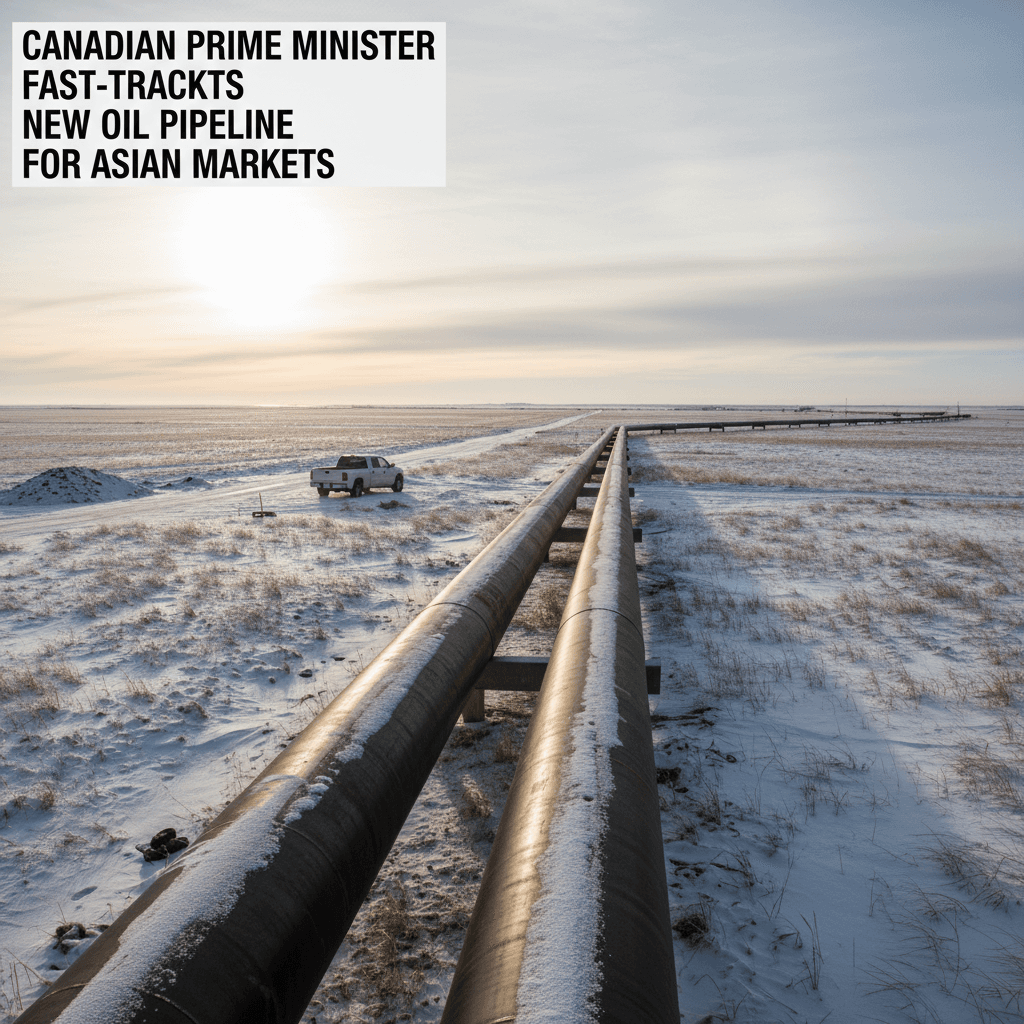
The Canadian government has reached a deal that could see construction start on a major new West Coast oil pipeline as early as September 2027, a move that could eventually provide a new export route for crude from the Bakken region. According to a report from OilPrice.com, Prime Minister Mark Carney and Alberta Premier Danielle Smith announced the agreement on Friday, May 15, 2026, building on a November memorandum.

The proposed pipeline would have the capacity to move roughly 1 million barrels per day to the Pacific coast, with the ultimate target of Asian markets. For North Dakota producers, a new outlet to tidewater could provide long-term optionality for Bakken crude, which currently relies heavily on U.S. Gulf Coast and Midwest markets. The agreement attempts to solve Canada's long-standing policy conflict of expanding oil infrastructure while attaching climate conditions.

Under the deal, Alberta's industrial carbon pricing framework will gradually increase, reaching C$130 per metric ton by 2040. OilPrice.com reported this is slower than many environmental groups wanted but leaves portions of the oil industry uneasy about competitiveness with the United States, which has no national carbon price. Concurrently, a major condition for federal support has been scaled back: the massive Pathways carbon capture project, backed by oil sands producers, now targets 6 million tons of emissions reductions by 2035, down from initial plans of 22 million tons annually by 2030.

The agreement establishes a concrete timeline. Alberta plans to submit a formal pipeline proposal by July 1, 2026, and Ottawa aims to designate it a project of national interest to fast-track reviews. However, a critical detail remains unresolved. OilPrice.com notes there is still no private sector pipeline company that has formally stepped forward to propose and build the project.

Despite the lack of a named proponent, the advancement from "perpetual debate" to a potential construction start date marks a significant shift. For Bakken operators and royalty owners, the development is worth monitoring. A new Canadian export pipeline could alter long-term flow dynamics and market access for light sweet crude from the Williston Basin, though any direct impact remains years away given the proposed 2027 start date.

The report frames the deal as Canada "inching toward something unusual" after years of legal and policy fights: an actual project. The success of this initiative hinges on the alignment of federal and provincial policies, industry investment, and the eventual identification of a pipeline builder.

Source

OilPrice.com
canadapipelineexportsalbertacarbon pricinginfrastructuremarket access

Share this article

Related Articles

Global Midstream Moves Highlight Strategic Shifts as Bakken Exports Compete - Bakken Wire
Pipeline & Infrastructure

Global Midstream Moves Highlight Strategic Shifts as Bakken Exports Compete

International midstream and refining developments reported this week highlight the complex global market in which Bakken crude competes for buyers and favorable transport routes. In Australia, Buru Energy said it plans to build a mini-refinery to supply the Kimberley region, according to Rigzone. The project is part of a new sales model for volumes from the Ungani field in the Canning Basin. While not directly related to North Dakota, such small-scale, localized refining projects represent a global trend toward securing regional fuel supply chains, a contrast to the Bakken's primary role as an exporter of light sweet crude to larger, distant refineries. Separately, the Dangote Group has offered East African countries a 30 percent equity stake in a giant refinery planned for the region, Rigzone reported, citing a Kenyan presidential adviser. The development of major new refining capacity in Africa could alter long-term crude flow patterns and competition for market...

☀️Morning Wire·Aug 22
Global Midstream News Highlights Refinery Plans, Shipping Risks - Bakken Wire
Pipeline & Infrastructure

Global Midstream News Highlights Refinery Plans, Shipping Risks

International midstream and refining developments reported Friday highlight the global context for North Dakota's oil exports, with new projects emerging and persistent shipping risks affecting crude flows. In Australia, Buru Energy said it plans to build a mini-refinery to supply the Kimberley region, according to Rigzone. The project is part of a new sales model for volumes from the Ungani field in the Canning Basin. While a small-scale project, it reflects a broader industry trend toward localized refining to capture value from stranded or marginal resources. Separately, the Dangote Group has offered East African countries a 30 percent equity stake in a giant refinery planned for the region, Rigzone reported, citing a Kenyan presidential adviser. This major infrastructure development aims to serve the East African market, potentially altering long-term refined product trade flows. Meanwhile, shipping disruptions continue to pose risks to global crude movements. Various tankers, including from the Sinokor...

🌅Afternoon Wire·Aug 21
Global Tensions Lift Oil Near $94; Mid-East Export Routes Shift - Bakken Wire
Pipeline & Infrastructure

Global Tensions Lift Oil Near $94; Mid-East Export Routes Shift

Global oil prices climbed to a one-month high near $94 per barrel this week as new U.S. threats against Iran raised fears of a prolonged conflict, according to Rigzone. The increase in geopolitical risk provides underlying support for Bakken crude prices, which are benchmarked against global markers. In response to security threats, Saudi Arabia is altering its crude export logistics. Shipowners, including Sinokor Group, are helping shuttle Saudi oil north to evade Houthi militants targeting exports via the Bab el Mandeb chokepoint in the southern Red Sea, Rigzone reported. This rerouting underscores ongoing volatility in key global shipping lanes that can affect crude flow and pricing. Meanwhile, Norway's natural gas production rose for a second consecutive month in July, with preliminary figures showing output of about 12.38 billion cubic feet per day, Rigzone reported. As a major supplier to Europe, sustained production from Norway helps balance global gas markets, indirectly...

🔆Midday Wire·Aug 21