WTI Crude--
Brent Crude--
Natural Gas--
ND Rig Count--
WTI Crude--
Brent Crude--
Natural Gas--
ND Rig Count--
Federal Grant, DAPL Settlement Mark Key Week for North Dakota Energy - Bakken Wire
Regulatory

Federal Grant, DAPL Settlement Mark Key Week for North Dakota Energy

A $36M DOE award launches major Bakken EOR initiative as the state nears a settlement over Dakota Access Pipeline protest costs.

Bakken Wire Staff·🌅Afternoon Wire·

The U.S. Department of Energy has officially awarded $36 million to a major initiative aimed at unlocking the next stage of oil production from the Bakken formation, according to an announcement by Sen. John Hoeven. The funding is part of the $157 million "Crack the Code 2.0" project, which includes contributions from the state and several oil companies, and aims to develop cost-effective enhanced oil recovery (EOR) technologies.

The effort will be led by the Energy and Environmental Research Center (EERC) at the University of North Dakota and will involve multiple large-scale pilot projects run by four different oil companies. "The key component of all of this is the EERC," said North Dakota Petroleum Council President Ron Ness. "We’ve got to bring the best of all those ideas together. That’s what the EERC does."

The federal funding comes as the EERC recently faced staffing cuts due to funding delays. UND confirmed 27 positions were cut and 13 employees were furloughed, with intentions to bring furloughed workers back when funding is available. Hoeven said the DOE award, available immediately, along with the renewal of a $25 million cooperative agreement, will help.

The project targets the economic challenge of applying EOR in shale formations like the Bakken. Lynn Helms, former state oil regulator and now leading EOR efforts with the Petroleum Council, said smaller pilot projects have shown increased oil recovery but not at economic levels. "That’s what these major, large demonstration projects are all about... The costs are very, very high," Helms said. The new pilot projects, scheduled to begin over the next 12 months, will be on a much bigger scale, according to John Harju, a vice president with the EERC.

In a separate federal matter, a nearly seven-year lawsuit over state costs from Dakota Access Pipeline (DAPL) protests is nearing a settlement. A federal district court judge has indicated he will nullify a nearly $28 million judgment against the federal government so the parties can settle, according to a hearing held Friday.

North Dakota is still set to receive a "substantial monetary payment" described as satisfactory by Attorney General Drew Wrigley, though the amount was not disclosed. The lawsuit, filed in 2019, claimed the federal government caused protests to grow by allowing demonstrators to camp on federal land, forcing the state to pay millions for policing and cleanup.

Attorneys for both sides said the settlement would avoid a lengthy appeals process. "We’re hoping we really don’t need to fight any further," said Department of Justice attorney Jonathan Guynn. A condition of the settlement is that Judge Daniel Traynor's 2025 judgment and related orders be voided to prevent their legal conclusions from influencing future lawsuits.

Source

Bing News (kfgo.com), published May 8-9, 2026.
enhanced oil recoverydepartment of energyeercbakken formationdakota access pipelinedaplfederal lawsuitregulationnorth dakota

Share this article

Related Articles

Regulatory

Global Energy Security Concerns Highlight Need for Robust Bakken Production

The rapid digitalization of power grids is outstripping regulatory frameworks, creating energy security vulnerabilities, according to a recent report from European energy experts. This global dynamic underscores the continued strategic importance of reliable, domestic hydrocarbon production from regions like the Bakken. Elena Boskov-Kovacs, co-founder of Blueprint Energy Solutions, stated that regulatory processes lag behind technological deployment in the energy sector. "There’s a mismatch in speed rather than a gap in technology – in making digital solutions useful and deployable quick enough to keep pace with the physical transformation of the grid," she was quoted in a report for Enlit. She cited the rapid connection of solar, EVs, and heat pumps as creating "very practical concerns for system operators: unobservability at the edge of the grid, limited hosting capacity, congestion and ultimately the risk of blackouts." These challenges in grid management and energy security are particularly acute in Europe, which is...

🌅Afternoon Wire·Oct 6
EPA Relinquishes Power Plant GHG Authority, Citing Economic Benefits - Bakken Wire
Regulatory

EPA Relinquishes Power Plant GHG Authority, Citing Economic Benefits

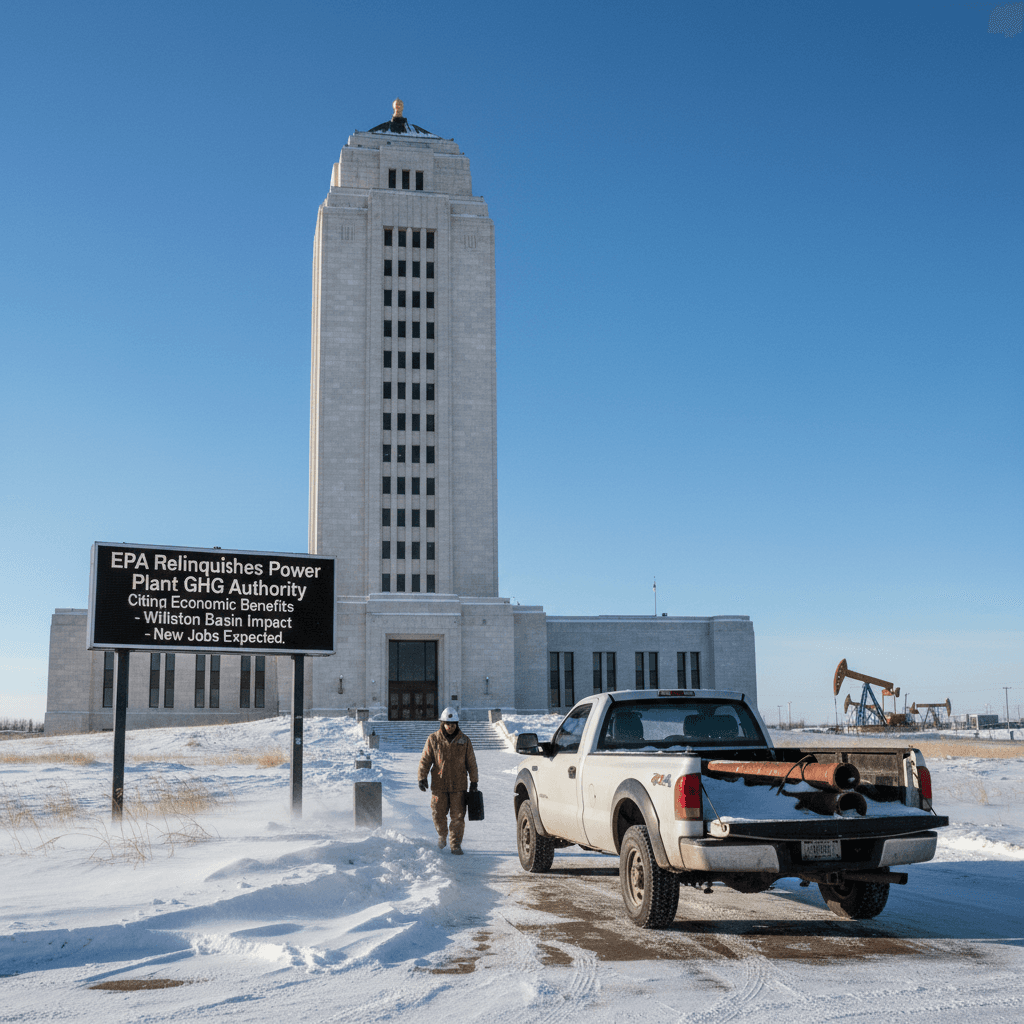
The U.S. Environmental Protection Agency (EPA) announced in September that it will relinquish its authority to regulate greenhouse gas emissions from power plants under the Clean Air Act, according to OilPrice.com. The move effectively removes federal limits on emissions from coal and natural gas plants. The EPA expects the decision to result in an additional 123 million metric tonnes of carbon dioxide released into the atmosphere over the next decade, OilPrice.com reported. The agency's analysis estimates the change will save power plant operators $370 million in direct compliance costs, but does not factor in the financial benefits of reduced air pollution. For North Dakota, a major coal-producing and natural gas-fired power state, the policy shift could impact the operating environment for associated energy infrastructure. The decision follows President Trump's earlier move to overturn the foundational 2009 EPA endangerment finding that greenhouse gases threaten public health and the environment, and a...

🔆Midday Wire·Sep 27
Regulatory

EIA Projects Record US Gas Output Amid Rising Demand, AI Data Center Buildout

U.S. natural gas production is on track to hit new record highs in 2026 and 2027, with surging demand from liquefied natural gas (LNG) exports and a wave of gas-fired power plants for AI data centers driving the outlook, according to U.S. Energy Information Administration (EIA) data released in September 2026. For North Dakota's Bakken formation, a major gas-producing region, the forecasts reinforce a strong market for associated natural gas, despite a recent regulatory setback for a gas plant project in North Carolina. The EIA now expects dry natural gas production to rise from a record 107.6 billion cubic feet per day (bcfd) in 2025 to 111.7 bcfd in 2026 and 115.9 bcfd in 2027, OilPrice.com reported. Domestic gas consumption is projected to increase from 91.9 bcfd in 2025 to 92.2 bcfd in 2026 and 94.3 bcfd in 2027. Average U.S. LNG exports are forecast to climb from 15.1 bcfd...

☀️Morning Wire·Sep 27