WTI Crude--
Brent Crude--
Natural Gas--
ND Rig Count--
WTI Crude--
Brent Crude--
Natural Gas--
ND Rig Count--
ND Industrial Commission Approves $500M Backstop for WBI Gas Pipeline - Bakken Wire
Regulatory

ND Industrial Commission Approves $500M Backstop for WBI Gas Pipeline

The state's financial commitment finalizes support for the Bakken East pipeline, aimed at moving 1 Bcf/d of gas from the core of the play to eastern markets by 2030.

Bakken Wire Staff·☀️Morning Wire·

The North Dakota Industrial Commission has unanimously voted to commit up to $500 million in state funds as a financial backstop for WBI Energy's planned Bakken East natural gas pipeline. The vote on Tuesday, April 28, finalizes a selection process that began last summer and provides a major boost to infrastructure aimed at moving more Bakken gas to market.

The Bakken East pipeline is designed to move 1 billion cubic feet of natural gas per day from McKenzie County in the heart of the Bakken to central and eastern North Dakota. WBI Energy, a subsidiary of MDU Resources, expects the pipeline to be in service by the end of 2030.

"This is going to be great in the short term, and it’s going to be great for the long term for North Dakota," said Gov. Kelly Armstrong, who chairs the three-member Industrial Commission, according to the North Dakota Monitor. Armstrong stated the legislative goal was both "financial incentive and promotional incentive," which he believes is being achieved.

The commitment fulfills a mandate from the 2025 Legislature, which authorized the financing to connect the western oil fields to the eastern half of the state. The Industrial Commission selected WBI Energy's two-phase project over a competing applicant last August. The state's support is structured as purchasing a portion of the pipeline's transport capacity.

Justin Kringstad, executive director of the North Dakota Pipeline Authority, was authorized to execute the agreement. He noted that after a closed-door briefing last month on negotiations with potential shippers and customers, the need for the state's commitment—described as "$50 million per year"—remained to advance the project, the North Dakota Monitor reported.

The project is critical for Bakken operators who face persistent challenges with natural gas capture due to a lack of pipeline takeaway capacity, particularly to markets within the state. Moving gas east could support new industrial customers and power generation, adding value to a product that is often flared when pipelines are full.

The Industrial Commission also includes Agriculture Commissioner Doug Goehring and Attorney General Drew Wrigley. The commission's vote marks the culmination of nearly a year of negotiations since WBI Energy's proposal was selected for the state guarantee.

Source

North Dakota Monitor (April 29, 2026), Bismarck Tribune (April 29, 2026)
natural gaspipelinesregulationinfrastructurewbi energymdu resourcesnorth dakota industrial commission

Share this article

Related Articles

Regulatory

Global Energy Security Concerns Highlight Need for Robust Bakken Production

The rapid digitalization of power grids is outstripping regulatory frameworks, creating energy security vulnerabilities, according to a recent report from European energy experts. This global dynamic underscores the continued strategic importance of reliable, domestic hydrocarbon production from regions like the Bakken. Elena Boskov-Kovacs, co-founder of Blueprint Energy Solutions, stated that regulatory processes lag behind technological deployment in the energy sector. "There’s a mismatch in speed rather than a gap in technology – in making digital solutions useful and deployable quick enough to keep pace with the physical transformation of the grid," she was quoted in a report for Enlit. She cited the rapid connection of solar, EVs, and heat pumps as creating "very practical concerns for system operators: unobservability at the edge of the grid, limited hosting capacity, congestion and ultimately the risk of blackouts." These challenges in grid management and energy security are particularly acute in Europe, which is...

🌅Afternoon Wire·Oct 6
EPA Relinquishes Power Plant GHG Authority, Citing Economic Benefits - Bakken Wire
Regulatory

EPA Relinquishes Power Plant GHG Authority, Citing Economic Benefits

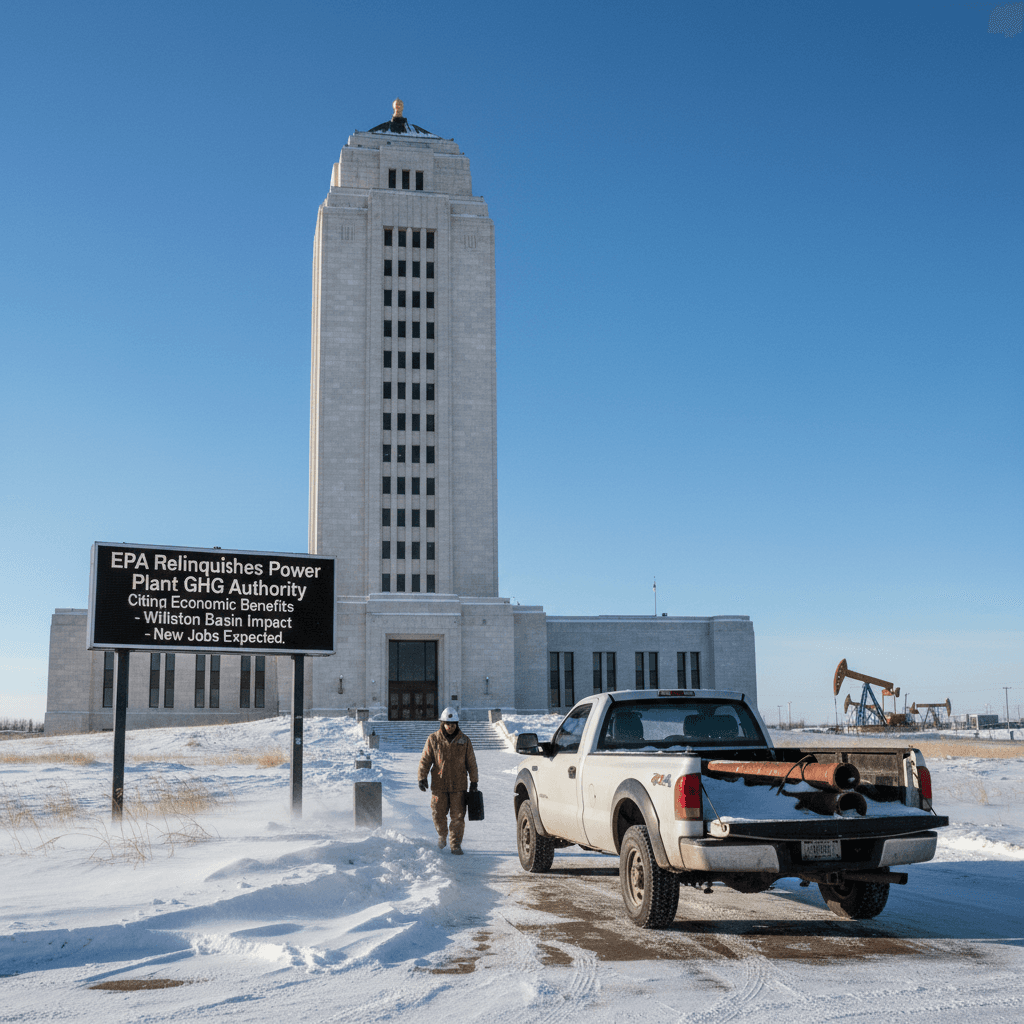
The U.S. Environmental Protection Agency (EPA) announced in September that it will relinquish its authority to regulate greenhouse gas emissions from power plants under the Clean Air Act, according to OilPrice.com. The move effectively removes federal limits on emissions from coal and natural gas plants. The EPA expects the decision to result in an additional 123 million metric tonnes of carbon dioxide released into the atmosphere over the next decade, OilPrice.com reported. The agency's analysis estimates the change will save power plant operators $370 million in direct compliance costs, but does not factor in the financial benefits of reduced air pollution. For North Dakota, a major coal-producing and natural gas-fired power state, the policy shift could impact the operating environment for associated energy infrastructure. The decision follows President Trump's earlier move to overturn the foundational 2009 EPA endangerment finding that greenhouse gases threaten public health and the environment, and a...

🔆Midday Wire·Sep 27
Regulatory

EIA Projects Record US Gas Output Amid Rising Demand, AI Data Center Buildout

U.S. natural gas production is on track to hit new record highs in 2026 and 2027, with surging demand from liquefied natural gas (LNG) exports and a wave of gas-fired power plants for AI data centers driving the outlook, according to U.S. Energy Information Administration (EIA) data released in September 2026. For North Dakota's Bakken formation, a major gas-producing region, the forecasts reinforce a strong market for associated natural gas, despite a recent regulatory setback for a gas plant project in North Carolina. The EIA now expects dry natural gas production to rise from a record 107.6 billion cubic feet per day (bcfd) in 2025 to 111.7 bcfd in 2026 and 115.9 bcfd in 2027, OilPrice.com reported. Domestic gas consumption is projected to increase from 91.9 bcfd in 2025 to 92.2 bcfd in 2026 and 94.3 bcfd in 2027. Average U.S. LNG exports are forecast to climb from 15.1 bcfd...

☀️Morning Wire·Sep 27