WTI Crude--
Brent Crude--
Natural Gas--
ND Rig Count--
WTI Crude--
Brent Crude--
Natural Gas--
ND Rig Count--
ND Wins $36M Federal EOR Grant, DAPL Protest Settlement Advances - Bakken Wire
Regulatory

ND Wins $36M Federal EOR Grant, DAPL Protest Settlement Advances

A federal judge signaled he will vacate a $28M judgment against the U.S. as a settlement is finalized, while the state receives new funding for oil recovery.

Bakken Wire Staffยท๐Ÿ”†Midday Wireยท

North Dakota is set to receive a multimillion-dollar federal payment to settle a lawsuit over Dakota Access Pipeline protest costs, while simultaneously securing a $36 million grant for enhanced oil recovery projects in the state, according to reports from this week.

According to Bing News, U.S. District Court Judge Daniel Traynor signaled on Friday, May 8, 2026, that he will vacate a nearly $28 million judgment against the federal government. The judgment was awarded to North Dakota in April 2025 after the state argued the federal government allowed protesters to camp on federal land during the 2016-2017 demonstrations near the Standing Rock Sioux Reservation, leading to millions spent on law enforcement and cleanup. Attorneys for both parties stated during a hearing that North Dakota is still expected to receive a payment from the federal government as part of a settlement, though the final amount has not been disclosed. The Department of Justice sought to have Traynor's rulings vacated to avoid the legal findings influencing future cases.

Separately, North Dakota is receiving $36 million from the Department of Energy for enhanced oil recovery (EOR), Bing News reported. Senator John Hoeven stated that this new multi-million dollar investment will mean more oil production in the state.

For Bakken operators and the state's oil industry, the two developments represent significant financial inflows. The settlement, even at a reduced amount, would recoup some of the costs borne by North Dakota during the DAPL protests, which impacted pipeline operations and regional security. The $36 million EOR grant is a direct investment in technology to increase production from existing wells, potentially boosting ultimate recovery from the Bakken formation.

The legal settlement advances a case that has been pending since North Dakota filed the lawsuit in 2019. The resolution removes lingering litigation and provides closure on a contentious period that involved the state's primary oil transportation artery.

The federal EOR funding aligns with state and industry goals to extend the life and productivity of the Bakken play. Enhanced oil recovery techniques, such as carbon capture and storage used for injection, can help operators recover more oil from mature fields.

Source

Bing News (Federal judge signals he will vacate $28M DAPL protest judgment as settlement nears, published 2026-05-11; North Dakota receives $36 million in federal money for enhanced oil recovery, published 2026-05-11)
dakota access pipelineregulationfederal governmentlitigationenhanced oil recoveryfundingbakken

Share this article

Related Articles

Federal Offshore Reef Program Announced, Bakken Impact Unclear - Bakken Wire
Regulatory

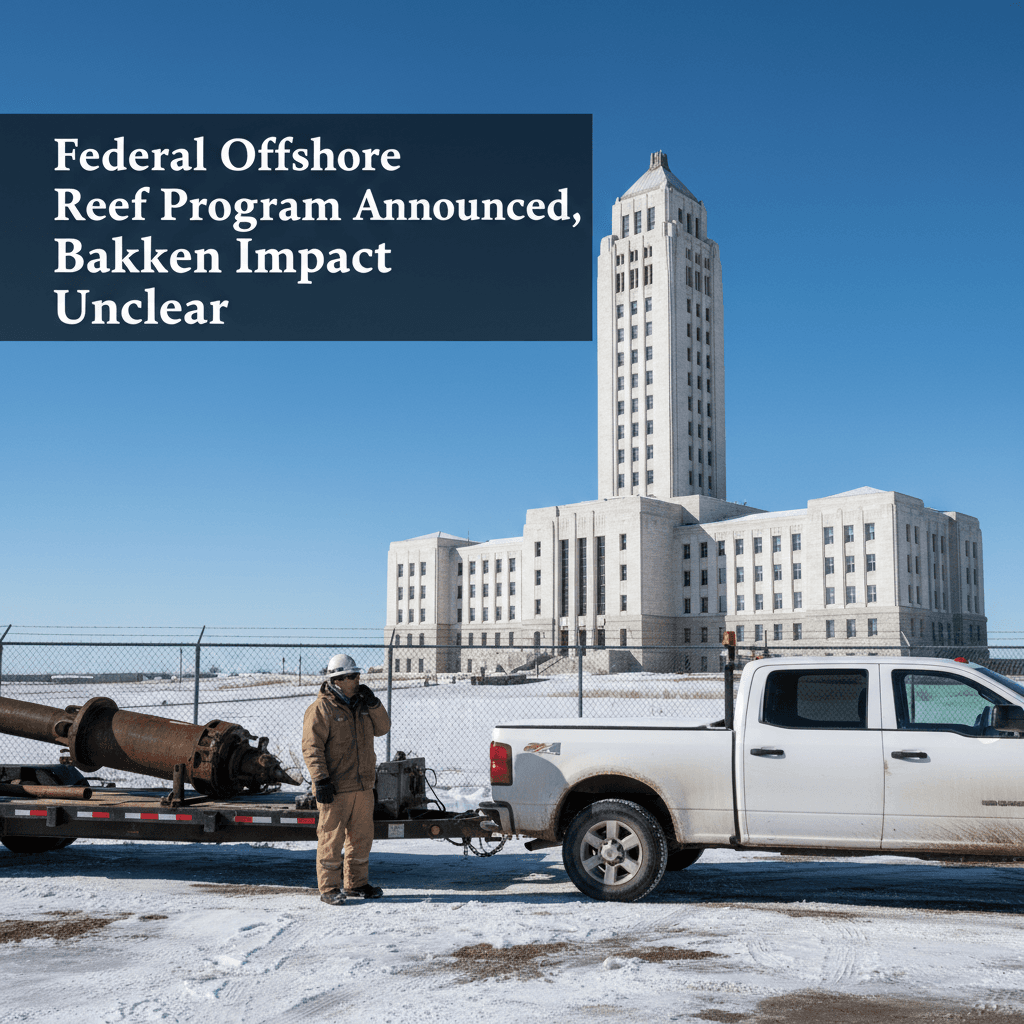
Federal Offshore Reef Program Announced, Bakken Impact Unclear

The federal Maritime and Minerals Administration (MMA) has announced a new "Reef in Place" program for the Outer Continental Shelf (OCS), according to a report from Rigzone. The program allows eligible decommissioned offshore structures to be converted into artificial reefs. Acting MMA Director Mike Olsen stated that the eligible structures "can continue to serve our coastal communities as artificial reefs," Rigzone reported. The announcement was made on November 18, 2026. The program applies specifically to federal offshore operations and has no direct regulatory or operational impact on onshore shale basins like North Dakota's Bakken formation. Bakken operators are subject to different state and federal land management and well-plugging regulations. For the Williston Basin industry, the news highlights the divergent regulatory paths for offshore versus onshore oil and gas development. While offshore operators may now have a new option for structure decommissioning, Bakken operators follow a stringent state-led process for well...

๐Ÿ”†Midday WireยทNov 18
Regulatory

Venezuela Gear Repairs, Federal Land Sale Plan Draw Bakken Attention

Friday, Nov. 13, 2026 โ€” Two policy developments reported by Rigzone on Nov. 12 are likely to draw attention from Bakken operators and royalty owners, even though neither report described North Dakota leases. Venezuela is sending state-owned oil equipment to the United States for repairs for the first time in more than a decade, according to Rigzone. The move points to a limited reopening of a trade channel that has been constrained for years. For Bakken operators, the broader significance lies in equipment logistics, service-market access and regulatory posture. The Bakken depends on a deep U.S. services base, so operators typically watch shifts in international equipment flows for signs of cost pressure, competition for shop capacity and changing trade-risk calculations. Rigzone also reported that the Trump administration unveiled plans to sell public land as part of a new strategy laying out Interior Department goals. For Bakken producers, federal-land policy matters...

โ˜€๏ธMorning WireยทNov 13
Regulatory

Venezuelan Oil Gear Sent to U.S. for Repairs After Decade

Venezuela is sending state-owned oil equipment to the United States for repairs for the first time in more than a decade, according to Rigzone. The report was published Thursday, Nov. 12, 2026. The development carries regulatory significance because it involves cross-border movement of state-owned oil equipment, a type of transaction that can be shaped by policy decisions, licensing and sanctions-related restrictions. Rigzone did not provide additional details on the equipment, the regulatory approvals involved or the companies performing the repairs. For Bakken operators, the significance is indirect but real. North Dakota producers depend on a deep U.S. oilfield services base for drilling, completions, workovers and maintenance. When foreign state-owned oil equipment uses U.S. repair shops and service yards, it can reflect the availability of American industrial capacity. It can also affect demand for specialized parts, machining, inspection and repair crews that compete with domestic workloads. The move may also signal...

๐ŸŒ…Afternoon WireยทNov 12