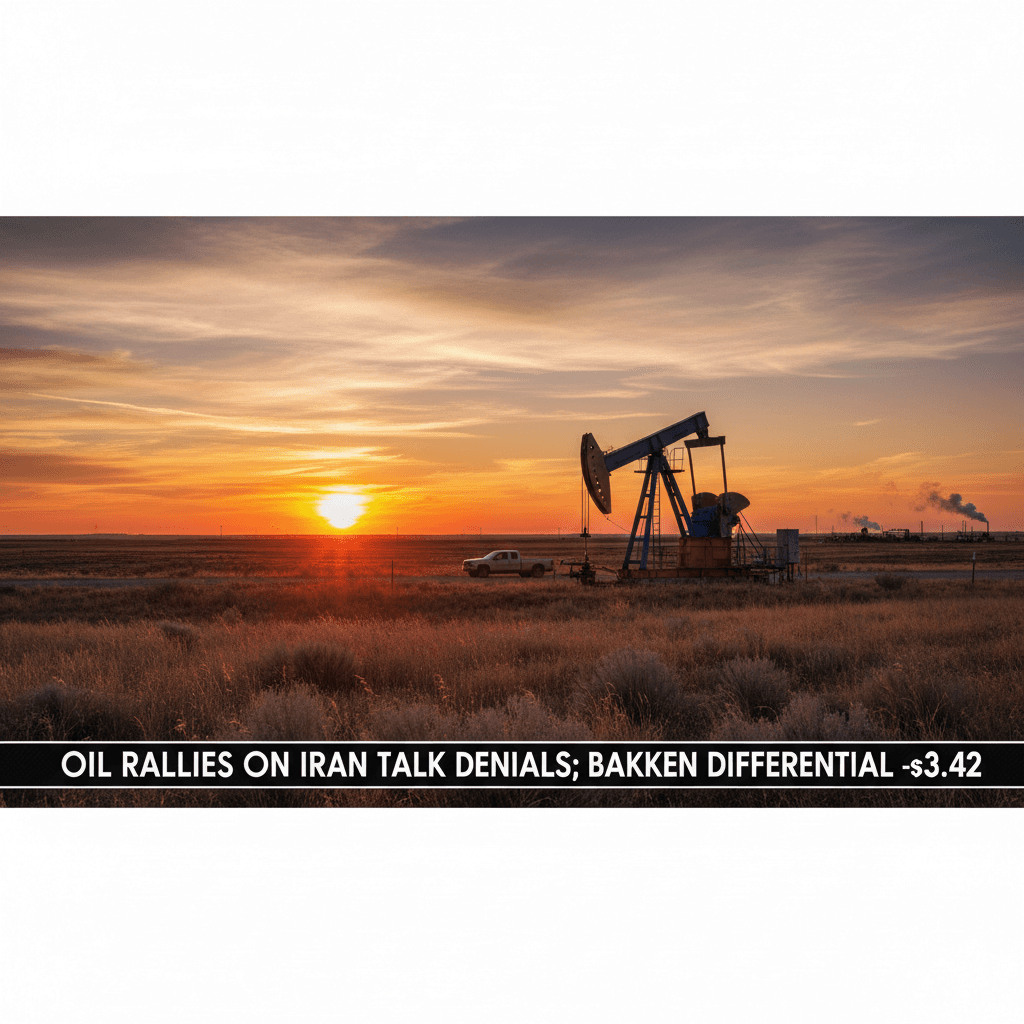
Oil Prices Dip as Supply Disruptions Ease, Bakken Differential Holds at -$3.42
WTI falls to $85.79 amid signs of recovering crude flows from the Persian Gulf, a key development for global benchmarks.
Oil prices declined in morning trading on Thursday, with West Texas Intermediate (WTI) crude down 0.86% to $85.79 per barrel. The international benchmark Brent crude also fell, dropping 0.67% to $92.14, according to live price data. The price of Bakken crude, a key grade for North Dakota producers, traded at a discount of $3.42 per barrel below WTI.
The modest price pullback coincides with reports that crude supply routes from the Persian Gulf are materially recovering. According to a report from OilPrice.com, India has imported more oil from the Persian Gulf than from Russia so far in November—the first time since the Iran war began nine months ago. Data from Kpler cited by Bloomberg shows India imported an estimated 2.1 million barrels per day (bpd) from the Gulf this month, compared to 1.8 million bpd from Russia.
This shift signals a significant rebound in shipments through the critical Strait of Hormuz, which had seen flows to India collapse to as low as 247,000 bpd in April. The recovery is attributed to expanded ship-to-ship transfer operations, which have moved closer to India's coastlines to bypass congestion and security risks near the Strait. The report notes that Middle Eastern exporters are working to keep supplies flowing to Asian markets, with one major Indian refiner, Bharat Petroleum Corporation Limited (BPCL), already planning to reduce Russian crude purchases in November due to high freight costs.
For Bakken operators, the easing of a major global supply disruption applies downward pressure on the benchmark prices that dictate their revenue. However, the stable Bakken differential, which reflects the local price at the wellhead relative to WTI, suggests regional market dynamics remain consistent. The current differential of -$3.42 is a critical figure for calculating netbacks for North Dakota producers.
Natural gas prices bucked the trend in energy markets, rising by $0.07 to $3.28 per MMBtu. This increase may provide a marginal boost to operators with significant gas production in the Bakken's rich gas window.
The overall price movement reflects a market adjusting to improved physical supply availability from a key producing region. While geopolitical risks persist, the re-establishment of more reliable crude flows from the Gulf helps to alleviate one of the premium factors that has supported oil prices in recent months. Bakken producers will continue to watch these global developments closely, as they directly impact the WTI benchmark against which their oil is priced.
Source
Live price data, OilPrice.com report published November 12, 2026