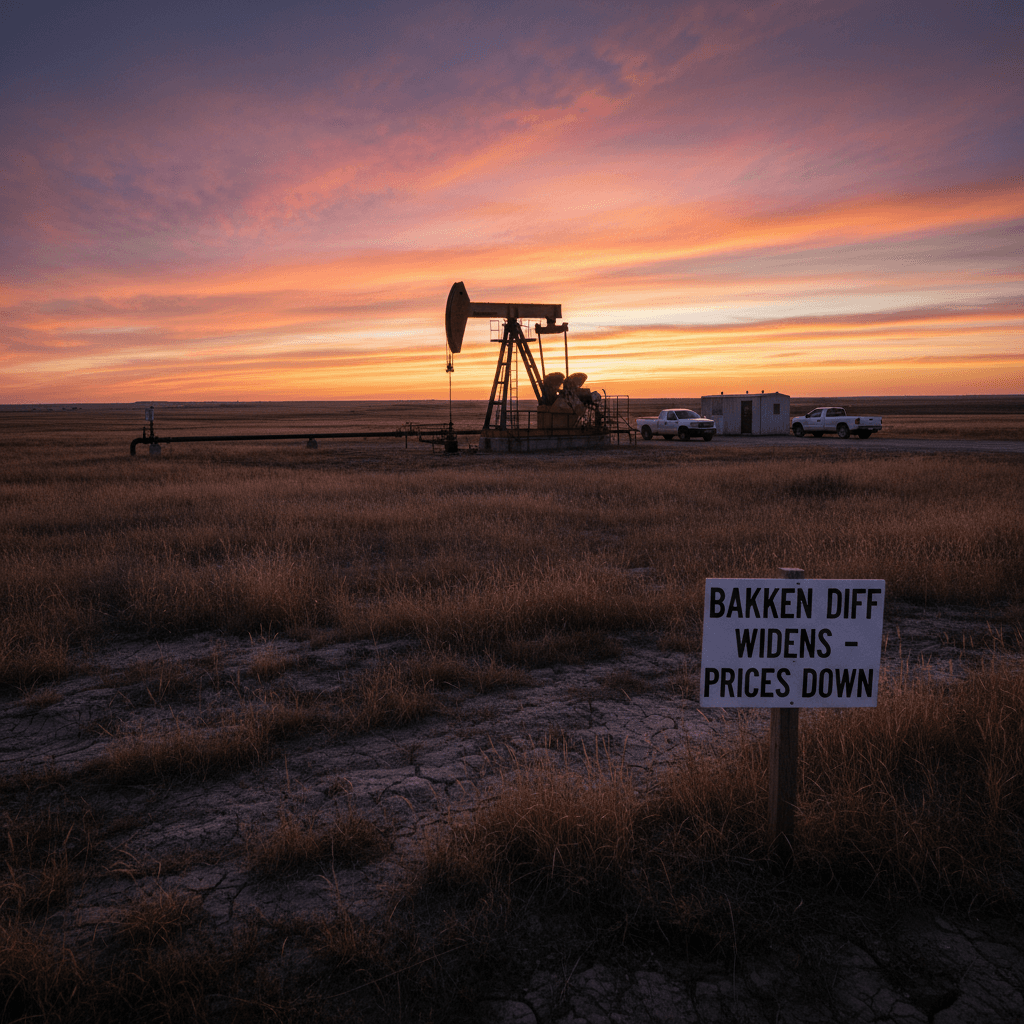
Oil Prices Drop Sharply Amid Demand Concerns, Bakken Differential Widens
WTI and Brent crude post significant losses, while Bakken crude trades at a wider discount to the benchmark.
Oil prices fell sharply in trading Saturday, with global benchmarks Brent and WTI crude both dropping more than 2.5%. West Texas Intermediate (WTI) crude closed at $92.41 per barrel, a loss of $2.20 or 2.33%. The global benchmark, Brent crude, settled at $97.44 per barrel, down $2.78 or 2.77%.
The price drop pressures the value of crude produced in the Bakken formation. North Dakota's Bakken crude price is typically quoted as a differential to WTI. According to live price data, the Bakken differential widened to a discount of $3.42 per barrel below WTI. This means Bakken crude is effectively priced at approximately $88.99 per barrel.
Natural gas prices also declined, with the benchmark falling $0.15 to settle at $3.23 per million British thermal units (MMBtu).
The sudden downturn reverses recent strength in oil markets. Analysts point to rising concerns over global fuel demand as a primary driver for the sell-off. Economic data from major consuming nations, including signs of slowing manufacturing activity, has fueled fears that oil consumption may weaken.
For Bakken operators, the immediate impact is a reduction in the per-barreal revenue received for their production. The wider differential compounds the effect of the falling benchmark price, meaning Bakken producers realize a price nearly $5.60 per barrel less than the global Brent benchmark. This squeeze on margins can influence decisions on well completion schedules and drilling pace, particularly for operators with higher breakeven costs.
The price movement comes amid a complex global landscape for oil. Market participants continue to monitor geopolitical tensions in key producing regions and the production policy of the OPEC+ alliance. Inventory reports from the U.S. Energy Information Administration, which showed a larger-than-expected build in crude stocks earlier in the week, have also contributed to a less bullish sentiment.
While prices remain at elevated levels compared to historical averages, the volatility underscores the sensitivity of the Bakken's economic viability to global commodity swings. The formation's high productivity and relatively low decline rates help offset price dips, but sustained lower prices would test operator resilience. Royalty owners in North Dakota will also see the effects of the lower realized prices in their upcoming monthly statements.
Source
Live Price Data provided to Bakken Wire