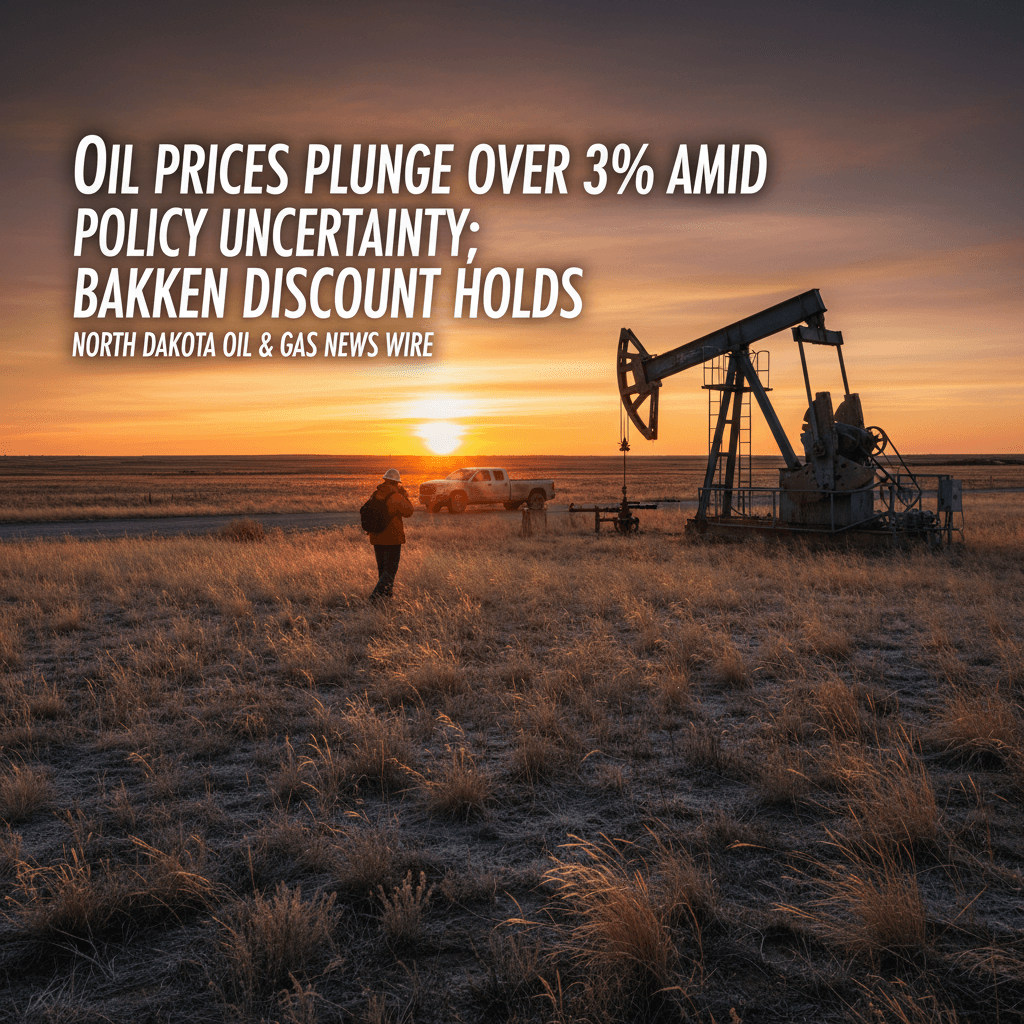
Oil Prices Plunge Over 3% Amid Policy Uncertainty; Bakken Discount Holds
WTI crude drops below $89 as White House considers red-dyed diesel relief as alternative to export ban.
Oil prices fell sharply on Tuesday, with the U.S. benchmark dropping nearly 4% as policymakers weighed measures to address soaring fuel costs. West Texas Intermediate (WTI) crude settled at $88.91, down $3.69 (-3.98%) for the session. The global benchmark, Brent crude, closed at $95.65, a decline of $2.18 (-2.23%). Bakken crude traded at a discount of $-3.42 per barrel versus WTI.
The price decline coincides with ongoing discussions in Washington over how to combat high diesel prices, according to a report from OilPrice.com. The White House is reportedly weighing a plan to boost the availability of tax-exempt red-dyed diesel as an alternative to a proposed diesel export ban. Red-dyed diesel, used in agriculture and construction, is exempt from the federal excise duty of $0.244 per gallon.
The policy debate highlights the complex pressures on fuel markets seven months into a war involving the United States, Israel, and Iran. Diesel prices hit record highs earlier this month, topping $6.50 per gallon, as constrained exports from the Persian Gulf led U.S. refiners to ramp up processing and export more fuel to Europe. While President Trump has signaled support for an export ban, Energy Secretary Chris Wright and analysts warn such a move could backfire by forcing refiners to cut run rates, potentially reducing gasoline supply and raising its price.
For Bakken operators, the sustained high differential of over $3 below WTI represents a significant headwind on per-barreal revenue, even as global benchmarks remain elevated. The ongoing geopolitical tension and policy uncertainty create a volatile planning environment. The discussion around red-dyed diesel relief is aimed primarily at the agricultural and construction sectors, key components of the regional economy surrounding the Bakken play.
The current price environment, with Brent holding above $95, continues to provide economic incentive for production in the Williston Basin, but local price realizations are tempered by the persistent differential. Market watchers will be focused on whether proposed federal interventions provide relief for end-users without disrupting the crude export flows that underpin much of the basin's activity.
Source
Live Price Data, OilPrice.com