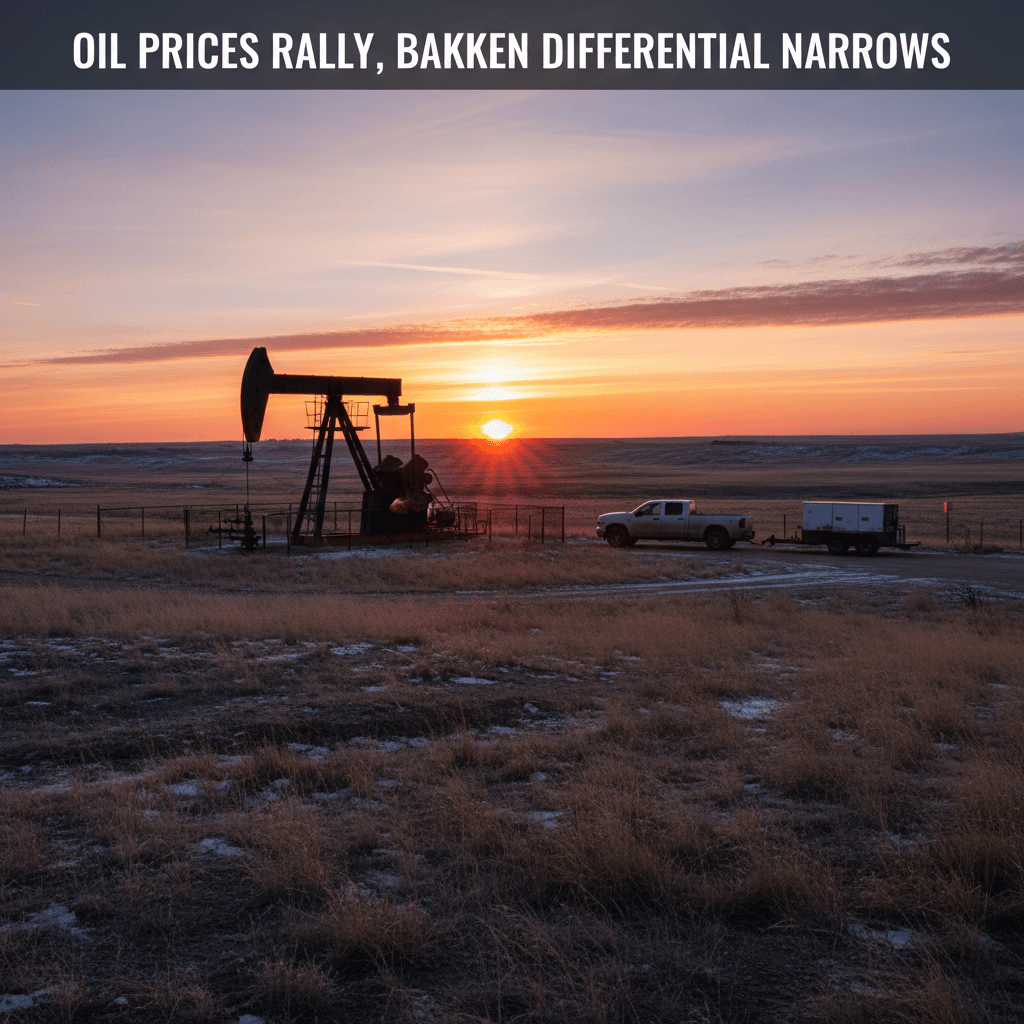
Oil Prices Rally, Bakken Differential Narrows
WTI and Brent crude gain over 1.8% on supply concerns, boosting the outlook for Bakken producers.
Oil prices posted strong gains in Tuesday's trading, with global supply constraints and geopolitical tensions providing support. West Texas Intermediate (WTI) crude for January delivery settled at $81.63 per barrel, a gain of $1.46 or 1.82%. The global benchmark, Brent crude, rose $1.79 to close at $88.47 per barrel, a 2.07% increase, according to live price data.
The rally widened the spread between the two benchmarks to nearly $7, reflecting ongoing concerns about disruptions to Middle Eastern supply routes. Natural gas prices also saw significant upward movement, rising $0.16 to settle at $3.69 per MMBtu.
For Bakken shale operators, the price of their crude is benchmarked against WTI, minus a regional discount known as the differential. That differential narrowed on Tuesday, standing at -$3.42 per barrel below the WTI price. This means the effective price for Bakken crude at the Clearbrook, Minnesota, trading hub is approximately $78.21 per barrel.
A combination of factors is driving the bullish sentiment. Persistent output cuts from OPEC+ nations, notably Saudi Arabia and Russia, continue to tighten the global market. These coordinated reductions are designed to balance the market and have provided a consistent floor under prices throughout 2026. Recent escalations in conflict in key regions have also heightened the risk premium priced into crude, particularly for the Brent benchmark which is more sensitive to Middle Eastern and Atlantic Basin supply issues.
The price environment above $80 WTI, coupled with a differential under $4.00, is favorable for North Dakota producers. At these levels, most drilling in the core of the Bakken formation remains economically viable, supporting steady production and cash flow. The state's output has hovered near 1.3 million barrels per day for much of the year, and sustained prices can help maintain that plateau.
The concurrent rise in natural gas prices offers an additional revenue stream for Bakken operators, many of whom produce significant associated gas alongside oil. While North Dakota still faces infrastructure challenges for gas capture and transportation, higher prices improve the economics for gas processing and flaring reduction efforts.
Today's price action suggests the market is absorbing broader economic signals and focusing on tangible supply risks. For royalty owners and operators in the Williston Basin, the current price structure supports continued investment and operational stability as the year draws to a close.
Source
Live Price Data