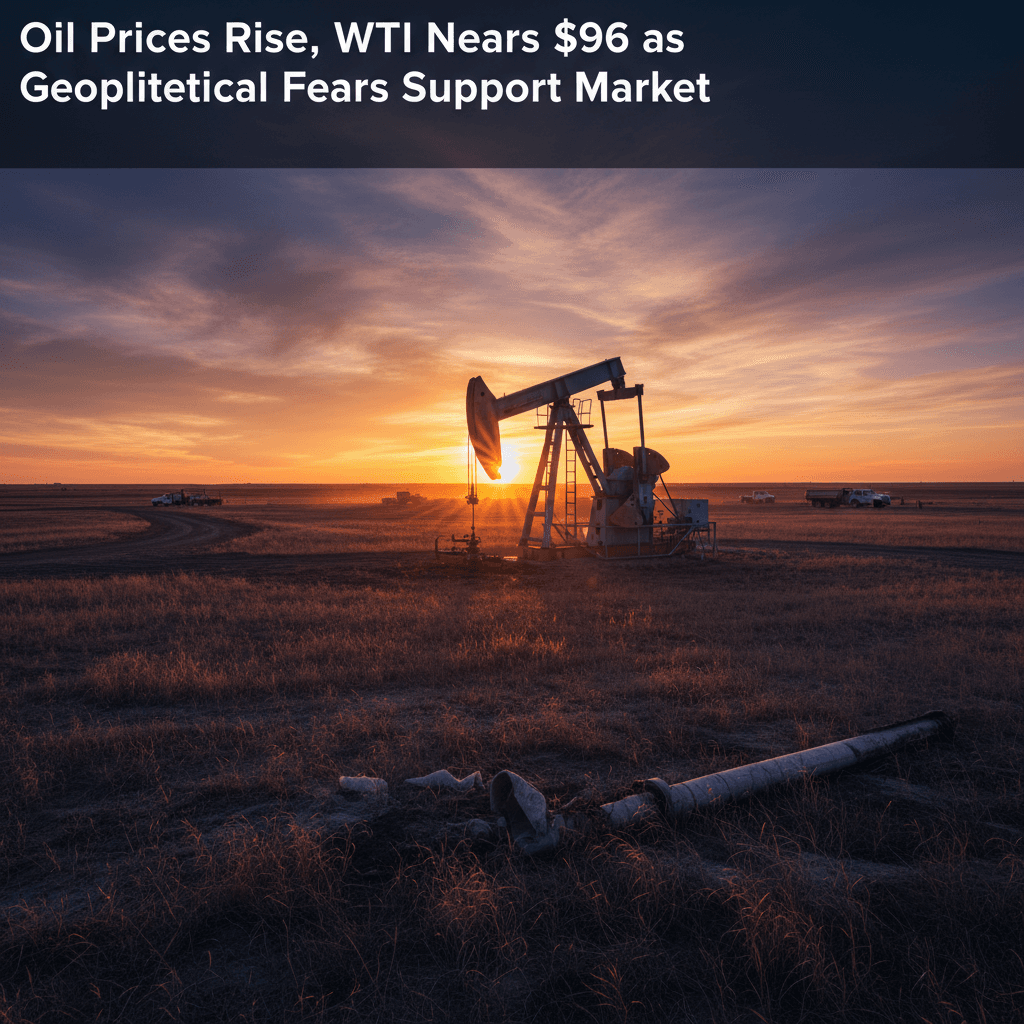
Oil Prices Rise, WTI Nears $96 as Geopolitical Fears Support Market
Bakken crude trades at a $3.42 discount to WTI as natural gas prices dip slightly.
Front-month WTI crude oil prices surged 1.89% in early trading Wednesday, October 14, adding $1.78 to trade at $95.92 per barrel. The global Brent benchmark also rose, gaining $0.64 to $106.33 per barrel, according to live price data.
The price strength continues to be underpinned by ongoing geopolitical tensions in the Middle East, which pose a persistent threat to global supply. Rigzone reported that these concerns supported the market even as traders engaged in some profit-taking, leading to a mixed settlement in the previous session.
For Bakken producers, the rally in the U.S. benchmark directly boosts wellhead economics. The Bakken crude differential—the discount at which local crude trades compared to the WTI benchmark—was recorded at $-3.42. This means Bakken barrels are priced at approximately $92.50 per barrel based on the current WTI price.
In contrast to the gains in crude, natural gas prices saw a slight decline, edging down $0.03 to $3.25 per barrel. This divergence highlights the commodity-specific drivers affecting the energy complex, with oil more immediately sensitive to international supply risks.
The sustained premium of Brent crude over WTI, now at over $10 per barrel, reflects the greater exposure of European and Asian markets to potential supply disruptions from the Middle East. This wider spread can influence export economics for U.S. crude, including volumes from the Bakken formation.
For operators in the Williston Basin, the current price environment above $95 WTI provides strong cash flow and supports drilling and completion activity. The narrower Bakken differential, historically volatile, also improves netbacks for local production compared to periods of wider discounts.
Market observers are watching for any escalation in the Middle East that could further tighten physical supplies. The steady upward pressure on prices, as noted by Rigzone, suggests the market is pricing in a persistent risk premium.
Source
Live Price Data, Rigzone