
WTI Crude--
Brent Crude--
Natural Gas--
ND Rig Count--
WTI Crude--
Brent Crude--
Natural Gas--
ND Rig Count--
U.S. to Pay North Dakota $28M for DAPL Protest Costs - Bakken Wire
Regulatory

U.S. to Pay North Dakota $28M for DAPL Protest Costs

A federal settlement closes a seven-year lawsuit over law enforcement expenses incurred during the 2016-17 pipeline demonstrations.

Bakken Wire Staff·🌅Afternoon Wire·

North Dakota will receive approximately $28 million from the federal government to cover costs incurred by the state during the Dakota Access Pipeline protests, according to a settlement announced Thursday. The U.S. Department of Justice agreed to the payment, matching a 2025 judgment awarded to the state by U.S. District Court Judge Dan Traynor.

Attorney General Drew Wrigley announced the settlement at the state Capitol on June 11, 2026, stating it would prevent both parties from spending more public money litigating the nearly seven-year-old lawsuit. "An important chapter in our state’s history has been rendered indisputable and closed," Wrigley said, according to the North Dakota Monitor.

The lawsuit, filed in 2019, alleged that the federal government under the Obama administration caused the protests to grow by unlawfully allowing demonstrators to camp on U.S. Army Corps of Engineers-managed land in rural south-central North Dakota. The Department of Justice, in a statement issued as part of the settlement, acknowledged that "the federal government could have done more to reduce the impacts to the people of North Dakota" during the protests, according to the Monitor.

Governor Kelly Armstrong said the settlement was "long overdue" and would help make the state whole. "The Obama administration not only enabled but in fact encouraged these unlawful protests by failing to evict protestors from Army Corps of Engineers’ land – instead playing politics with a legally permitted pipeline that has now been operating for almost a decade without incident," Armstrong stated, according to NewsDakota.com. He noted the settlement comes "on top of the $10 million previously paid by the DOJ to the state for protest-related costs."

The financial impact on North Dakota was substantial. Trial testimony revealed the state's emergency response lasted over 230 days, involved 178 response agencies, and spanned Morton, Sioux, Burleigh, and Emmons counties. Law enforcement made 761 arrests, 709 of which were out-of-state residents. The cleanup of protest camps required over 600 dumpsters for 9.8 million pounds of garbage and hazardous materials, NewsDakota.com reported.

For Bakken operators and the state's oil industry, the settlement represents a final resolution to a costly period of disruption targeting critical infrastructure. The Dakota Access Pipeline has been a major conduit for Bakken crude oil since it began operating in 2017. The state's argument centered on the federal government's failure to act on a legally permitted energy project, a point underscored by Governor Armstrong's statement.

The Department of Justice maintained in its statement that the decision not to forcibly remove protesters was made for safety reasons "to avoid further escalation of unlawful behaviors," but recognized that "this difficult choice had painful consequences for North Dakota and many of its residents," according to the North Dakota Monitor. The federal government dismissed its appeal of Judge Traynor's ruling as part of the settlement agreement.

Source

North Dakota Monitor, NewsDakota.com
dakota access pipelineregulationlaw enforcementlegalnorth dakota

Share this article

Related Articles

Regulatory

Global Energy Security Concerns Highlight Need for Robust Bakken Production

The rapid digitalization of power grids is outstripping regulatory frameworks, creating energy security vulnerabilities, according to a recent report from European energy experts. This global dynamic underscores the continued strategic importance of reliable, domestic hydrocarbon production from regions like the Bakken. Elena Boskov-Kovacs, co-founder of Blueprint Energy Solutions, stated that regulatory processes lag behind technological deployment in the energy sector. "There’s a mismatch in speed rather than a gap in technology – in making digital solutions useful and deployable quick enough to keep pace with the physical transformation of the grid," she was quoted in a report for Enlit. She cited the rapid connection of solar, EVs, and heat pumps as creating "very practical concerns for system operators: unobservability at the edge of the grid, limited hosting capacity, congestion and ultimately the risk of blackouts." These challenges in grid management and energy security are particularly acute in Europe, which is...

🌅Afternoon Wire·Oct 6
EPA Relinquishes Power Plant GHG Authority, Citing Economic Benefits - Bakken Wire
Regulatory

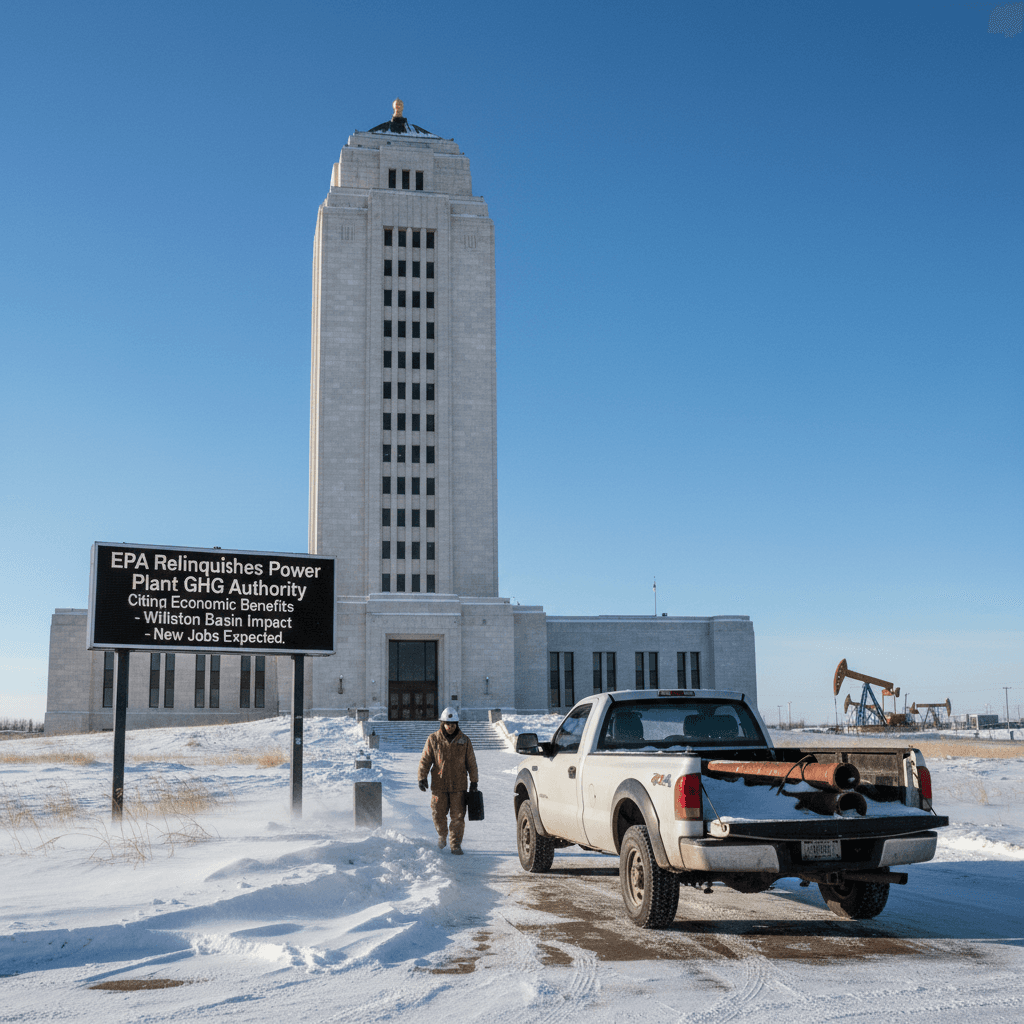
EPA Relinquishes Power Plant GHG Authority, Citing Economic Benefits

The U.S. Environmental Protection Agency (EPA) announced in September that it will relinquish its authority to regulate greenhouse gas emissions from power plants under the Clean Air Act, according to OilPrice.com. The move effectively removes federal limits on emissions from coal and natural gas plants. The EPA expects the decision to result in an additional 123 million metric tonnes of carbon dioxide released into the atmosphere over the next decade, OilPrice.com reported. The agency's analysis estimates the change will save power plant operators $370 million in direct compliance costs, but does not factor in the financial benefits of reduced air pollution. For North Dakota, a major coal-producing and natural gas-fired power state, the policy shift could impact the operating environment for associated energy infrastructure. The decision follows President Trump's earlier move to overturn the foundational 2009 EPA endangerment finding that greenhouse gases threaten public health and the environment, and a...

🔆Midday Wire·Sep 27
Regulatory

EIA Projects Record US Gas Output Amid Rising Demand, AI Data Center Buildout

U.S. natural gas production is on track to hit new record highs in 2026 and 2027, with surging demand from liquefied natural gas (LNG) exports and a wave of gas-fired power plants for AI data centers driving the outlook, according to U.S. Energy Information Administration (EIA) data released in September 2026. For North Dakota's Bakken formation, a major gas-producing region, the forecasts reinforce a strong market for associated natural gas, despite a recent regulatory setback for a gas plant project in North Carolina. The EIA now expects dry natural gas production to rise from a record 107.6 billion cubic feet per day (bcfd) in 2025 to 111.7 bcfd in 2026 and 115.9 bcfd in 2027, OilPrice.com reported. Domestic gas consumption is projected to increase from 91.9 bcfd in 2025 to 92.2 bcfd in 2026 and 94.3 bcfd in 2027. Average U.S. LNG exports are forecast to climb from 15.1 bcfd...

☀️Morning Wire·Sep 27