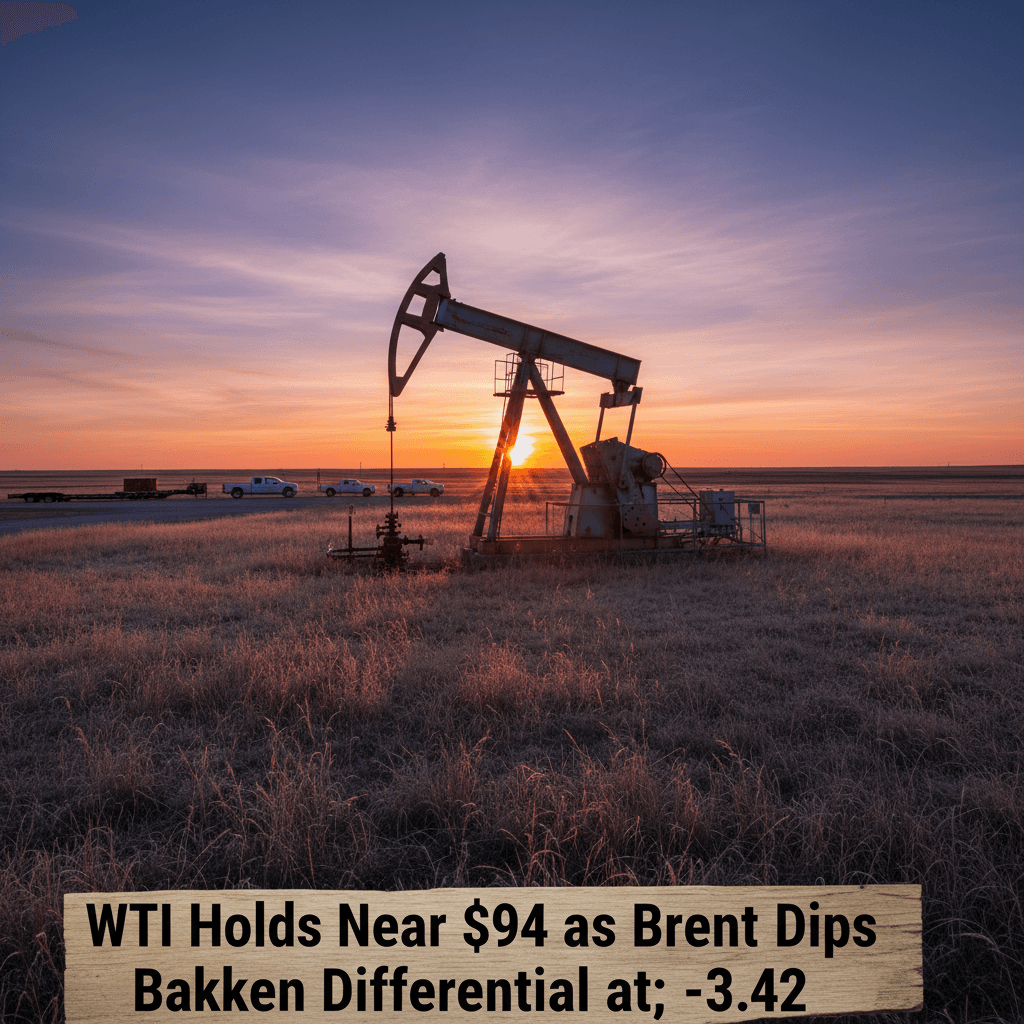
WTI Holds Near $94 as Brent Dips; Bakken Differential at -$3.42
Diverging benchmarks and a key Saudi crude shipment to China frame a mixed morning for Bakken-linked pricing.
West Texas Intermediate (WTI) crude held steady near $94 a barrel early Thursday, while its international counterpart Brent declined, signaling a split in market pressures. As of the morning of October 15, 2026, WTI traded at $94 per barrel, a marginal gain of $0.10 or 0.11%. Brent crude, however, fell to $104.76, down $1.30 or 1.23%. The premium for Bakken crude at the wellhead narrowed, with the differential at -$3.42 versus WTI.
The price divergence between the two major benchmarks comes amid shifting global trade flows. According to Rigzone, Saudi Aramco and its local partners received the first crude cargo for their new refining complex in China on October 14. This long-planned venture solidifies a key demand channel for Saudi crude into the world's largest oil importer, potentially influencing global supply balances and benchmark differentials.
For Bakken operators, the stable WTI price above $90 remains a supportive environment for drilling and completion programs. The narrower Bakken differential, which reflects the discount for North Dakota crude relative to the U.S. benchmark, improves realizations for producers. Natural gas prices also showed strength, rising $0.06 to $3.26 per MMBtu, providing additional revenue support for wells with associated gas.
Broader energy market sentiment was influenced by developments in the electric vehicle supply chain. A report from OilPrice.com detailed a plunge in lithium prices, with China’s most actively traded lithium futures contract dropping 14% since the start of the week. The slide follows a deal between the European Union and China that could cut Chinese hybrid car exports to the bloc by up to 50%, dampening immediate demand prospects for battery materials.
While the lithium news highlights concerns over long-term oil demand from vehicle electrification, the immediate oil market remains focused on geopolitical supply risks and physical trade. The ongoing conflict in the Middle East, referenced in the OilPrice.com report as a driver for increased battery storage demand earlier this year, continues to underpin a risk premium in crude prices. For Bakken producers, the current price structure reinforces the economic viability of the play, with local pricing closely tracking a robust WTI floor.
Source
Live Price Data, OilPrice.com (October 15, 2026), Rigzone (October 14, 2026)