WTI Crude--
Brent Crude--
Natural Gas--
ND Rig Count--
WTI Crude--
Brent Crude--
Natural Gas--
ND Rig Count--
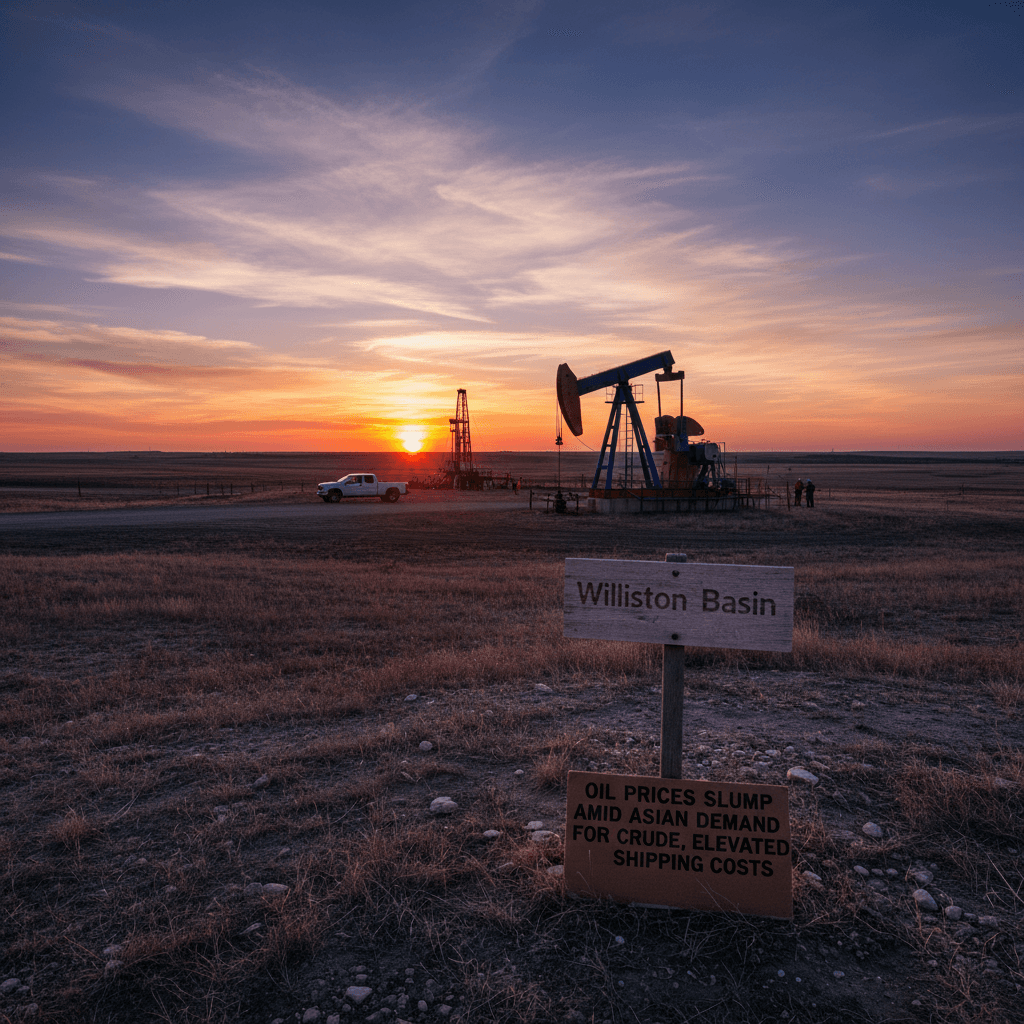
Oil Prices Slump Amid Asian Demand for US Crude, Elevated Shipping Costs - Bakken Wire
Oil Prices

Oil Prices Slump Amid Asian Demand for US Crude, Elevated Shipping Costs

WTI falls over 3% despite structural support from Middle East conflict, as Bakken crude trades at a $3.42 discount.

Bakken Wire Staff·☀️Morning Wire·

Front-month WTI crude oil futures traded at $81.84 on Tuesday morning, down $3.17 or 3.73% from the prior close. The global benchmark Brent crude was at $87.53, down $3.01 or 3.32%. North Dakota's Bakken crude price differential was $3.42 per barrel below WTI.

The day's price decline comes despite continued bullish pressures from the ongoing Iran conflict, which has choked Middle Eastern oil supply and disrupted global shipping. According to a report from OilPrice.com, the war has caused benchmark crude prices to rise about 25% since it began in late February, with spikes into the $100s.

A major factor supporting prices has been a massive surge in shipping costs, particularly for crude moving through or near the Strait of Hormuz. Freight rates for a VLCC from Saudi Arabia's Ras Tanura to India have soared 411% to $4.34 per barrel in August, from $0.85 per barrel before the war. War-risk insurance for a single Hormuz passage has jumped from around $250,000 to up to $10 million.

These costs have driven increased demand for crude from outside the conflict zone. According to Rigzone, Asian refiners are on course to nearly double their purchases of U.S. crude for September compared to August. This surge in demand for non-Middle Eastern cargoes has also caused freight rates from other origins to soar; the Corpus Christi-India rate has jumped 150% to $15.86 a barrel.

For Bakken operators, the dynamics present a mixed picture. The strong Asian demand for U.S. crude is a supportive market factor for domestic production. However, the elevated global shipping costs, while less impactful for crude destined for U.S. refineries, contribute to a complex price environment. The current Bakken differential of -$3.42 versus WTI reflects local market conditions amidst these global flows.

The high cost environment is severely impacting major importers. OilPrice.com reported that India's crude oil import bill soared in the April-June quarter, costing 60% more than the same period last year. The July import bill was 41% higher year-over-year.

Natural gas prices saw a minor decline, trading at $2.81, down $0.03 on the day.

Source

Live price data, OilPrice.com, Rigzone
oil priceswtibrentbakken differentialshippingexportsasiaindia

Share this article

Related Articles

Oil Edges Higher as Hormuz Risk Offsets Gulf Supply - Bakken Wire
Oil Prices

Oil Edges Higher as Hormuz Risk Offsets Gulf Supply

Oil prices rose modestly in Tuesday’s midday update as geopolitical risk in the Middle East offset signs of increased supply, according to OilPrice.com. WTI crude was at $86.45 per barrel, up $0.73, or 0.85%. Brent crude rose $0.77, or 0.83%, to $93.21. Natural gas was $3.15, up $0.03. Bakken crude traded at a $3.42 discount to WTI, implying a regional benchmark near $83.03. The discount underscores the transport and refining factors that can limit how much of a global price gain reaches Williston Basin producers. OilPrice.com reported prices had been somewhat directionless over the past couple of trading days as the physical impact of rising Middle Eastern exports was offset by an unprecedented level of tanker attacks in the Strait of Hormuz. The outlet said Iran’s attack on a US military radar system in Bahrain marked another escalation in the US-Iran conflict, which has been focused on maritime warfare lately....

🔆Midday Wire·Nov 17
Bakken Crude Discount Holds at $3.42 as WTI, Brent Rise - Bakken Wire
Oil Prices

Bakken Crude Discount Holds at $3.42 as WTI, Brent Rise

Bakken Wire - Oil prices rose modestly Tuesday morning, with West Texas Intermediate crude up $0.60, or 0.7%, to $86.32 a barrel and Brent crude up $0.69, or 0.75%, to $93.13, according to live market data compiled by Bakken Wire. The gains were small but broad across the crude complex. Brent remained $6.81 above WTI, a spread that often reflects seaborne supply conditions, global demand expectations and transportation costs between U.S. inland benchmarks and international markets. For North Dakota producers, the key figure was the Bakken differential, which stood at negative $3.42 against WTI. The discount means Bakken crude is priced $3.42 below the U.S. benchmark. At WTI’s $86.32, that implies a Bakken benchmark price of $82.90. That differential matters directly to Bakken operators and royalty owners. Many Williston Basin producers sell crude into regional gathering systems, rail or pipeline markets, where basis levels can move with local throughput, refinery...

☀️Morning Wire·Nov 17
Oil Prices Plunge Amid OPEC+ Delay, Demand Worries - Bakken Wire
Oil Prices

Oil Prices Plunge Amid OPEC+ Delay, Demand Worries

Oil prices fell sharply on Monday, with West Texas Intermediate (WTI) crude closing at $85.22 per barrel, a drop of $3.34 or 3.77%. The global Brent benchmark fell to $91.95, down $3.89 or 4.06%. The sell-off was primarily driven by news that the OPEC+ group of oil producers has postponed its policy meeting scheduled for this weekend. The unexpected delay of the OPEC+ meeting, reportedly due to internal disagreements over production quotas, injected significant uncertainty into the market. Traders interpreted the move as a sign of potential discord within the alliance, which could undermine its ability to manage supply and support prices. This comes at a time when concerns over global economic growth and fuel demand are already weighing on sentiment. For Bakken producers, the price drop is compounded by a widening discount for local crude. The Bakken differential weakened to negative $3.42 per barrel versus WTI on Monday. This...

🌅Afternoon Wire·Nov 16