Oil Prices Steady as Market Awaits OPEC+ Decision
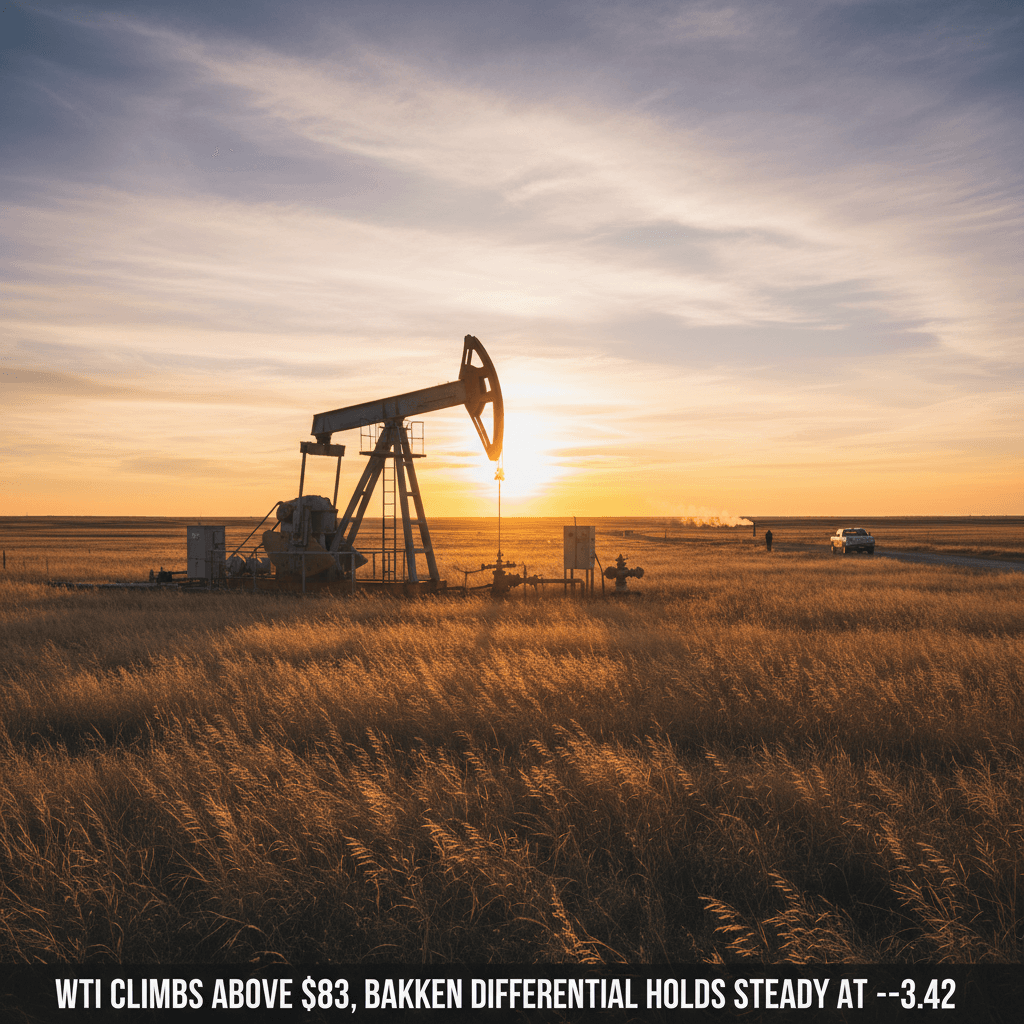
WTI holds above $83 while Bakken crude trades at a $3.42 discount; all eyes on potential production cuts from the producer group.
Front-month WTI crude oil futures were unchanged in Sunday trading, holding at $83.41 per barrel, according to live price data. The global benchmark, Brent crude, was also flat at $89.95 per barrel.
The price stability comes as traders await a key decision from the OPEC+ alliance of oil-producing nations. The group is scheduled to meet virtually on December 4 to discuss production policy for 2027. Market analysts widely expect the meeting to focus on whether to extend or deepen existing output cuts into the new year, a move aimed at supporting prices.
For Bakken operators, the local price benchmark is the Bakken differential, which represents the price difference between Bakken crude at the Clearbrook, Minnesota hub and the U.S. benchmark, WTI. On Sunday, that differential was reported at a discount of $3.42 per barrel. This means Bakken crude is effectively priced at approximately $79.99 per barrel.
A steady WTI price above $83 is generally supportive for shale producers, providing cash flow for drilling and completion activities. However, the persistent discount for Bakken crude, influenced by regional pipeline capacity and refining demand, slightly dampens the realized price for North Dakota barrels compared to other U.S. oil streams.
In the natural gas market, prices were also steady, with the front-month contract holding at $3.75 per million British thermal units (MMBtu). While not a primary driver for most Bakken producers, who focus on oil, associated gas production contributes to overall well economics and is subject to local pricing and flaring regulations.
The upcoming OPEC+ decision is the primary near-term catalyst for global oil markets. Any sign that the group is unified in supporting prices through disciplined supply management would likely be viewed as bullish. Conversely, internal disagreements or a decision to increase output could pressure prices downward.
For North Dakota, the current price environment sustains a stable, if not spectacular, operating climate. Prices are well above the breakeven costs for most core Bakken acreage, which should maintain steady production levels. Operators will continue to monitor the differential closely, as any widening can directly impact profitability on a per-barrel basis.
The market will also be watching for weekly U.S. inventory data from the Energy Information Administration, due for release on Wednesday, November 25. A larger-than-expected draw in crude stocks could provide upward momentum, while a significant build could reinforce concerns about demand.
Source
Live Price Data